
Catholic school security requires more than applying a public-school security plan to a religious school environment.
Catholic, parochial, and other faith-based schools often have distinctive facilities, governance structures, traditions, and community relationships. Effective Catholic school security assessments must understand those differences while protecting students and preserving the welcoming culture central to the religious entity and school mission.
I recently discussed these challenges with OSV News in its article, “Catholic schools’ new year sees safety, security and budget impacts after school shooting.” The article examines security issues following the 2025 attack at Annunciation Catholic Church in Minneapolis, where a shooter fired through church windows at children attending an all-school Mass.
The tragedy highlights a fundamental question for Catholic school leaders: How can Catholic schools strengthen security without turning welcoming faith communities into fortresses?
What Makes Catholic School Security Different?
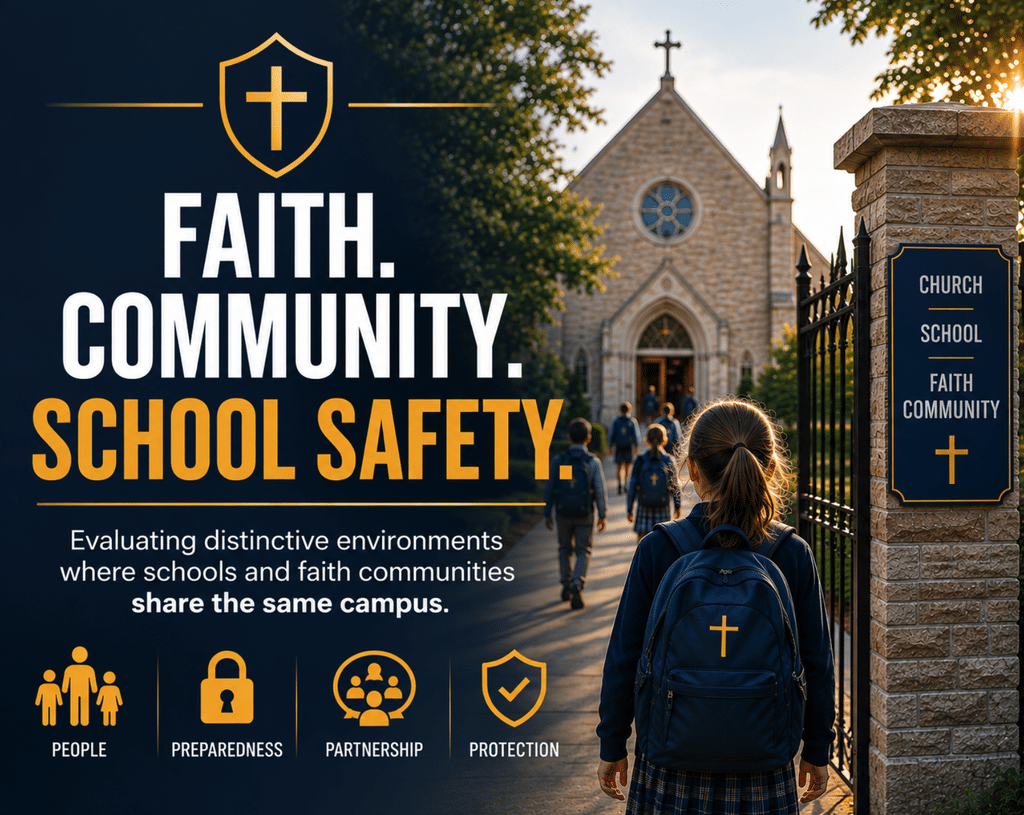
Many Catholic schools are attached to, adjacent to, or share a campus with a parish church. Students may regularly move between the school and church for Mass, religious instruction, and special parish ceremonies and events.
At the same time, the church serves a much broader community. Weekday Masses, funerals, parish ministries, volunteers, contractors, and other activities may bring people onto the property while students are present.
A parish campus can simultaneously function as a school, house of worship, workplace, and community gathering place. Throw in youth ministries, CYO sports in evenings and on weekends, and other activities at parish sites. That creates security challenges that cannot be addressed with a generic checklist.
School Masses Require Specific Security Planning
The OSV News report examines security surrounding school Masses, including church access and checks of church interiors before students arrive. The Archdiocese of Chicago also told OSV News that it conducts physical security assessments encompassing churches, schools, and other parish properties and works with law enforcement and other emergency response partners.
Important questions include: Who can enter the church while students are present? Which entrances remain open? Who monitors them? How do school and parish personnel communicate? Who takes charge during an emergency? How would students evacuate, shelter, or reunify with families if an incident occurred during Mass?
The answers will differ by school and parish. The important point is that leaders ask these questions before an emergency.
Churches cannot simply be treated as another school building. Their mission includes welcoming people. The challenge is managing access, supervision, situational awareness, communications, and emergency preparedness when students and the public may occupy the same campus.

Can Catholic Schools Be Both Welcoming and Secure?
Absolutely. I have previously written about independent, private, and parochial school security assessments and the concern some school leaders have that stronger security could undermine their school’s culture. Thoughtful security should do the opposite. It should become part of that culture.
Some of the strongest school security measures are remarkably low-tech. Active supervision means having trained, attentive, and engaged adults who are visibly present, recognize what is normal for their environment, and notice when something does not look or feel right.
That can be especially important on Catholic and other faith-based campuses where students, staff, clergy, parishioners, volunteers, visitors, and members of the public may share or move between school and religious facilities.
As I discussed in The Most Powerful Words in School Safety: “Hello. May I Help You?”, we have emphasized this simple practice for more than four decades in school security assessments, consulting, and staff training. A courteous greeting lets an unfamiliar person know that attentive adults have noticed their presence while giving legitimate visitors an opportunity to identify themselves and receive assistance.
The goal is not confrontation. It is situational awareness, active supervision, and a culture in which people pay attention. A welcoming faith-based school does not have to be an unquestioning environment.

Catholic School Security Requires Parish-School Coordination
Catholic school campuses can also have overlapping leadership responsibilities.
The principal may oversee the school. The pastor oversees the parish. Diocesan or archdiocesan leaders may establish policies. Parish staff may manage church facilities. Police, fire, and emergency responders bring additional responsibilities.
Those organizational lines can become operational problems during an emergency if roles have not been established beforehand.
A Catholic school security assessment should therefore examine more than locks, cameras, access control, and other hardware. It should evaluate leadership, communications, supervision, emergency responsibilities, parish-school coordination, and relationships with first responders.
Catholic School Security Must Be Sustainable
Security funding is another challenge highlighted in my OSV News interview. Schools may invest in cameras, access control, communications systems, security personnel, training, assessments, and other measures. Some involve one-time costs. Others create recurring expenses for staffing, maintenance, subscriptions, training, and replacement.
Immediately following a tragedy, attention and resources often increase. The harder leadership question is what happens years later.
Sustainable school safety does not mean buying every new security product. It means identifying actual risks, vulnerabilities, and priorities and making defensible investments in people, practices, preparedness, physical security, and appropriate technology.

What Should a Catholic School Security Assessment Examine?
An effective assessment should begin by understanding how the school and faith community actually operate.
How do students move between school and church? When does the public enter the campus? What happens during Mass, arrival, dismissal, athletics, and special events? Who supervises transitions? How do clergy, administrators, teachers, staff, volunteers, and first responders communicate?
Most importantly: What security measures reduce risk while respecting the school’s educational and faith mission?
A meaningful security assessment should not simply walk around looking for places to install more equipment. It should examine how people, facilities, policies, practices, communications, supervision, emergency planning, and culture work together.
Faith, Community, and School Security Can Coexist
Catholic schools should not have to choose between being welcoming and being secure. Neither should other religious and faith-based schools. Effective security supports the institution’s mission rather than overwhelming it.
The strongest security practices are often quietly embedded into everyday operations: attentive adults, caring and supportive relationships, controlled access, active supervision, good communication, school-family connectedness, thoughtful emergency planning, relationships with first responders, and leaders continually asking, “What if?”
Catholic and other religious schools have distinctive cultures worth preserving. The goal is to understand those cultures well enough to protect them.
Related resources:
- OSV News: Catholic schools’ new year sees safety, security and budget impacts after school shooting
- Independent, Private School Security Assessments: Creating a Culture of Safety
- School Security and Emergency Preparedness Assessments
Dr. Kenneth S. Trump is President of National School Safety and Security Services
National School Safety and Security Services
Experts You Can Trust!
Connect with Dr. Ken on Linkedin: www.linkedin.com/in/kentrump/
Follow Dr. Ken on X(Twitter) @safeschools
Visit and “Like” Our Facebook School Safety News Channel at: www.facebook.com/schoolsafety