

How Parents Can Address School Safety Concerns: 10 Practical Steps to Protect Your Child
A Practical Guide for Parents Who Are Worried About Safety at School
When parents are worried about school safety, they want answers, action, and assurance that their concerns are being taken seriously.
Parents frequently contact Dr. Ken Trump with concerns about bullying, threats, weapons, assaults, supervision gaps, unsafe bus incidents, poor communication, or school leaders minimizing their concerns.
While outside consultants cannot resolve specific incidents without direct involvement and firsthand facts, parents can take practical, constructive steps to raise school safety concerns effectively.
The goal is not to attack school officials. The goal is to protect children, document concerns, follow the right process, and work toward reasonable solutions.
Why Parents’ School Safety Concerns Matter
School safety is one of the few issues that can matter to parents as much as, and sometimes more than, academics.
Parents today are more informed. They know when answers sound scripted, incomplete, or dismissive. They also know when school leaders are giving them the “company line” instead of directly addressing a legitimate concern.
When school officials minimize parent safety concerns, trust can break down quickly. When parents communicate clearly, calmly, and persistently, they are more likely to get meaningful attention and action.
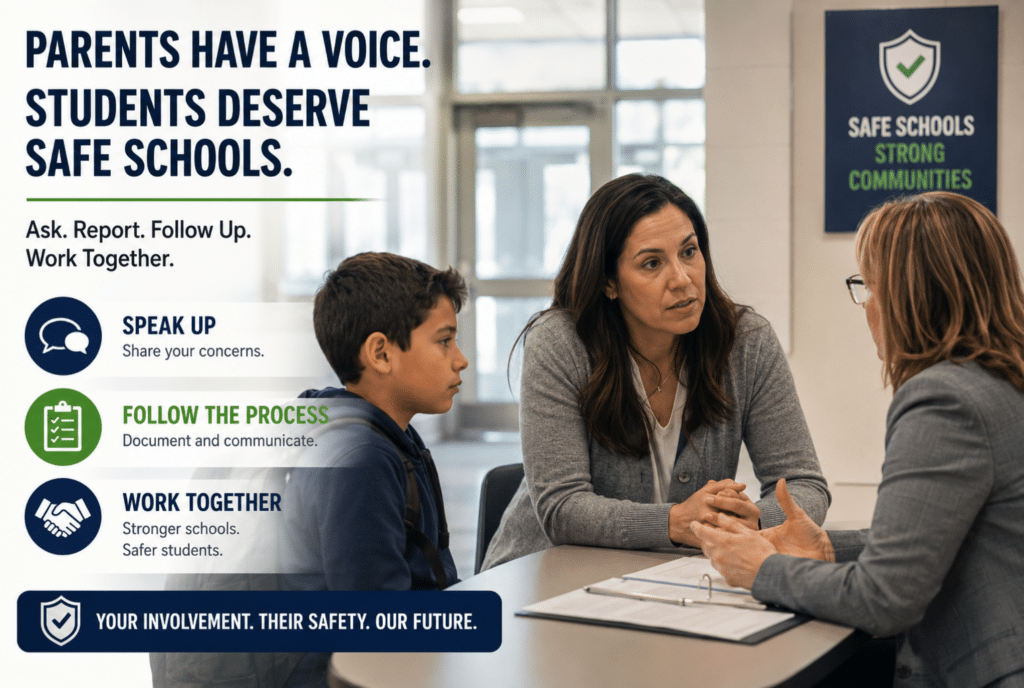
10 Steps Parents Can Take to Address School Safety Concerns
1. Start Closest to the Source
If the concern involves a classroom issue, start with the teacher. If it involves a bus, start with transportation staff and the school administrator. If it involves supervision in a hallway, cafeteria, playground, restroom, or dismissal area, contact the principal or assistant principal.
Start with the people closest to the incident. They are usually in the best position to explain what happened and what can be done next.
2. Engage the School Counselor or Student Support Staff
Many safety concerns involve peer conflict, bullying, harassment, threats, anxiety, depression, trauma, social media conflict, or relationship issues.
Ask whether the school counselor, psychologist, social worker, threat assessment team, behavior support staff, or student services personnel can be involved.
Parents should not wait until a situation escalates before asking for support.
3. Follow the Chain of Command
Parents are sometimes tempted to go straight to the superintendent, school board, media, or social media. In some emergency situations, higher-level action may be appropriate. But in most cases, parents should first work through the school’s chain of command.
A practical order may include:
- Teacher or staff member involved
- Counselor or student support staff
- Assistant principal
- Principal
- District administrator
- Superintendent
- School board, if appropriate
Following the chain of command shows that you made a good-faith effort to resolve the issue at the proper level.
4. Parents Should Document Their Concerns in Writing
Written communication matters.
Document dates, times, locations, names, witnesses, prior reports, injuries, screenshots, emails, text messages, police report numbers, medical documentation, and previous school responses.
Keep your written communication factual. Avoid exaggeration, name-calling, threats, or emotional language that distracts from the concern.
A simple written record can help establish a timeline and show that the parent made reasonable efforts to seek help.
5. Parents May Notify Police When a Potential Crime Is Involved
Some school safety concerns are also potential criminal matters. These may include assaults, weapons, serious threats, sexual misconduct, stalking, extortion, or credible threats of violence.
If a potential crime has occurred, parents may contact law enforcement. A school discipline process and a police report are separate processes. One does not automatically replace the other.
If there is an immediate threat, call 911.
6. Parents Can Review School Policies, Handbooks, and Appeal Procedures
Parents should read the student handbook, code of conduct, bullying policy, threat assessment policy, transportation rules, discipline procedures, complaint procedures, and appeal rights. Many parent-student handbooks, as well as school board policies, are available on line on the school’s or school district’s website.
Many parent concerns involve discipline decisions, perceived inaction, or inconsistent enforcement of rules. Knowing the written policy helps parents ask better questions and determine whether the school followed its own procedures.
7. Parents Should Communicate Constructively With School Officials
Parents can be firm without being hostile.
Going on the attack, making threats, or placing blame may feel understandable when a child is hurt or afraid. But it can also make it harder to resolve the problem.
A stronger approach is to be specific, factual, persistent, and solution-focused.
Ask:
- What steps have been taken?
- What steps will be taken next?
- Who is responsible for follow-up?
- When should I expect a response?
- What should my child do if the concern happens again?
8. Consider Whether There Is Strength in Numbers of Parents
Specific incidents involving your child are usually best handled privately and directly.
But some school safety issues affect many families. Examples may include unlocked doors, chronic supervision gaps, unsafe arrival or dismissal procedures, dangerous bus conditions, repeated fights in the same area, or poor emergency communication.
In these cases, parents may raise concerns through a parent organization, parent safety committee, or a group letter to school leaders.
Collective concerns should still be factual, respectful, and focused on solutions.
9. Parents Can Seek Outside Advocacy or Legal Support When Necessary
Most concerns should begin within the school system. But if parents have worked through the teacher, counselor, principal, district administrators, superintendent, and school board without reasonable resolution, outside support may be necessary.
Depending on the issue, this may include:
- A child advocate
- A special education advocate
- A mental health professional
- A medical professional
- A civil rights agency
- An attorney
- Law enforcement
- A community-based support organization
As an expert witness in school safety lawsuits, Dr. Ken Trump says more parents are taking their grievances from the schoolhouse to the courthouse with civil litigation against schools and offenders when their children are harmed.
Legal or media involvement should usually be a last resort, not the first step. But in extreme or unresolved cases, outside intervention may become necessary.
10. Parents May Get Professional Support for Your Child and Family
If your child is showing signs of anxiety, depression, withdrawal, fear, school avoidance, trauma, substance abuse, self-harm, or major behavior changes, seek help early.
Parents should not rely only on the school to meet every emotional, social, or mental health need. Medical, counseling, community, faith-based, and social service supports may be important.
Your child’s safety and well-being come first.

What Parents Should Avoid When Raising School Safety Concerns
Parents should avoid relying only on social media, posting accusations before facts are clear, skipping every step in the chain of command, sending angry emails late at night, or assuming that one conversation will fix a complex problem.
Parents should also avoid letting school officials dismiss serious concerns without documentation, follow-up, or a clear next step.
The best approach is calm, documented persistence.

When Parents Should Escalate a School Safety Concern
Parents should consider escalating a concern when:
- The issue involves a weapon, assault, threat, or potential crime.
- The concern has been reported but continues.
- The school has not responded in a reasonable timeframe.
- The same safety problem affects multiple students.
- The school’s response appears inconsistent with written policy.
- The child is afraid to attend school.
- The concern involves possible retaliation, discrimination, or serious misconduct.
- The parent has documented concerns but receives no meaningful follow-up.
Escalation should be strategic, not emotional. Move up the chain of command with documentation and a clear request for action.
Sample Email Parents Can Send to School Officials
Dear [School Official],
I am writing to document a school safety concern involving my child, [Child’s Name], that occurred on [Date] at approximately [Time/Location].
My concern is: [Briefly describe what happened using facts.]
I previously reported this concern to [Name/Position] on [Date], and I am requesting follow-up on the steps being taken to address it.
Please let me know:
- What actions have been taken to review this concern?
- What steps will be taken to help prevent this from happening again?
- Who should my child contact immediately if the concern happens again?
- When can I expect a follow-up response?
I appreciate your attention to this matter and look forward to working with the school to help keep my child and other students safe.
Sincerely,
[Parent Name]
Frequently Asked Questions About Parent School Safety Concerns
What should I do first if I am worried about my child’s safety at school?
Start by documenting the concern and contacting the person closest to the issue, such as the teacher, bus supervisor, counselor, assistant principal, or principal. If the concern involves an immediate threat or potential crime, contact law enforcement.
Should I go directly to the school board with a safety concern?
Usually, no. Start with the building-level staff and administrators first. If the concern is not reasonably addressed, move up the chain of command to district administrators, the superintendent, and then the school board if needed.
Should parents call police about school safety incidents?
Parents should contact police when a potential crime is involved, such as assault, weapons, serious threats, sexual misconduct, stalking, or credible threats of violence. If there is an immediate danger, call 911.
How should parents document school safety concerns?
Keep a written timeline with dates, times, locations, names, witnesses, screenshots, emails, medical notes, police reports, and school responses. Keep communication factual and focused on what happened and what action is requested.
What if the school does not respond to my concern?
Follow up in writing. Ask for a response by a specific date. If there is still no response, escalate through the chain of command. Serious unresolved concerns may require outside advocacy, legal advice, or law enforcement involvement depending on the facts.
What if my child is afraid to go to school?
Take the concern seriously. Talk with your child, document what they report, contact the school, and ask for immediate support. If your child shows signs of anxiety, depression, trauma, self-harm, or withdrawal, seek professional help.
Parents and Schools Should Work Together for Safer Schools
The best outcome is when parents and school officials work cooperatively, sincerely, and persistently to resolve safety concerns in the best interests of children.
Parents should be respectful. School officials should be responsive. Both should stay focused on student safety, supervision, prevention, intervention, communication, and trust.
School safety improves when legitimate concerns are heard early, documented clearly, and addressed before they become larger problems.
For Parents Who Need Help With School Safety Concerns
National School Safety and Security Services provides school safety consulting, training, assessments, expert witness services, and parent-focused resources.
For school safety consulting, parent presentations, or professional guidance for school leaders, contact Dr. Kenneth S. Trump, President of National School Safety and Security Services.
What actions can a parent take if they feel that their child is not in a safe environment at school? For example, my 12 year old son had his nose broken by a 14 year old boy on the school bus. I don’t feel that he was treated fairly. He is considered the victim. There are no counselors at the school to talk with him nor are there any social workers that we can discuss this situation with. They both received the same disciplinary action. We took it to a juvenile counselor for the court system and is waiting for a response from them. However, the school is not taking the matter serious enough to me. The doctor stated that my sons’ nose was probably broken due to being hit in the face with a brass nuckle or weapon/object.
This was truly an assault with a weapon conflicting serious injury. Usually most schools have a one year school suspension for this. Failure to address this any further could lead up to a knife or gun being brought to the school next time. Please help me, I am worried about my son.
While we recommend working at the front-line level with teachers, counselors, and principals who are working with your child on a day-to-day basis, there are also some incidents which constitute a crime. As you’ll see in the blog post on steps parents can take, one step includes reporting crimes to the police. If the school does not report a criminal incident first, the parent certainly has the right to make a police report. There is no “double jeopardy” when a student is disciplined via the school disciplinary system AND a police report is made if the same act is potentially a violation of the criminal code. You may, based on your message, wish to pursue both avenues (disciplinary and criminal).
I have to sympathize with the above parent. My son is 13 yrs.old in the 8th gr. In a nyc public school. He has been threatened with a box cutter by a 16yr old whose in his class. I reported it 2 the principal who scheduled a meeting with the mother and me. THe child denied any wrong doing and staff dismissed being allowed to take any actions. It was concluded that he would stay away from my son. However, he did it again, with witnesses present and, yet the principal claims its only an allegation and there is nothing she can do. At my local precint I was told that school safety was responsible for taking action…I feel like the bucket is being passed around, while my childs safety hangs in the balance…what can I do???
Thanks for sharing your concerns. I completely understand your frustration. I suggest you go back through the various steps I listed in this blog post and make sure you’ve covered the full chain of options. Also, consider documenting your concerns in writing to the various entities. When you create a papertrail, sometimes this generates a different level of attention. And be persistent — go back again if the problem has not been resolved or reoccurs. These situations often reoccur and require persistence, albeit it quite an uncomfortable process for student victims and parents.
Police reports, pictures, doctors documentation, retraining order against the violent child. Student Code Chapter 37.007 and 37.008 is mandatory removal of violent children to DAEP. File level1,2,3 greivance with faxed confirmations. Schools are supposed to have an ANTI BULLY PROGRAM !
I can relate to these concerns as a parent. I had a mother enforce violence with their child towards my daughter. She actually waited for my daughter in the early AM outside of her house for my daughter to fight with my daughter. She actually coached her daughter on what to do to my daughter. Passer by actually broke up the fight. The school is handling it lightly so I took the initiative to call the Asst superintendent and also make a report in the police dept. I also gave the name of a boy who video taped the fight.
Good evening. My name is Jennifer and my family and I relocated to a small town in Southwest Texas in April 2011. I will cut to the chase, as time is of the essence. Let me start by saying, I have 3 Caucasian children in grades 2nd,7th, and 9th and am certainly not one of those parents who believes their child can do no wrong. I am the first to admit and discipline when they are in the wrong, but by the same token, I will fight tooth and nail when they are in the right.I have had no issues with the older 2 in this district, but my 2nd grade daughter has become the target of a “28 year veteran” teacher in this small town. There have been many documented incidents and this woman believes she is immune. The principal is also the wife of a local officer with the Sheriff’s Department and backs her staff, even when outside substitute teachers are brought in to validate my 7 year old daughter’s story (a former incident.) They all believe they are beyond reproach. The latest incident was so flagrant, even I am in awe. Friday, after a conference call regarding my daughter receiving her 3rd ISS referral in 2 weeks for failure to bring back a homework sheet (this was true, as she did not return it), the teacher promptly returned to class with my daughter. Not long after, during the course of teaching, a question arose which led to this: The teacher stated,”Class, “Mrs. G” (principal) said ……..(my daughter’s name) does not like me and that I do not help you. Do I help?” To which the class stated yes. She then said to my daughter, “See, ….., the class is on MY side and you are on your OWN side!” This thoroughly embarrassed my child, especially since she has already been alienated and picked on; some being simple normal children behavior and some being the result of teacher input. A bit later during the same session, the teacher introduced a “new” way to do math and my daughter said excitedly (trying to regain some points), “I think you showed us this and I know how to do it!” The teacher stopped and stated, “Class, have I ever taught any of you this before?” They stated No. This further embarrassed my child. She had actually learned this at her prior school.
I will stop there as this is very lengthy and there is so very much more that has led to this point. I believe you get the”jest of it”I need help and this clannish town seems to stick together. I have scoured the internet for resources and found you. Let me also say that my husband and I both have Criminal Justice degrees and are not ignorant. However, while we have documented everything, we are at a loss as to where to go next. I am going to the Superintendent tomorrow but am not hopeful that this demeaning teacher will be reprimanded as she should.
I thank you for reading this and any advice, help, or input you may have. Thank you so very much for your time.
Warm Regards,
Jennifer
jenniferkhayes@yahoo.com
I had a similar experience. No matter what is said to this teacher, she will find a way to make your child miserable. She should be ashamed that she stoops to competing with a child. However, the only way out for you is to completely remove your child from the school into a safe environment. I transferred my son to a small Catholic school (yes, I had to pay tuition but after i explained the emotional mess my son was in, they gave me a price break. We are not Catholic. However, my son told me years later that Miss Flemming (his new teacher) saved his life. His nerves were torn all to pieces and I don’t think he has recovered to this day at age 40. This is serious for your child. After you get the child in a safe environment, write letters everywhere you can giving details…not angry letter but documented truthful letters. Write letters to the editor about emotionally ill teachers (don’t name names but sign your own) and the damage they can do to children. Do research, fight the fight. but get your child safe first.
Good luck.
What should I do. I live at the Satate of FL and the firdt week of school on Fri the sent my son home riding the bus. He was supposed to go to daycare. They left him at the entrance of our subdivision a very transit road. The bus left and my son started to cry and saw a couple of working guys working at the opposite side of the road. He crossed the road and asked for help. Then a lady that was driving buy saw him and stopped to help. Got my number and they call me. But I was a work can’t have my phone on me so that was not much of a help. Then she toke him back to school. The school only said to me that he was put on the bus by mistake. I found out when the lady thar found my son called me back to know how he was doing. I want to change my child from this school cuz I don’t believe he is safe there but the principal said I can’t do that cuz goes by school zone and he belong to that school. I understand that but what about his safety doesn’t count?
Sorry to hear of your situation. While I cannot give advice on specific situations not having firsthand knowledge, I do suggest you sit down with the principal and transportation director to discuss your concerns, and document the concerns to them as well.
what can a parent do in a situation where an individual 6y/o threatened ( a very gruesome/serious threat) another 6 y/o, then the next school day brings a “swiss army” knife to school, pulls it out & threatens the same 6 y/o ago about to follow through with his threat he stated the day before. Talked to Teacher, Principal, Asst. Superindentant, Superindentant, made a report with local law enforcement (to be told since it happened on school property its the district) excurded all places to contact/envolve with-in the circle.
I am at a loss. I have followed chain of command and escalated the bullying to the superintendent and the police but there is still no recourse. They spin everything back onto my child. She was committed due to a mental breakdown from being bullied, they said she was depressed, then they said SHE was the bully, she was attacked on the school bus and drug down by her hair by a girl that flunked and is older then her, and now the girl and her friends are starting rumors about her being sexually active and how they clipped her into a phonographic video and showed the principal. The principal called me and refused to offer any information or evidence. Yes! We weren’t allowed to know who brought it in, when it supposedly happened nor were we able to view it. We have a $13,200 medical bill, multiple slips from her engaging the counselor, our meetings with the teachers documented, I wrote a four page hand written letter to the superintendent, emailed BOE chief of police and now two local police reports have been filed. I removed the children from the school myself but now we are stuck because it’s so late in the school year and I just dont have a clue about what to do next.
Hi just found out the security guard in my son’s school pulled my son’s arm yesterday when my son did not listen to the guard directive not to go back in the school … even though my son forgot his jacket and just wanted to get it
My son was hit in the eye on the bus by a 2 nd grader. My son is only 6 this is clearly bullying. The school is not doing what they need to do to ensure my sons safety. It’s been reported to the principal, superintendent and board members.
Our school board made a decision to disarm our SRO in May of 2021. Soon after, there were two gun incidents in two weeks. Even after the Michigan shooting safety is not discussed during their meetings. They refuse to reverse the decision. We’ve talked to everyone in the chain of command, done local news interviews, podcasts, petition, everything. What other steps can we take?
My son is 5yrs old his behavior since school started started changing and he makes comments that suggest hes being bullied but refuses to talk to me about it. he started refusing to go on the bus started making up excuses to go to school and is showing symptoms of distresss and emotional detatchment i sought the school for help. Because the school has in their possession the information needed to be reviewed and give clarification on the allegations and give me peace of mind knwing how to help my son and trusting the school would use the information to do so as welll to ensure his safety but the school was dismissive of my reports on him possibly being bullied the administrator tried to minimize my concerns and instead of doing her job to investigate the facts of the issue, visited my son with the counselor got my son to identify the kids who were bothering him during lunch time proceeded to force my kid to confront the 2 older students of age 8 or 9 used conflict resolution to resolve this and allowed to other students to lie and downplay their actions and took their word for the truth. when theirs a clear impalance of power that was innappropiate and invalidating to my sons own feelings from wat he experienced the she refused to review the videos wont provide me with a written staement of her actions and wont aknowledge my request with a proper denial notice so i can appeal within the time frame i have i have tried conytacting to super intendant who also didnt respond to my email after requesting clearly i wanted a reciept that she would look into it. so not only did the administration fail to act and prevent any bullying to be happening they did not protect my sons privacy or safety from being retaliated against on the sschool bus and are ignoring my request for written documentations of the whole thing and again its t=repeated only that my sons allegation this time after being back on the bus for the 2nd day he said he was chocked. i filed a police report notified his teacher to be vigillant for any actions from my son that can seem as intent of self harm as he was showing at home after that day and she then forwarded the email to the same administrator who without my consent or even speaking to me first went to see my son with the counselor and tried to again minimize my concerns she seemed dismissive she left me confused when she tried to depict an image of my son that i know he is not to suggest everything is fine and he is a happy kid who doesnt seem to be hurting or have a ny fear and that she reviewed the video and nothing happened and i dont believe her becasue she broke the trust i had in the school i then requested a written follow up summarizing hthe schools involvment and she asked me why do i need that for and what do i want her to write in this email for me as if she felt like she didnt have to report it to me then she might not even be reporting the incident as she should to any one else or even for my sons school records. . i am beyond impacted by her approavch over the whole thing. i have a meeting with the school tomorrow but i dont know how i can address her behavior without staying off topic on my son and idk what students codes i can use to hold her responsible for the fact she allowed it to get this far beacuse she did nothing to prevent it . shes imposed her personal opinions on me as the truth and expects me to settle for that and agree and and not be against her as if i cant demand actual facts becuase shes made it hit her mission to make me feel as if my concerns are legitimate enough and should not be of existence its like baisaclly im saying hey my son is being picked on and shes saying i dont think so. and i tell her i think so and she saying well hes not showing that hes hurt or doesnt seem like hes going through anything. and lies about his nehavior to suggest hes great and doing fine when at home is psychological damage that im witnessing. how dare she you know sorry for the misspelling im very aggravated and lost my mouse so i cant t=run a spelling check.
If anyone know of any codes i can look up to bring with me to the meeting it would be really appreciated i feel small and outnumbered but i know with the right information i can open their eyes to the problem that isnt just bullying here, clearly. thanks.
Thanks for sharing your concerns. While we cannot provide the guidance you requested via the Internet on matters like this with which we have no specific involvement, we do have a page on our website for steps parents can take to address their school safety incident concerns. See https://schoolsecurity.org/2010/01/steps-parents-can-take-to-address-school-safety-concerns/
There typically are steps, including engagement with the school district’s central office and outside private counselors, that may be of support to you as well.
This is very strange to me, everyone in here going through this with their children. My Grandson is being bullied, for 3 years, since kindergarten.
What I find crazy is that the bully’s are winning and the teachers, principals and school board are way to scared to change this behaviour.
Why do we have anti bullying. My grandson will go home with a black eye today from His elementary school.
To me this is insane.
I am a fosterparent. I have done this school for 15 years as well as other schools.
We need to make a real change parents. Why are we on here truying to help our kids. Where are the adults in these schools who are supposed to keep our children safe.
I think we need help with the media, we need to call out these schools where it’s happening.
Let’s publish them, let’s make them accountable.
Like we have to go through the right chain to get help for our kids or it’s doesn’t work.
Like when I read that, I am like no way we need to yell amd scream amd bring awareness to these people, these schools
My child had just started a new school and is a walker. On her first day walking home I am around the corner waiting just too make sure she remembers the way. She never showed up so I drove too the school. As I approached the school I see a man with her but he is walking away too the school. (My daughter tells me that’s the principal later) when I pick her up I asked why she wasn’t walking home and she then tells me they wouldn’t let her leave because her grandpa was picking her. They told her his name and color of vehicle and even after she told them that she didn’t know that person they still made her wait. I called them and asked them about the situation and she said well I took the call and delivered the information too her myself and my response was but I never called. My best friend had called too get a calendar sent home with my daughter (I was with her when she called and she is on the emergency contact list) she never once said anything about a man picking her up. What do I do because I don’t feel safe having my child there now.
Thanks for sharing your concerns. I do encourage you to meet with your school’s leadership to discuss the concerns (principal, assistant principal, etc.). See additional steps to consider at: https://schoolsecurity.org/2010/01/steps-parents-can-take-to-address-school-safety-concerns/
Both of my grand children go to the same school. One of them was assaulted and beaten by another student with a school issued laptop. The injuries required medical attention and my grand now has permanent scaring. I did pressed charges with the local police and they issued warrants for their arrest. Multiple students jumped her in class and the teacher-newly hired to the school did not try to break it up. One of the student involved in the fight was supposed to be in another classroom. I am still trying to find out why and how she was allowed to be in my granddaughter class. The Principal has not spoken to me or addressed any concerns about this issue. All communication has been between me and the Dean of Students. I even called the Board of Education and still no response or call back. This has really impacted my grandchildren and neither one wants to go back to the school. I also have to put them back in therapy as they are traumatized.This school never reports or notify parents when they have serious incidents that tajes place in the school. Just recently a student brought a knife to school. The student ended up being expelled but they never notified any parents, they just swept that incident under the rug. Now there’s this incident with my granddaughter. I been receiving calls from other parents who child attend the same school not only are they concerned about my grand but also concerned that this could of happened to their child. Why haven’t the school notified them of this incident. They are only finding out about this from their child. Also the school held an assembly the very next day after the incident and pretty much threatened all the other students by telling them if they are heard discussing the attack they will be sent home immediately and not able to return on Friday (the assault took place on a Wednesday). I am at the point, I am contacting my local television station as the school administration is now avoiding me. My grands has a right to an education in a safe environment. I also contacted an Attorney for the civil side of the issue. The parents of the assaultants are responsible for their children actions.