
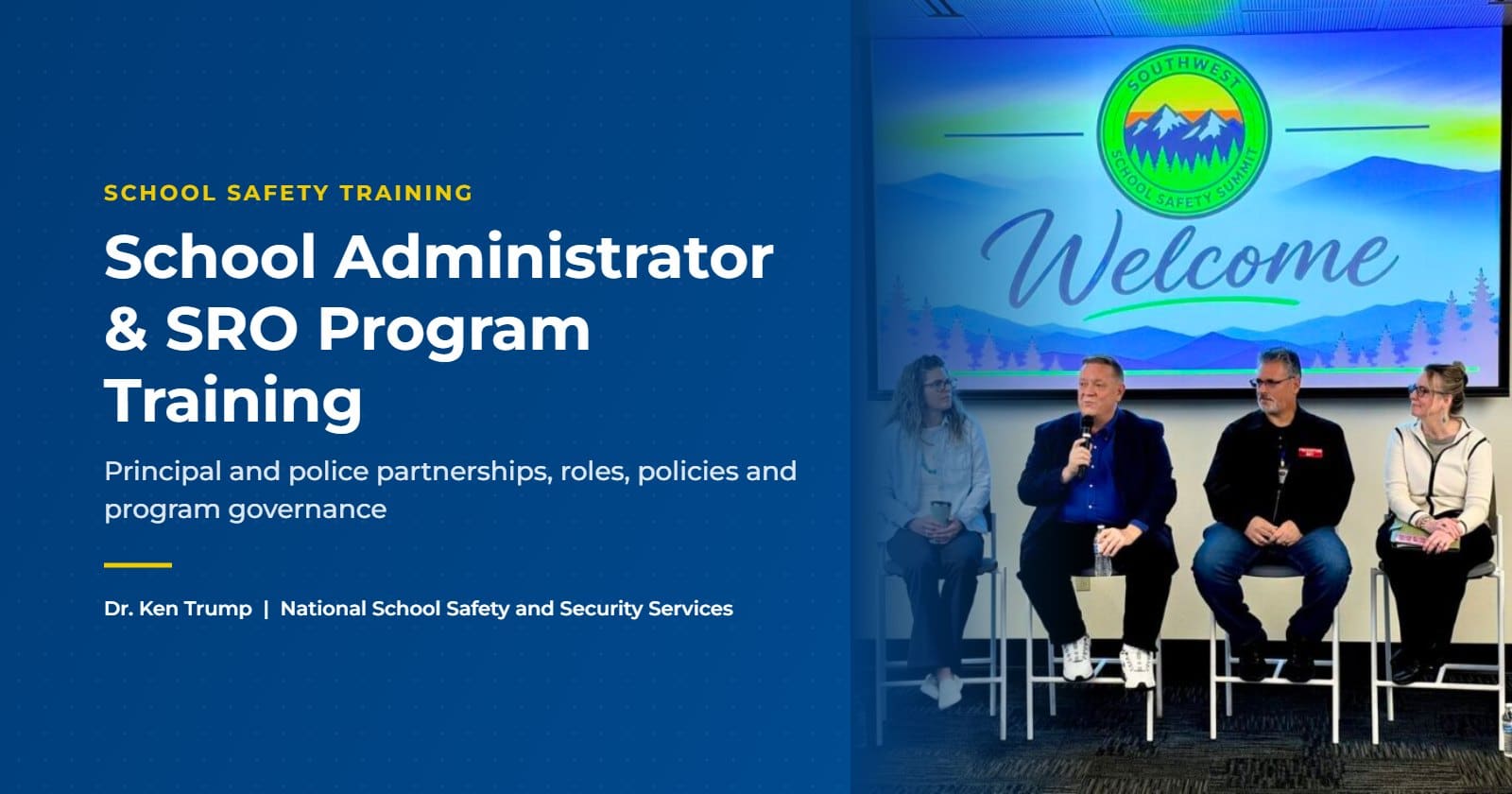
Helping school leaders and school-based law enforcement build clear roles, effective relationships, and sustainable school safety partnerships.
School Resource Officers can be an important asset in school safety when programs are well designed, clearly governed, appropriately supervised, and aligned with the educational mission of schools.
At the same time, superintendents, school boards, principals, police supervisors, and SROs often face difficult questions about roles, authority, student discipline, use of force, school climate, communications, and the boundaries between school administration and law enforcement.
National School Safety and Security Services provides training, consultation, and program evaluation services designed to strengthen working relationships between school administrators and school-based police officers and School Resource Officers.
Our work brings together experience in school-based policing, school administration, school security and emergency preparedness, school psychology, crisis communications, and school-community relations. School Safety Services
REQUEST TRAINING
Discuss Administrator-SRO Training or Consultation
Call (216) 251-3067 or email ken@schoolsecurity.org.
Talk with KenSchool-based policing works best when principals and officers understand one another’s roles, responsibilities, expectations, and professional cultures.
Administrators are responsible for leading schools, educating students, maintaining school climate, and enforcing school discipline. School Resource Officers are law enforcement professionals operating within an educational environment.
Problems can arise when those roles are unclear, expectations are inconsistent, or disagreements about authority are not addressed before a difficult incident occurs.
Our training and consultation help districts examine these relationships before conflict, controversy, or a high-profile incident exposes weaknesses.
School districts should evaluate SRO and school police programs periodically, just as they evaluate other major programs and services.
An effective review may examine:
National School Safety and Security Services provides independent consultation and evaluation of school-based police and security operations, personnel, services, and relationships with school leadership. School Safety Services
Programs can be customized for the needs of the district, school system, or law enforcement agency.
Options may include:
Audiences may include superintendents, school board members, principals, central office administrators, communications professionals, school-based police officers, SROs, security staff, law enforcement supervisors, and command personnel. School Safety Services
Training may address:
One of the most important areas of administrator-SRO partnership is distinguishing between school disciplinary matters and criminal matters requiring law enforcement involvement.
Training may include:
Clear written agreements can reduce ambiguity and prevent conflict.
Training and consultation may address:
School policing requires an understanding of children and adolescents, not just criminal law.
Programs may address:
Training can also examine difficult operational issues involving:
SRO programs should not be defined only by enforcement.
School-based officers may also contribute to:
The most effective programs balance enforcement responsibilities with prevention, preparedness, relationships, and the educational mission of the school.
Even well-intentioned programs can develop problems.
Warning signs may include unclear roles, personality conflicts, inconsistent supervision, inappropriate use of police for routine discipline, poor officer selection, weak communication between the district and law enforcement agency, inadequate training, or repeated incidents that damage trust with students, staff, families, or the community.
Independent review can help school and law enforcement leaders determine whether a problem reflects an individual incident, a personnel issue, a policy gap, a leadership problem, or a larger structural weakness in the program.
The goal is not simply to identify what went wrong, but to determine how to strengthen the partnership going forward.
School leaders should be prepared to explain the purpose, structure, expectations, and value of their SRO programs.
Communication becomes especially important when an incident involving an officer generates community concern, media attention, social media activity, or video that circulates widely.
Training may address:
School leaders should not wait until a controversial incident occurs to decide how they will communicate about their SRO program.
Effective relationships are built on clearly defined roles, mutual respect, frequent communication, consistent expectations, and an understanding that school administrators and law enforcement officers bring different professional responsibilities to the same school environment.
Routine violations of school rules should generally remain within the school’s disciplinary process.
Law enforcement involvement should focus on matters that warrant a police response. Districts should define these boundaries clearly in policy, training, and Memoranda of Understanding.
A well-developed MOU can clarify roles, responsibilities, supervision, information sharing, officer selection, training, use of force, student discipline, data collection, and procedures for resolving disagreements.
The document should reflect how the program actually operates rather than existing only as a compliance document.
Districts should review SRO programs periodically and whenever significant changes, incidents, leadership transitions, recurring concerns, or community controversies suggest that practices may need reconsideration.
Evaluation should examine both operational outcomes and the quality of relationships among administrators, officers, students, staff, and the community.
Yes.
School-based officers can provide valuable input into emergency planning, drills, tabletop exercises, threat assessment, first-responder coordination, and crisis communications.
Their role should be integrated with, not separate from, the district’s broader emergency preparedness structure.
Strong school-based policing programs depend on more than assigning an officer to a school.
They require clear roles, thoughtful leadership, appropriate officer selection, meaningful administrator-SRO relationships, ongoing training, accountability, and regular program evaluation.
National School Safety and Security Services provides independent training and consultation to help school districts and law enforcement agencies strengthen these partnerships.
REQUEST TRAINING
Request Administrator-SRO Training or Consultation
Call: (216) 251-3067
Email: ken@schoolsecurity.org