
Frontline school employees are often the first to see a problem, hear a concern, encounter a difficult person, or face an emergency. Too often, they are also among the least trained.
School safety and emergency preparedness training often focuses on administrators, teachers, school resource officers, and security personnel. Yet school secretaries, custodians and maintenance staff, food service and cafeteria employees, and school bus drivers perform some of the most operationally important jobs in a school system.
They control access. They communicate information. They supervise students in less structured settings. They maintain buildings and critical systems. They interact with parents, visitors, vendors, and community members. They transport students. They often see and hear things that others do not.
These employees do not need generic security presentations or shortened versions of administrator training. They need role-specific school safety and emergency preparedness training built around the jobs they actually perform.
What should get their attention? What should they report? What should they do when normal operations suddenly change? When should they seek assistance or disengage? What is their role during a lockdown, evacuation, reunification, medical emergency, or other crisis?
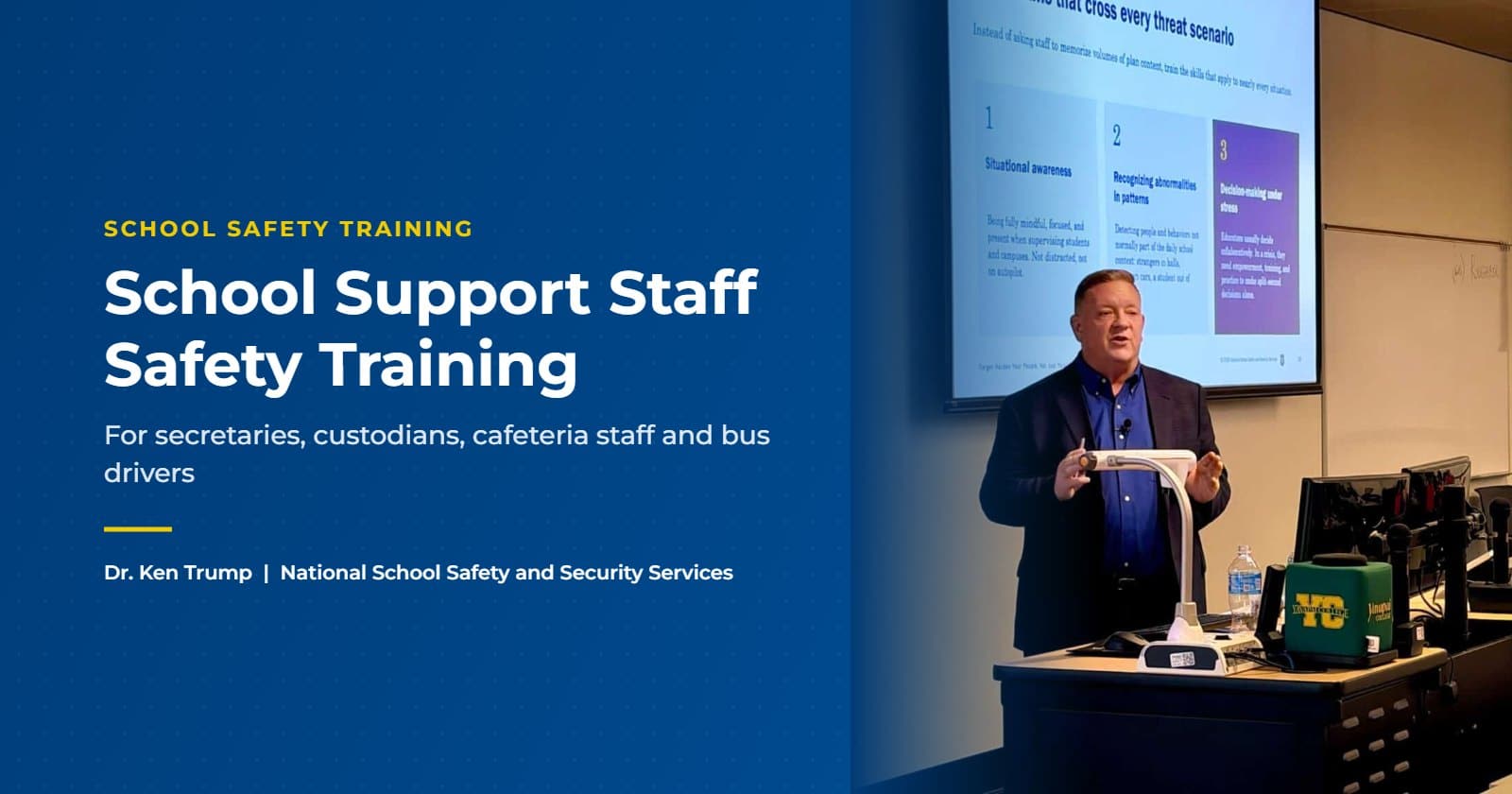
National School Safety and Security Services provides customized training for four key employee groups:
Programs are typically provided in minimum two-hour sessions by employee group, allowing training to focus on the duties, environments, risks, and decisions specific to each job category rather than delivering one generic presentation to everyone.
REQUEST TRAINING
Request School Support Staff Safety Training
Call (216) 251-3067 or email ken@schoolsecurity.org.
Request TrainingSupport employees are often present where everyday school safety actually happens.
These employees are not secondary to school safety. They are part of the school’s everyday prevention, supervision, communication, and emergency response systems.
Training should reflect that reality.
Support employees should understand the district’s overall emergency procedures, but they also need training that answers a more practical question:
What does school safety look like in my job?
The responsibilities of a school secretary are different from those of a custodian.
The decisions facing a cafeteria employee during lunch are different from those facing a school bus driver on the road.
Effective training should be built around each employee group’s actual work environment, recurring challenges, access to communications, supervision responsibilities, interactions with students and adults, and role during an emergency.
Our programs focus on those differences.
School secretary safety training should focus on front-office access, communications, difficult visitors, emergency response, and knowing when to seek help or disengage.
School secretaries and front office personnel often sit at the intersection of access, information, communications, and people. They may be the first school employee to encounter an angry parent, suspicious visitor, threatening caller, custody dispute, unexpected delivery, or rapidly developing emergency.
During a crisis, administrators and first responders may also depend heavily on the front office for information and communications.
Training should help secretaries understand both their important safety responsibilities and their limits. They should know when to ask questions, report concerns, summon assistance, disengage from escalating encounters, and avoid being placed in situations they should not be expected to handle alone.
School custodian and maintenance staff safety training should focus on building security, facility systems, suspicious activity, emergency operations, and coordination with administrators and first responders.
Custodians and maintenance employees often possess some of the best operational knowledge of the school building. They know entrances, keys, mechanical systems, utilities, storage areas, service corridors, roof access, delivery points, fire systems, and places that many other employees rarely see.
They may also work before or after normal school hours when administrative staffing is limited.
Their daily movement throughout buildings and grounds can put them in an excellent position to notice security problems, suspicious activity, facility vulnerabilities, or conditions that have changed from the normal pattern.
School cafeteria staff safety training should focus on active supervision, student behavior, emergency procedures, large-group management, medical emergencies, and communications.
Cafeterias are among the busiest, loudest, and least structured areas of many schools. Food service employees may work around hundreds of students at one time while also managing food preparation, service lines, deliveries, vendors, kitchen equipment, storage spaces, and entrances.
Their responsibilities place them in an important position for active supervision and early recognition of student conflict, medical problems, suspicious behavior, or other developing concerns.
Emergency procedures also need to account for what happens when a crisis begins while large numbers of students are eating, moving through serving lines, or entering and leaving the cafeteria.
School bus driver safety training should focus on student behavior, active supervision, de-escalation, emergency communications, law enforcement response, evacuation, and transportation crisis operations.
School bus drivers operate in one of the most challenging supervision environments in a school system. They must safely operate a large vehicle while monitoring student behavior, communicating with dispatch, watching traffic and surrounding conditions, and responding to unexpected incidents, often without another school employee immediately available.
Bus drivers also see students and communities from a perspective school-based employees may not. They may observe bullying, behavioral changes, neighborhood conflicts, suspicious activity, family disputes, or other warning signs before those concerns come to the attention of school administrators.
For districts seeking a deeper transportation-specific program, see our School Bus Driver & Transportation Safety Training page.
Our school support staff safety training is built around the actual duties, environments, and responsibilities of each employee group.
Programs are typically provided in minimum two-hour sessions by job category, allowing enough time to move beyond general awareness and address the situations employees are most likely to encounter in their work.
A district may schedule separate sessions for:
Multiple employee groups can be trained on the same professional development day while keeping the content specific to each audience.
Training may include discussion, real-world examples, scenarios, problem-solving, and application to district procedures. Longer sessions can provide additional time for exercises, case examples, and facilitated discussion.
The objective is not to turn support employees into security professionals. It is to help them become more aware, better prepared, more confident, and clearer about their responsibilities before, during, and after a school safety incident or emergency.
Support staff often perform safety-critical duties that differ significantly from those of teachers and administrators.
Secretaries manage access and communications. Custodians understand buildings and utilities. Cafeteria employees supervise large groups of students in less structured environments. Bus drivers may be responsible for students while away from the school building.
Role-specific training helps employees understand how school security and emergency preparedness apply to the work they actually perform.
Yes. Their responsibilities, work environments, communication tools, supervision duties, and emergency roles differ significantly.
Effective training should be tailored by job category rather than delivered as one generic school safety presentation to all support employees.
Programs are typically designed as minimum two-hour sessions for each employee group.
Longer workshops may be appropriate when a school district wants additional discussion, scenarios, exercises, or application to local policies and emergency procedures.
Yes. School districts can schedule separate sessions for secretaries, custodians and maintenance personnel, food service staff, and school bus drivers during the same professional development day.
Each group receives training tailored to its own work environment and responsibilities rather than one generic presentation for all employees.
Topics vary by employee group but may include:
The emphasis is on practical responsibilities support employees may actually face.
No. Effective school emergency preparedness training for support staff should take an all-hazards approach.
Training may address everyday security concerns as well as threatening individuals, fights, medical emergencies, severe weather, suspicious activity, access problems, utility emergencies, transportation incidents, lockdowns, evacuations, reunification, and other situations that can disrupt school operations.
Yes. Support employees can provide important operational perspectives during drills, tabletop exercises, emergency plan reviews, reunification planning, and after-action discussions.
Their participation can help identify gaps between what is written in an emergency plan and what employees are realistically able to do.
Yes. Training can be tailored around district procedures, recent concerns, staffing patterns, facilities, emergency plans, employee responsibilities, and specific training objectives.
Customization is especially important because the responsibilities of support staff can vary significantly from one district to another.
School secretaries, custodians, maintenance employees, food service personnel, and school bus drivers are often on the frontlines of school safety.
They should not be among the last employees to receive meaningful training.
National School Safety and Security Services provides independent, vendor-free school support staff safety and emergency preparedness training customized for PreK-12 schools and districts. Learn more about our school safety training and keynote presentations.
REQUEST TRAINING
Request School Support Staff Safety Training
Call: (216) 251-3067
Email: ken@schoolsecurity.org