
School safety is often discussed in terms of cameras, access control systems, panic buttons, weapons detection technologies, and other security measures. While these tools may play a role in a comprehensive safety strategy, one of the most powerful and evidence-based school safety practices is far simpler: active supervision.
At its core, active supervision is reflected in the longstanding educational and legal principle of in loco parentis, meaning schools officials act in the place of the parent to assume a duty of care for students while they are under school supervision. Parents expect school personnel to exercise reasonable care, vigilance, and oversight. Courts often examine these same expectations when evaluating school safety incidents.
Simply put, schools cannot effectively protect students if adults are not actively present, engaged, and aware of what is happening around them.
Active supervision is not merely a behavior management technique. It is a foundational school safety and security practice that helps schools prevent problems, identify concerns early, and maintain safe and orderly learning environments.
Understanding In Loco Parentis and the School’s Duty of Care
The concept of in loco parentis has guided schools for generations. While legal standards vary by jurisdiction, schools generally have a responsibility to provide reasonable supervision and care for students during school activities.
This responsibility extends beyond classrooms to hallways, cafeterias, playgrounds, buses, athletic events, arrival and dismissal periods, and other school-sponsored activities.
When safety incidents occur, one of the questions frequently examined is whether reasonable supervision was present and whether warning signs, concerning behaviors, or unsafe conditions should have been observed and addressed.
What Is Active Supervision in Schools?
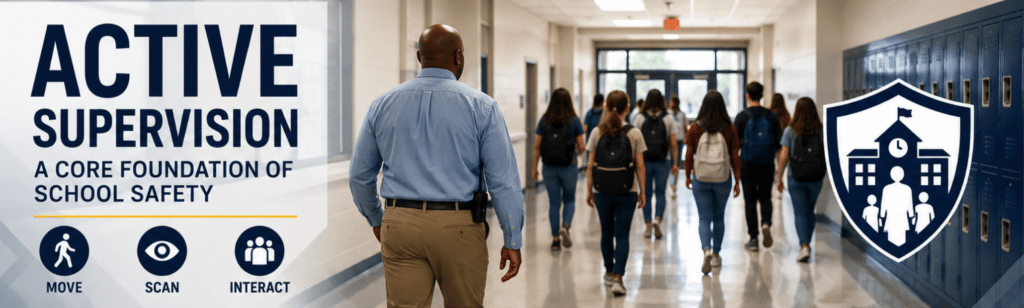
Active supervision is the intentional, ongoing monitoring of students and school environments by adults who are visible, alert, mobile, and engaged.
Unlike passive supervision, active supervision calls for adults to continuously observe, interact, and respond.
Examples of active supervision may include adults:
- Moving throughout assigned supervision areas
- Scanning students, activities, and surroundings
- Monitoring entrances, exits, and potential blind spots
- Interacting positively with students
- Recognizing early signs of conflict, distress, bullying, or misconduct
- Redirecting inappropriate behavior before it escalates
- Communicating concerns to appropriate staff
- Remaining attentive and free from distractions
Active supervision means adults are actively working their supervision assignments rather than simply occupying a location.

Why Is Active Supervision Important for School Safety?
Many school safety incidents do not begin with a failure of technology. They begin with a failure of awareness.
Conflicts often develop gradually. Bullying frequently occurs in unsupervised spaces. Students experiencing emotional distress often display warning signs before a crisis occurs. Unauthorized visitors may enter buildings through gaps in supervision rather than gaps in technology.
Active supervision helps schools:
- Prevent student misconduct
- Improve school climate and student behavior
- Enhance situational awareness
- Identify students who may be struggling emotionally
- Reduce opportunities for bullying and victimization
- Improve accountability and order
- Detect safety concerns before they escalate
- Strengthen relationships between students and adults
Students notice when adults are engaged and paying attention. They also notice when adults are distracted, absent, or disengaged.

Is Active Supervision an Evidence-Based School Safety Practice?
Yes. Peer-reviewed research has consistently identified active supervision as an evidence-based practice for improving student behavior, increasing engagement, and reducing problem behaviors.
Research studies and meta-analyses have found that active supervision contributes to:
- Reduced misconduct
- Improved student engagement
- Better transition management
- Increased positive student behavior
- Improved school climate
The research-supported components of active supervision consistently include:
- Moving
- Scanning
- Interacting
These same components align closely with the school safety concepts of visibility, situational awareness, relationship building, and early intervention.

How Active Supervision Helps Prevent School Safety Incidents
Effective school safety is built on prevention. Active supervision allows adults to identify and address concerns before they become larger problems.
Examples might include:
- Recognizing escalating student conflicts before a fight occurs
- Observing bullying behavior before it becomes chronic
- Identifying students in emotional distress who may need support
- Detecting unauthorized visitors or suspicious activity
- Recognizing unsafe behaviors that could lead to injury
- Noticing students who may be avoiding class or supervision
Prevention of disruptive and/or violent behavior is often the direct result of active supervision.
Active Supervision Is More Than Classroom Management
Active supervision is often discussed solely as a classroom management strategy. That perspective is too narrow.
From a school safety and security standpoint, active supervision supports:
- Violence prevention
- Threat identification
- Situational awareness
- Emergency preparedness
- Student connectedness
- School climate improvement
- Information gathering through positive relationships
Technology can support supervision efforts, but it cannot replace engaged adults who are present in the environment and interacting with students.
Where Schools Need Active Supervision
Active supervision is particularly important during less structured periods and in areas where students naturally congregate.
Areas where questions of supervision often come under the microscope include:
- Hallways
- Cafeterias
- Playgrounds
- Restrooms
- Locker rooms
- Stairwells
- Bus loading and unloading areas
- Parking lots
- Athletic events
- Assemblies
- Arrival and dismissal periods
- Before-school and after-school activities
These locations often present greater opportunities for misconduct, conflict, injuries, bullying, and other safety concerns than do classroom contexts.

Common School Supervision Failures and Risk Factors
Many schools have supervision plans. Questions often center around whether school leaders consistently implement and enforce them.
Common supervision weaknesses include:
- Staff remaining stationary rather than moving
- Adults clustering together and socializing
- Adults looking at their cell phones instead of actively supervising students
- Inadequate supervision during transitions
- Limited monitoring of stairwells, restrooms, and other blind or hot spots
- Weak arrival and dismissal supervision
- Unclear staff expectations
- Lack of accountability for supervision duties
A supervision plan on paper does not improve safety. Consistent implementation does.

How School Leaders Can Strengthen Active Supervision
Strong supervision does not happen by accident.
School leaders can strengthen active supervision by:
- Clearly defining supervision expectations
- Providing staff training
- Identifying high-risk locations and times
- Establishing accountability measures
- Conducting regular observations
- Providing coaching and feedback
- Reinforcing the connection between supervision and school safety
School leaders should communicate that supervision is not a secondary responsibility. It is a core safety function of school safety.

The Bottom Line: Active Supervision is a Core Component of School Safety and Security
Schools spend significant time and resources discussing technology, equipment, and physical security measures. Cameras may record events after they occur. Security technologies may assist with detection. Emergency systems may support response efforts.
Yet one of the most effective school safety strategies remains the consistent presence of trained, attentive, and engaged adults. Active supervision helps prevent problems from occurring in the first place.
For that reason, active supervision remains one of the most important and evidence-based foundations of school safety and security.
Dr. Kenneth S. Trump is President of National School Safety and Security Services
National School Safety and Security Services
Experts You Can Trust!
Connect with Dr. Ken on Linkedin: www.linkedin.com/in/kentrump/
Follow Dr. Ken on X(Twitter) @safeschools
Visit and “Like” Our Facebook School Safety News Channel at: www.facebook.com/schoolsafety