
Active supervision, firm and consistent discipline, clear expectations, and an orderly, supportive school climate are fundamental to creating safer schools and stronger learning environments.
Students may not ask adults for order, structure, and discipline. But they need them. School leaders who want to create safer learning environments need to provide them.
Too much of today’s school safety conversation focuses on target hardening with security products and technology. These tools can have a role in a comprehensive school safety program. But they cannot substitute for something far more fundamental: an orderly, structured, well-supervised school climate where expectations are clear and adults consistently enforce them.
School safety begins with people, behavior, relationships, and culture.
Order and Structure Are School Safety Strategies
A safe school should be predictable. Students should know what is expected when they enter the building, move through hallways, change classes, eat breakfast and lunch, attend extracurricular activities, leave at dismissal, ride school buses, attend school athletic events, etc.
Adults should know what is expected of them, too. That means schools need clear routines, consistent expectations, visible adult leadership, and accountability.
Rules that exist only in handbooks or administrative memos do little to improve school safety if they are inconsistently applied in hallways, cafeterias, buses, restrooms, classrooms, and other common areas.
Order is not the opposite of a supportive school climate. Order helps create one.
Students benefit when they know where the boundaries are, what adults expect, and that adults will respond when those boundaries are crossed.

Active Supervision Is a Foundation for Safer Schools
One of the most practical school safety strategies is also one of the least glamorous: active supervision.
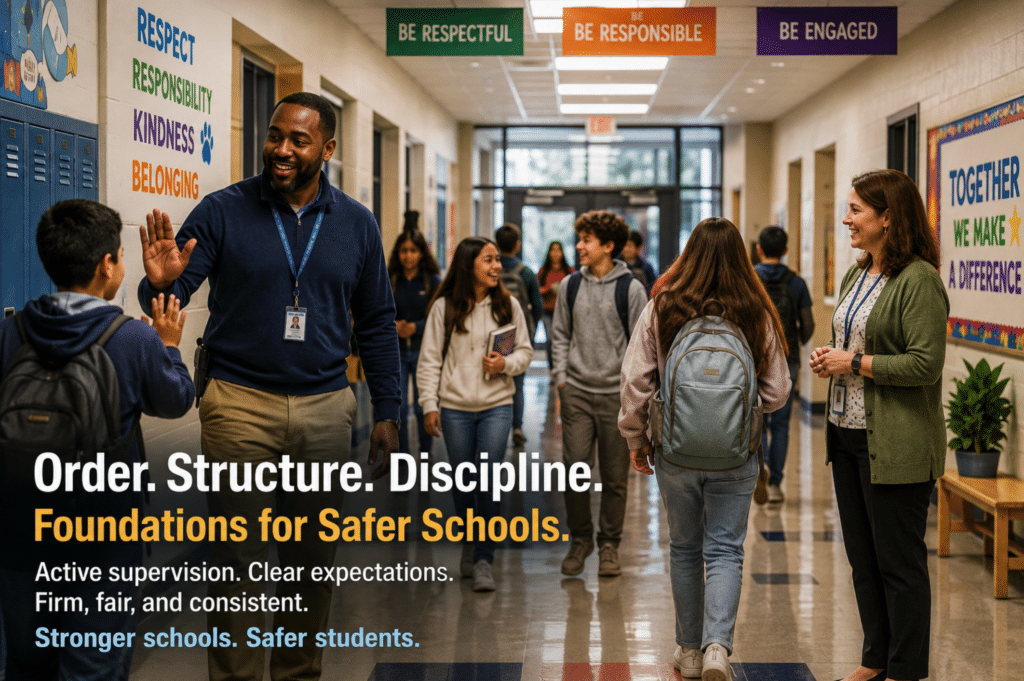
Active supervision means more than assigning an adult to stand at a doorway or cafeteria entrance. Staff members should be visible, mobile, alert, engaged, scanning their surroundings, interacting with students, recognizing unusual behavior, and intervening early when something does not look or feel right.
Administrators should be visible in their schools. Teachers and support staff should understand their supervisory responsibilities. School safety should not be delegated solely to school resource officers, security personnel, or security technology.
The adults closest to students often have the greatest opportunity to identify problems before they escalate. Deal with small problems while they are small problems! School safety is not a department. It is a culture.
Active supervision can help reduce fights, bullying, vandalism, unauthorized access, disruptive behavior, and other problems. Just as importantly, engaged adults build relationships with students and develop the situational awareness needed to recognize when something has changed.
For more information, see our page on active supervision as an evidence-based school safety strategy.

Firm, Fair, and Consistent Discipline Matters
Discipline is another word that has become unnecessarily controversial in some school safety conversations.
Effective discipline should not mean harsh, arbitrary, or punitive treatment of students. It should mean firm, fair, developmentally appropriate, and consistent accountability.
Students quickly recognize inconsistency. If one teacher ignores behavior that another teacher addresses, if administrators repeatedly fail to follow through on consequences, or if rules change depending on the student, staff member, or circumstances, then adult credibility deteriorates. That inconsistency can undermine both school climate and school safety.
Effective school discipline establishes reasonable expectations, communicates them clearly, applies them fairly, and follows through consistently. It should also include appropriate student supports, intervention, problem solving, and opportunities to correct behavior.
Support and accountability are not competing ideas. Strong schools do both.

Supportive School Climates Still Need Boundaries
Creating a positive and supportive school climate does not mean eliminating boundaries or avoiding difficult conversations about student behavior. Students need adults who care about them. They also need adults willing to say no.
They need teachers who build relationships while maintaining classroom expectations. They need administrators who listen to students while holding them accountable. They need school environments where adults recognize individual needs without abandoning reasonable standards for behavior.
The strongest school climates combine relationships with expectations, support with accountability, and compassion with structure.
Students should feel that adults care about them and that adults are in control of the environment. Those ideas reinforce each other.

Disorder Can Become a School Safety Warning Sign
School leaders should pay attention when disorder begins becoming normalized.
Recurring hallway fights, chronic tardiness, students roaming unsupervised, ignored visitor procedures, inconsistent enforcement of rules, disruptive cafeteria behavior, propped-open doors, and adults routinely looking the other way can become more than discipline problems. They can signal weakening organizational control.
Small breaches of expectations also provide opportunities for school leaders to identify weaknesses before those weaknesses contribute to more serious incidents. This is why school safety assessments should examine more than locks, cameras, emergency plans, and security equipment.
They should examine how the school actually operates during an ordinary school day. Effective school security and emergency preparedness assessments are qualitative processes, not quantitative check-the-box checklists. Those questions reveal a great deal about the real safety culture of a school.
Who is supervising students? Are adults actively engaged? Are rules consistently enforced? Do students respect reasonable boundaries? Do staff members intervene when they see something wrong? Are administrators visible and accessible?
School Safety Starts With the Everyday
The most important school safety work often happens long before an emergency. It happens when a teacher redirects inappropriate behavior, an administrator walks the hallways instead of remaining behind an office door, and a staff member approaches an unfamiliar person and asks, “Hello, may I help you?”
It happens when adults notice a student struggling and intervene early. And it also happens when school leaders establish expectations and have the courage and consistency to uphold them.
Schools should certainly prepare for high-impact emergencies. But they cannot allow the focus on worst-case scenarios to distract from managing the everyday environment.
Kids need order. Kids need structure. Kids need boundaries. And kids need adults who actively supervise, support, and hold them accountable.
They may never ask for those things. But providing them anyway is part of responsible school leadership, and it is a foundation for safer schools.
Dr. Kenneth S. Trump is President of National School Safety and Security Services
National School Safety and Security Services
Experts You Can Trust!
Connect with Dr. Ken on Linkedin: www.linkedin.com/in/kentrump/
Follow Dr. Ken on X(Twitter) @safeschools