
School safety has become a billion-dollar industry of endless new security products. Yet amid all the discussions about technology, one of the most effective and evidence-based school safety strategies often receives surprisingly less attention:
Active supervision.
The reality is that many school safety incidents do not occur because a school lacked another piece of technology. They occur because warning signs were missed, conflicts were not observed, supervision gaps existed, or adults were not positioned to identify concerns before they escalated.
Research has consistently shown that active supervision can improve student behavior, increase engagement, reduce misconduct, and enhance situational awareness. Academic researchers have identified active supervision as an evidence-based practice in schools.
In other words, one of the most powerful school safety tools is not something schools purchase. It is the trained, attentive adult already in the building.
What Is Active Supervision in Schools?
One of the most common misconceptions about supervision is that physical presence equals effective supervision.
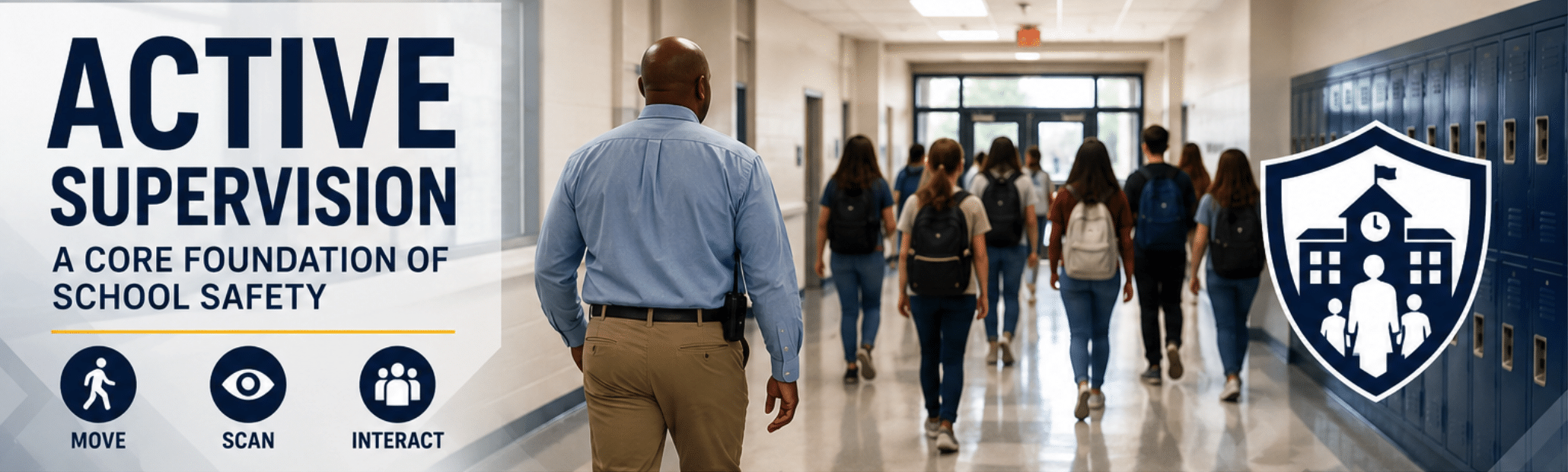
Active supervision requires adults to be visible, attentive, mobile, and engaged. Effective supervision means moving throughout assigned areas, scanning the environment, interacting with students, recognizing emerging concerns, and responding before problems escalate.
Research on active supervision consistently emphasizes several core components:
• Moving throughout the environment
• Scanning for potential concerns
• Interacting positively with students
• Maintaining situational awareness
• Reinforcing appropriate behavior
These principles apply not only in classrooms but also in hallways, cafeterias, playgrounds, buses, athletic events, arrival and dismissal periods, and other school settings.
Simply standing in a hallway is not active supervision. Purposefully observing, engaging, and monitoring students is.

Why Active Supervision Is Critical for School Safety
Active supervision is often discussed as a behavior management practice. While it certainly supports positive student behavior, its value extends far beyond classroom management.
From a school safety and security perspective, active supervision helps schools identify and address concerns before they become larger problems.
Adults who are actively supervising are more likely to:
• Notice escalating student conflicts
• Observe bullying behaviors
• Identify students experiencing emotional distress
• Recognize unsafe conditions
• Detect unauthorized visitors
• Observe unusual or concerning behaviors
• Intervene before minor issues become major incidents
Many successful school safety interventions never appear in news headlines because the problem was prevented before it became a crisis.
That prevention is often the result of effective supervision.
Active Supervision and a School’s Duty of Care
The importance of active supervision is also tied directly to the longstanding educational principle of in loco parentis, which recognizes that schools assume a duty of care for students while they are under school supervision.
Parents expect schools to provide reasonable supervision and oversight. Courts frequently examine supervision practices when evaluating school safety incidents, injuries, and litigation.
Examples of questions which may arise include:
• Were staff appropriately supervising students?
• Were warning signs observed?
• Were staff positioned where they should have been?
• Were supervision responsibilities clearly assigned and carried out?
• Were foreseeable risks identified and addressed?
These are not simply operational questions. They can become legal questions as well.

Common School Supervision Failures
Most schools have supervision plans on paper. The challenge is ensuring those plans are consistently implemented every day.
Common supervision weaknesses may include:
• Adults standing in one location rather than moving
• Staff clustered together talking
• Adults focusing on cell phones instead of students
• Inadequate supervision during class transitions
• Weak arrival and dismissal monitoring
• Limited oversight of stairwells, restrooms, and other blind spots
• Inconsistent expectations for supervision responsibilities
Even the strongest written supervision plan will fail if adults are not actively engaged in carrying it out.
Learn More About Active Supervision in Schools
Active supervision is not simply a behavior management strategy. It is a core foundational school safety practice supported by research and grounded in a school’s duty of care.
My new webpage explores the research, practical applications, common supervision failures, and strategies school leaders can use to strengthen active supervision throughout their schools.
Because one of the most effective school safety tools isn’t something you buy.
It’s the trained, attentive adult who is already in the building.
Learn more in analysis here: https://schoolsecurity.org/active-supervision-in-schools-an-evidence-based-foundation-for-school-safety-and-security/
Dr. Kenneth S. Trump is President of National School Safety and Security Services
National School Safety and Security Services
Experts You Can Trust!
Connect with Dr. Ken on Linkedin: www.linkedin.com/in/kentrump/
Follow Dr. Ken on X(Twitter) @safeschools
Visit and “Like” Our Facebook School Safety News Channel at: www.facebook.com/schoolsafety