
Best Practices for School Security and Emergency Preparedness Planning
School security and emergency preparedness require much more than cameras, doors, panic buttons, templated emergency plans, and periodic mandated drills.
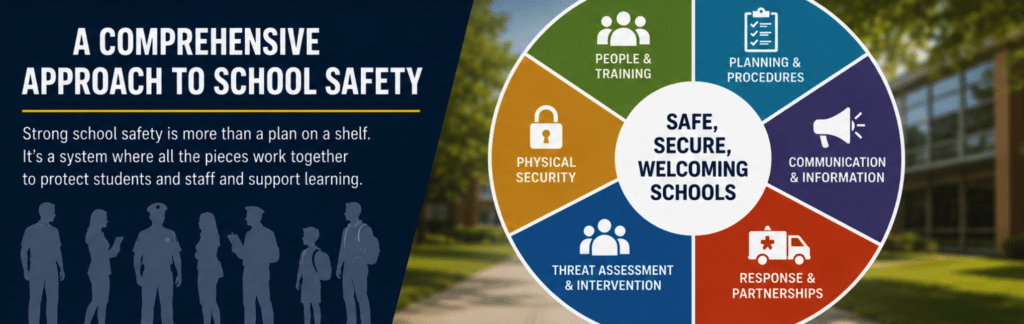
Effective school safety is a continuous leadership and management process. It combines trained and alert people, sound policies and procedures, behavioral threat assessment, appropriate physical security, emergency planning, communications, student supports, and strong partnerships with first responders.
School leaders should regularly evaluate whether their safety strategies reflect current risks, the characteristics of each school, lessons learned from exercises and actual incidents, and recognized school security and emergency preparedness best practices.
The goal is not to create schools that look or feel like prisons. The goal is to create safe, secure, welcoming, and well-managed learning environments in which students and staff are prepared without being unnecessarily frightened.
What Are Important School Security and Emergency Preparedness Best Practices?
Important school security and emergency preparedness best practices are:
- Build school safety leadership and accountability.
- Train all employees, not only administrators and security personnel.
- Conduct comprehensive security, risk, threat, and vulnerability assessments.
- Strengthen behavioral threat assessment and early intervention.
- Use physical security as part of a broader safety system.
- Develop building-specific emergency operations plans.
- Train school crisis teams and define individual responsibilities.
- Conduct age-appropriate drills and discussion-based exercises.
- Plan evacuation, family reunification, and continuity of operations.
- Strengthen partnerships with police, fire, emergency medical services, and emergency management agencies.
- Develop crisis communication and social media strategies.
- Review, test, and continuously improve safety practices.
These strategies work together. No single product, program, drill, policy, or employee can provide comprehensive school safety.

1. Establish Strong School Safety Leadership and Accountability
School safety begins with leadership.
Superintendents, school boards, principals, and district administrators should treat security and emergency preparedness as ongoing governance and management responsibilities. Safety should not become a priority only after a high-profile incident, parent complaint, media inquiry, or legislative mandate.
School leaders should:
- Establish clear district-level responsibility for coordinating school safety.
- Define the roles of administrators, crisis team members, school resource officers, security personnel, and support staff.
- Provide sufficient time, staffing, training, and resources for preparedness activities.
- Review whether safety policies are being implemented consistently at the building level.
- Include school safety in leadership meetings, principal meetings, staff development, and operational reviews.
- Create procedures for documenting concerns, corrective actions, and follow-up.
- Brief the school board regularly on strategy, progress, gaps, and priorities.
School safety is not a binder, checklist, or collection of products. It is a living leadership process that requires sustained attention and accountability.
2. Train All School Employees
A well-trained and highly alert school staff is one of the strongest layers of prevention and protection available to a school district.
Training should extend beyond administrators, teachers, school resource officers, and security personnel. Secretaries, custodians, cafeteria employees, bus drivers, transportation supervisors, nurses, counselors, coaches, substitute teachers, paraprofessionals, and other support staff often notice concerns first.
Employees should understand:
- How to recognize and report concerning behavior.
- How to report security gaps and suspicious activity.
- Visitor management and access-control procedures.
- Student supervision expectations.
- Their responsibilities during lockdowns, evacuations, shelter procedures, and other emergencies.
- How to communicate during a crisis.
- How to account for students and staff.
- How to assist students and adults with disabilities or other access and functional needs.
- What to do when administrators or usual decision-makers are unavailable.
Training should be practical, role-specific, repeated over time, and reinforced through conversations and exercises.
Staff members should understand not only what the procedures say, but also what they are personally expected to do.
3. Conduct Comprehensive School Security Assessments
School security measures should be based on identified risks and operational needs, not fear, political pressure, vendor marketing, or a reaction to the most recent tragedy.
A comprehensive school security assessment should examine much more than doors, cameras, and hardware. It should evaluate people, policies, procedures, supervision, communications, emergency planning, school climate, and the physical environment.
Assessment areas may include:
- Exterior grounds and property boundaries.
- Arrival and dismissal procedures.
- Visitor access and management.
- Interior and exterior doors. and key-control practices.
- Student supervision.
- Hallways, cafeterias, restrooms, athletic areas, and parking lots.
- Communications systems and radio coverage.
- Camera placement, monitoring, maintenance, and response protocols.
- Alarm, access-control, and notification systems.
- School resource officer and security staffing.
- Transportation facilities and school buses.
- Athletic events and after-hours activities.
- Threat reporting and behavioral threat assessment procedures.
- Emergency operations plans and crisis team readiness.
- Family reunification and continuity planning.
Assessments are a highly qualitative process and should be customized to each building. A one-size-fits-all checklist cannot adequately account for differences in school design, grade levels, enrollment, staffing, neighborhood conditions, transportation patterns, and community resources.
4. Strengthen Behavioral Threat Assessment and Early Intervention
School safety efforts should focus on identifying concerning behavior and connecting students with appropriate interventions before behavior escalates.
A multidisciplinary behavioral threat assessment and management team may include administrators, mental health professionals, school psychologists, counselors, law enforcement representatives, teachers, special education personnel, and others with relevant knowledge.
Effective threat assessment practices should include:
- A clearly defined reporting process.
- Multiple ways for students, employees, parents, and community members to report concerns.
- Training on what types of behaviors should be reported.
- Prompt screening and triage of reports.
- Information gathering from multiple sources.
- Assessment of behavior, circumstances, stressors, access to weapons, and protective factors.
- Development of individualized intervention and management plans.
- Documentation and follow-up.
- Coordination with families, service providers, and law enforcement when appropriate.
- Periodic review of whether interventions are working.
Threat assessment is not a profiling process and should not be based solely on whether a student makes a threatening statement. The focus should be on the totality of the circumstances, concerning behaviors, context, capacity, intent, and opportunities for intervention.
The Comprehensive School Threat Assessment Guidelines (CSTAG) by Dr. Dewey Cornell is a research-based multidisciplinary threat assessment process for identifying students of concern, assessing risk, and developing interventions.

5. Balance People, Procedures, and Physical Security
School security is often equated with visible equipment such as cameras, metal detectors, weapons detection systems, panic buttons, access-control systems, and additional police or security officers.
These measures may have a role in some schools. However, equipment is only as effective as the people, procedures, training, maintenance, and decision-making behind it.
Physical security should supplement, not replace:
- Student supervision.
- Staff situational awareness.
- Behavioral threat assessment.
- Effective discipline and student support systems.
- Staff training.
- Emergency planning.
- Clear communications.
- Consistent implementation of daily security procedures.
Before purchasing a security product or technology, school leaders should ask questions including:
- What specific problem are we trying to solve?
- What evidence supports the proposed solution?
- Is the product appropriate for our schools and identified risks?
- Who will monitor, operate, test, and maintain it?
- What training will employees receive?
- What happens when it generates an alert?
- How will false alarms and system failures be handled?
- Does it create new staffing, legal, privacy, financial, or operational challenges?
- How will we measure whether it improves safety?
- What lower-cost or people-centered alternatives were considered?
A key “people” consideration: Have we engaged students and parents in the school safety planning process?
6. Develop Comprehensive, Building-Specific Emergency Operations Plans
Every school should have an emergency operations plan that is customized to the building, people, programs, schedules, and surrounding community.
District-level plans provide policy direction and coordination. Building-level plans translate those expectations into actions that employees can carry out in a specific school.
Plans may include considerations for addressing a broad range of threats and hazards such as:
- Severe weather.
- Fires and hazardous materials incidents.
- Utility failures.
- Medical emergencies.
- Intruders and armed assailants.
- Bomb threats and suspicious packages.
- Missing students.
- Transportation emergencies.
- Cyber incidents affecting school operations.
- Community violence near a school.
- Civil disturbances.
- Infectious disease emergencies.
- Structural damage.
- Student or staff deaths.
- Other local hazards identified through assessment.
Guidance typically recommends using a collaborative, all-hazards planning process supported by leadership and customized to individual school buildings.
7. Make Emergency Plans Usable
Many school emergency plans are lengthy documents filled with boilerplate language, legal references, and procedures that employees have never read or practiced.
A 100-page plan is not necessarily better than a shorter, clearly organized plan.
Emergency plans should be:
- Easy to understand.
- Organized around specific roles and actions.
- Consistent with plain language.
- Accessible to authorized personnel during an emergency.
- Detailed enough to guide action without becoming unusable.
- Adaptable when an incident does not unfold as expected.
- Protected from unnecessary public disclosure when they contain sensitive security information.
Employees should receive concise, role-specific guidance instead of being expected to memorize an entire district plan.
8. Train School Crisis Teams
Listing employee names on a crisis team chart does not make a crisis team operational.
District and building crisis teams should be trained to function under pressure. Each member should understand their primary role, backup role, decision-making authority, communication responsibilities, and relationship to first responders.
Crisis teams may examine areas such as:
- Incident leadership.
- Calling 911 and communicating with first responders.
- Emergency notifications.
- Student and staff accountability.
- Medical response.
- Transportation coordination.
- Family reunification.
- Parent and media communications.
- Student support and mental health services.
- Facilities and utility management.
- Documentation.
- Continuity of operations.
- Recovery and after-action review.
Schools should identify backups because key administrators or team members may be absent, injured, isolated, or unable to carry out their normal responsibilities.
9. Conduct Thoughtful, Age-Appropriate Drills
Emergency drills are necessary, but more drills do not automatically produce better preparedness.
The purpose of a drill is to build competence, confidence, and familiarity. Drills should not be designed to surprise, frighten, or traumatize students and staff.
School leaders should:
- Follow applicable state requirements.
- Clearly identify drills as drills.
- Use age-appropriate procedures.
- Accommodate students and employees with disabilities, medical needs, sensory sensitivities, or trauma histories.
- Train adults before expecting them to guide students.
- Avoid graphic simulations and theatrical exercises.
- Coordinate appropriate exercises with first responders.
- Evaluate performance after each drill.
- Correct identified gaps.
- Communicate appropriately with families.
Drills should not create fear. Schools can create meaningful learning experiences without simulated gunfire, masked intruders, fake blood, or uninformed participants.
10. Use Tabletop Exercises to Test Decision-Making
Tabletop exercises are among the most useful and cost-effective tools for improving school emergency preparedness.
A tabletop exercise brings administrators, crisis team members, first responders, and community partners together to discuss how they would manage a hypothetical emergency.
Tabletop exercises can reveal:
- Unclear authority.
- Conflicting procedures.
- Communication failures.
- Unrealistic assumptions.
- Missing resources.
- Weak family reunification plans.
- Inadequate coordination with first responders.
- Gaps between district policies and building-level practices.
- Confusion about student and staff accountability.
- Problems with backup leadership and continuity.
Tabletop exercises allow participants to test plans in a low-risk environment before an actual emergency.
Schools should conduct exercises for situations beyond active shooter incidents. Severe weather, bus crashes, hazardous materials releases, utility failures, medical emergencies, anonymous threats, evacuations, and reunification challenges may be more likely to occur.
11. Strengthen Partnerships With First Responders
School officials should maintain ongoing working relationships with:
- Law enforcement agencies.
- Fire departments.
- Emergency medical services.
- Emergency management agencies.
- Public health agencies.
- Mental health providers.
- Transportation partners.
- Hospitals.
- Local government officials.
- Community organizations that may support response or recovery.
These relationships should not begin during a crisis.
First responders should be appropriately involved in:
- Reviewing emergency operations plans.
- Participating in tabletop exercises.
- Touring school buildings.
- Understanding school schedules and operations.
- Reviewing access points and emergency routes.
- Discussing command, communications, and jurisdiction.
- Identifying staging areas.
- Planning evacuation and reunification operations.
- Coordinating responses to anonymous threats.
- Reviewing floor plans and critical building information.
Schools should provide first responders with accurate and updated information while protecting sensitive materials from unauthorized disclosure.
Door numbering, clear building identification, accessible emergency keys, current floor plans, interoperable communications, and familiarity with school layouts can support a more effective response.
12. Plan for Evacuation and Family Reunification
Evacuation is not complete when students leave the building.
Schools must be prepared to move, shelter, transport, account for, protect, and reunify students with authorized caregivers.
Family reunification planning should address:
- Primary and alternate reunification locations.
- Transportation.
- Student and staff accountability.
- Student release procedures.
- Identity verification.
- Custody restrictions.
- Students with disabilities and medical needs.
- Medication and emergency supplies.
- Traffic and crowd management.
- Security at the reunification site.
- Communications with families.
- Media staging.
- Students whose caregivers are delayed or unavailable.
- Coordination with receiving facilities and first responders.
Reunification sites should be evaluated in advance. A nearby location may be affected by the same emergency, lack adequate space, create traffic congestion, or be visible to a potential attacker.
Plans should also address evacuations that occur during arrival, dismissal, lunch, athletic events, evening programs, and other nontraditional times.
13. Prepare for Emergencies During All Settings and Times
School emergency planning should not focus exclusively on traditional classroom hours.
Schools operate during:
- Arrival and dismissal.
- Lunch periods.
- Class changes.
- Athletic events.
- Board meetings.
- Performances and assemblies.
- Summer programs.
- After-school activities.
- Field trips.
- Transportation operations.
- Community use of school facilities.
- Construction and renovation projects.
Plans should account for substitutes, volunteers, contractors, visitors, spectators, and community groups that may not be familiar with school procedures.
A plan that works at 10:00 a.m. in a classroom may not work during a crowded football game, an evening performance, or dismissal involving buses, cars, pedestrians, and hundreds of students moving simultaneously.
14. Develop Crisis Communication and Social Media Strategies
School emergencies are also communication emergencies.
Parents, employees, students, first responders, elected officials, and the media will seek information quickly. In the absence of credible information, rumors and speculation can fill the gap.
A school crisis communication plan should identify:
- Who is authorized to communicate.
- Who approves messages.
- Which communication platforms will be used.
- How information will be verified.
- How frequently updates will be provided.
- How messages will reach people with disabilities or limited English proficiency.
- How employee communications will be coordinated.
- How rumors and misinformation will be addressed.
- How family reunification information will be communicated.
- How media inquiries will be managed.
- Who will monitor social media.
- What backup methods will be used if systems fail.
School leaders should prepare sample messages for foreseeable emergencies, but templates should not replace thoughtful communication.
Messages should acknowledge what is known, what is not yet known, what actions have been taken, and when the next update is expected.
School officials should avoid premature assurances such as “all students are safe” unless that information has been verified. Communicating safety credibly is more important than communicating quickly but inaccurately.
15. Include Mental Health, Recovery, and Continuity Planning
Emergency planning should extend beyond the immediate response.
Schools may need to address:
- Psychological first aid.
- Student and employee mental health supports.
- Memorials and anniversaries.
- Staff absences.
- Temporary relocation.
- Academic continuity.
- Payroll and essential business operations.
- Records and technology restoration.
- Family assistance.
- Community meetings.
- Media attention.
- Litigation and investigations.
- Long-term recovery.
Recovery decisions made immediately after a crisis can influence the school community for months or years.
Plans should identify recovery partners before they are needed. Schools should also consider how they will support administrators and crisis team members who have carried substantial responsibilities during an emergency.
16. Review and Improve Plans Continuously
School security and emergency preparedness plans should be reviewed at least annually and whenever:
- A building is renovated.
- Leadership or crisis team membership changes.
- New security technology is installed.
- Transportation or dismissal procedures change.
- A drill or exercise identifies a problem.
- A real incident occurs.
- State laws or district policies change.
- New programs or student populations create different needs.
- First responders identify operational concerns.
After drills, exercises, and actual incidents, schools should conduct structured after-action reviews.
An after-action review should identify:
- What was expected to happen.
- What actually happened.
- What worked.
- What did not work.
- Why gaps occurred.
- What corrective actions are needed.
- Who is responsible for completing them.
- When improvements will be reviewed.
The purpose is improvement, not blame.
Common School Security Planning Mistakes
School leaders should avoid these common mistakes:
- Treating security as primarily a hardware or technology issue.
- Copying another district’s emergency plan.
- Creating plans without employee or first responder input.
- Focusing almost exclusively on active shooter scenarios.
- Confusing the existence of a written plan with actual readiness.
- Training administrators while overlooking support staff.
- Conducting drills without evaluating the results.
- Failing to plan for evacuation and reunification.
- Not engaging students, parents, support staff, and other non-teaching/administrative persons.
- Purchasing products without identifying the problem they are expected to solve.
- Allowing emergency plans to become excessively long or complicated.
- Making public promises that no school can guarantee.
- Waiting for a crisis before building relationships with first responders.
- Failing to correct recurring implementation problems.
- Assuming procedures are consistently followed because they exist in policy.
A Practical School Safety Review Checklist
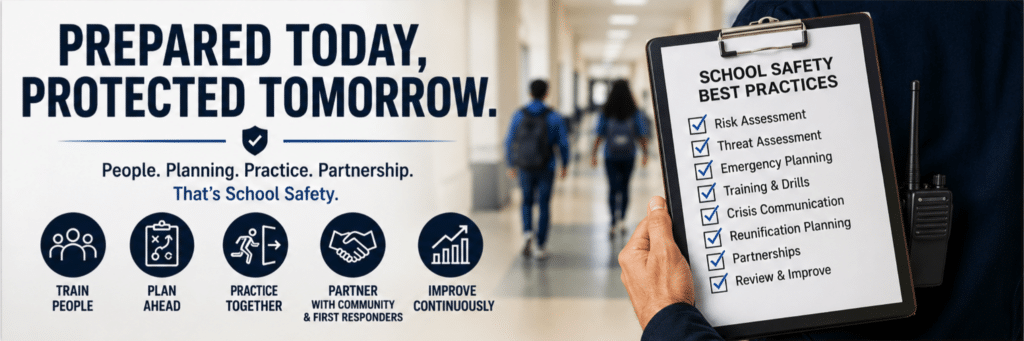
School and district leaders can begin by asking:
- Do we have clear leadership and accountability for school safety?
- When was our last independent security assessment?
- Are our procedures customized to each school?
- Have all employees received role-specific training?
- Are support staff meaningfully included?
- Do we have a trained multidisciplinary threat assessment team?
- Can students and adults easily report concerns?
- Are reported concerns documented, assessed, and followed up?
- Do our security technologies have clear operating and response protocols?
- Are emergency plans readable and usable?
- Are district and building crisis teams trained?
- Have we engaged students and parents in the processes?
- Have we conducted recent tabletop exercises?
- Are drills age-appropriate and evaluated afterward?
- Can we account for students during an evacuation?
- Do we have primary and alternate reunification sites?
- Are first responders familiar with our buildings and procedures?
- Do we have a crisis communication and social media strategy?
- Are plans in place for recovery and continuity of operations?
- Are corrective actions tracked to completion?
A “no,” “not sure,” or “it depends on the school” response may identify an area requiring additional review.
Frequently Asked Questions About School Security and Emergency Preparedness
What is the first line of defense in school security?
The first line of defense is a trained, alert, and properly supported school staff and student body. Security equipment may help, but it cannot replace situational awareness, supervision, reporting, intervention, communication, and sound leadership.
How often should school emergency plans be updated?
Schools should formally review emergency operations plans at least annually. Plans should also be updated after exercises, actual incidents, leadership changes, renovations, operational changes, or the installation of new security systems.
What should a school emergency operations plan include?
A school emergency operations plan should include clear responsibilities, communications, lockdown and shelter procedures, evacuation, student accountability, family reunification, medical response, continuity, recovery, and hazard-specific procedures.
Should every school have the same emergency plan?
No. Districts should establish common policies and expectations, but emergency procedures should be customized to each building’s design, grade levels, staffing, enrollment, programs, hazards, transportation arrangements, and community resources.
Are cameras, metal detectors, and security technology enough to keep schools safe?
No. Physical security technology can support a comprehensive safety program, but it cannot replace trained people, supervision, threat assessment, emergency planning, maintenance, communication, and consistent implementation.
What is a school tabletop exercise?
A tabletop exercise is a facilitated discussion in which school personnel and community partners work through a hypothetical emergency. It helps identify unclear roles, communication failures, unrealistic assumptions, and gaps in written plans without creating the disruption of a full-scale exercise.
Who should participate in school safety planning?
Planning should involve district and building administrators, teachers, support staff, mental health professionals, transportation personnel, facilities staff, school resource officers or security personnel, police, fire, emergency medical services, emergency management agencies, students, parents, and other community partners as appropriate.
What is the difference between school safety compliance and school safety culture?
Compliance means meeting required mandates, completing plans, conducting required drills, and checking procedural boxes. A school safety culture makes preparedness an ongoing part of leadership, training, supervision, communication, reporting, evaluation, and continuous improvement.
Moving From Written Plans to Operational Readiness
Strong school security and emergency preparedness do not result from reacting to one incident, buying one product, or completing one annual checklist.
Readiness develops when school leaders consistently invest in people, assessment, training, planning, communication, exercises, partnerships, and follow-through.
The central question is not simply, “Do we have a plan?”
School leaders should ask:
Do our people understand the plan, can they carry it out under stress, and have we tested whether it will work?
National School Safety and Security Services works with public, private, charter, and independent schools to evaluate security, strengthen emergency planning, train school personnel, conduct tabletop exercises, and support strategic school safety leadership.
Contact Dr. Kenneth S. Trump to discuss school security assessments, emergency preparedness training, emergency plan evaluations, tabletop exercises, or strategic school safety consultations.