
A new research report from the Advanced Law Enforcement Rapid Response Training (ALERRT) Center is fueling debate over whether it should be mandated that classroom doors remain locked throughout the entire school day.
The study, funded by the Security Industry Association (SIA), examined active shooter incidents in K-12 schools and concluded that locked doors can reduce casualties when attackers attempt entry into classrooms.
Some school districts and lawmakers may interpret such findings as support for requiring teachers to teach behind locked classroom doors all day. But the issue is more nuanced.
The debate should not be about whether classroom doors can be locked. They should be. Nor should it be about whether schools should secure perimeter doors, control visitor access, and maintain effective lockdown procedures. They absolutely should.
The real question is whether schools should fundamentally alter daily teaching and learning environments in response to an extraordinarily rare event.
That is where my perspective differs from advocates of all-day classroom door locking policies. I do not believe there should be laws or similar mandates that teachers must teach all days behind locked doors.
Classroom door policies are also one part of the larger challenge school leaders face when making school security products, technology, and physical security decisions based on evidence, operations, and real-world school conditions.
What the School Locked Door Research Found
The ALERRT report identified several important findings:
• Locked classroom doors were associated with fewer casualties when attackers attempted entry.
• Exterior doors remain a critical vulnerability, particularly in elementary schools where attackers are often outsiders.
• Most attackers did not defeat locks. Instead, they entered through doors that were unlocked or otherwise unsecured.
• Schools should ensure classroom doors can be locked quickly from inside the room.
These findings reinforce the importance of strong perimeter security, functional door hardware, and rapid lockdown capability.
What the School Locked Door Research Does Not Prove
One important aspect of the report deserves closer examination.
The researchers reviewed 54 active shooter incidents spanning 25 years. Within those incidents, they identified only 66 documented door interactions where perpetrator behavior could be analyzed.
That is valuable information, but it is not a large enough dataset to justify sweeping statewide mandates requiring every teacher in every classroom to teach behind locked doors all day long.
The researchers themselves describe the findings as descriptive rather than conclusive.
School leaders should be cautious about overstating what the data actually proves.

School Shootings Are Serious but Rare
One school shooting is one too many. The consequences of a school shooting are unquestionably severe.
But good risk management requires balancing both consequence and probability. The probability remains extraordinarily low compared to the millions of students who attend school safely every day.
Preparing for rare events is responsible. Structuring daily educational operations around rare events is a different question altogether.
The Practical Reality of Mandating Teachers Lock Classroom Doors
Schools are dynamic learning environments where students and staff move throughout the building all day.
Students leave classrooms for legitimate reasons including restroom visits, counseling appointments, nurse visits, special education services, interventions, and administrative meetings.
Teachers, counselors, specialists, aides, and administrators also move throughout schools continuously.
When classroom doors remain locked all day, those routine movements create repeated interruptions and distractions. Students knock on doors. Teachers stop instruction to admit students. Staff members enter and exit classrooms throughout the day.
While each interruption may seem minor, the cumulative effect can be significant.
A policy intended to improve safety may inadvertently interfere with teaching and learning every day.
Are We Building Confidence or Fear: Classroom or Prison?
There are other questions worth asking:
What message do we send when students spend every school day behind locked classroom doors? What message do we send to teachers?
School safety should build confidence and preparedness, not institutionalize fear.
Schools should be careful not to create environments that unintentionally communicate a constant expectation of danger in response to a threat that remains extraordinarily unlikely.
Who Will Consistently Enforce Mandatory Locked Classroom Doors?
There is also a practical question that receives far too little attention:
Who is going to enforce these policies?
Most principals and assistant principals are already stretched thin with instructional leadership, student discipline, staff supervision, parent concerns, and emergency management responsibilities.
Will administrators be expected to conduct classroom door inspections? Will teachers be disciplined when doors are temporarily unlocked during routine classroom operations?
A policy that cannot be realistically implemented and enforced may create the appearance of security without producing meaningful improvements in safety.

Effective School Safety Is About More Than Teaching Behind Locked Doors
Ironically, one of the most important findings in the ALERRT report is that attackers most often entered through unsecured doors rather than defeating locks.
That suggests the challenge is often not hardware. It is implementation.
School safety failures frequently involve propped-open exterior doors, poor supervision, delayed threat reporting, communication failures, and missed warning signs.
Those problems cannot be solved simply by mandating that every classroom door remain locked throughout the day.
Effective school safety requires people, processes, training, supervision, communication, prevention efforts, and physical security measures working together.

A Better Approach to Locked Doors and Reasonably Secured Campuses
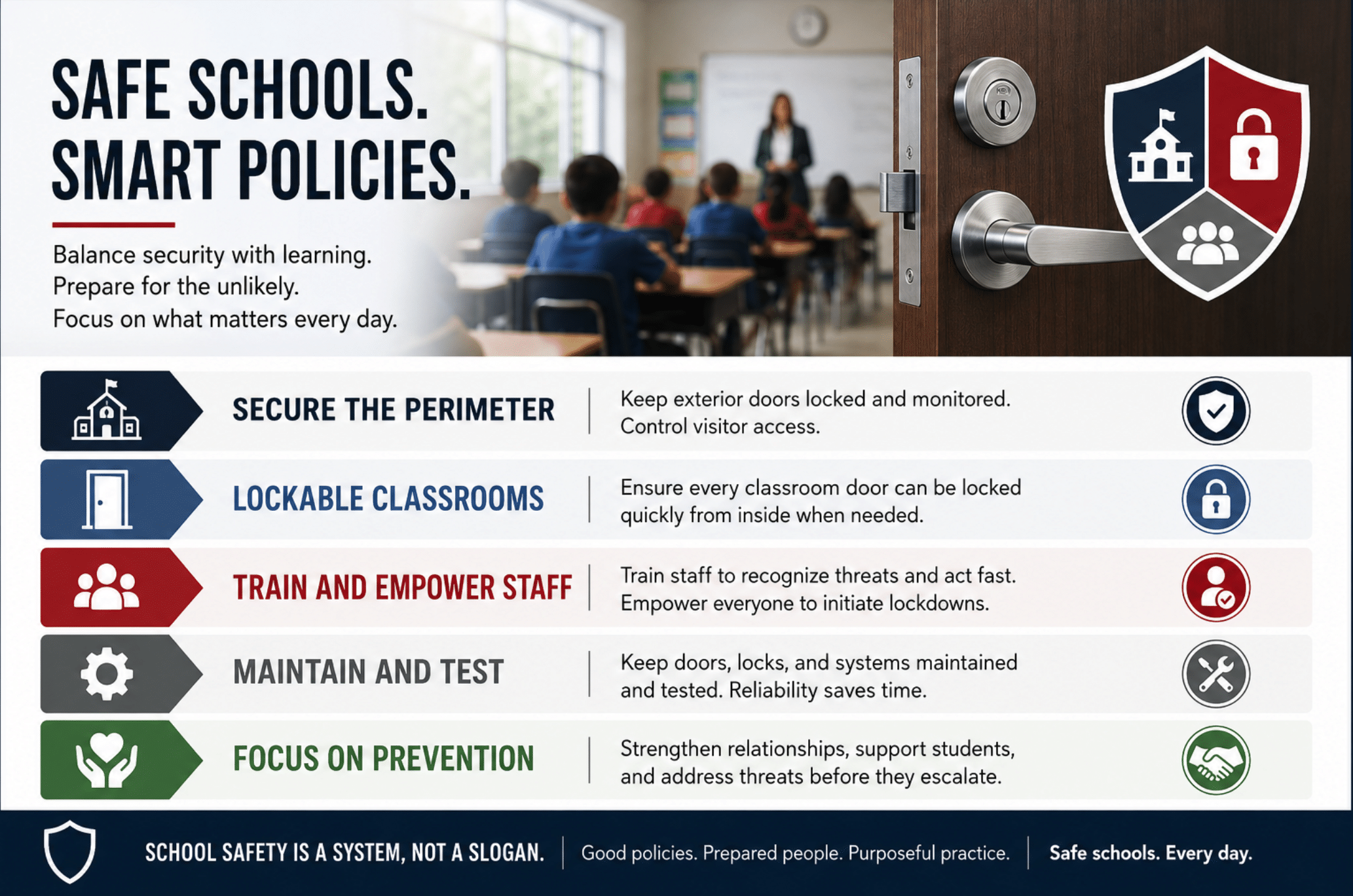
The better approach is straightforward:
• Outside campus kept free of loitering students, strangers, trespassers, and others
• Keep exterior doors locked and monitored.
• Control visitor access.
• Ensure classroom doors can be locked immediately from inside.
• Train and empower staff to act quickly when needed.
• Maintain locks, doors, and security systems.
• Strengthen threat assessment, prevention, and student support efforts.
Most importantly, allow local school leaders to make decisions based on their schools, students, staff, and operational realities rather than imposing one-size-fits-all statewide mandates.
School safety should support the educational mission, not interfere with it.
Lock the perimeter. Ensure classrooms can lock quickly when needed. Train people well.
Then let teachers teach and students learn.
Read my full analysis here: Should Classroom Doors Be Locked All Day? A Critical Look at the ALERRT/SIA School Locked Doors Research Report
Dr. Kenneth S. Trump is President of National School Safety and Security Services
National School Safety and Security Services
Experts You Can Trust!
Connect with Dr. Ken on Linkedin: www.linkedin.com/in/kentrump/
Follow Dr. Ken on X(Twitter) @safeschools
Visit and “Like” Our Facebook School Safety News Channel at: www.facebook.com/schoolsafety