
New Research Fuels Debate Over Mandatory Classroom Door Lock Policies
A 2026 research report from the Advanced Law Enforcement Rapid Response Training (ALERRT) Center has renewed debate over whether classroom doors should remain locked throughout the school day.
The report, funded by the Security Industry Association (SIA), examines active shooter incidents in K-12 schools and concludes that locked doors can play an important role in limiting casualties during an attack.
In recent years, some states, school districts, and advocacy groups have pushed beyond requiring classrooms to be capable of being locked during emergencies. Increasingly, proposals have emerged requiring teachers to teach with classroom doors locked throughout the entire school day.
In some jurisdictions, these requirements have been incorporated into district procedures. In others, lawmakers have proposed statewide mandates requiring classroom doors to remain locked whenever students are present.
The rationale is straightforward: If a door is already locked when an attack begins, valuable seconds may be saved.
While well-intentioned, this approach raises important questions about practicality, educational impact, enforcement, and whether policies are being driven by evidence or by fear of highly unlikely events.
While the report contains useful findings, school leaders and state lawmakers should be cautious about turning those findings into blanket policies requiring teachers to always teach behind locked classroom doors.
The question is not just whether doors can lock. It is whether mandatory all-day locked classroom door policies are practical, evidence-based, and appropriate for the daily realities of schools.
What the ALERRT School Locked Doors Report Found
The ALERRT researchers reviewed 54 K-12 active shooter incidents occurring between 2000 and 2025.
Among the report’s primary findings:
- Locked doors were associated with fewer casualties when attackers attempted entry.
- Exterior doors represented an important vulnerability, particularly in elementary schools where attackers were often outsiders.
- Most attackers did not defeat locks. Instead, they entered through doors that were unlocked or otherwise unsecured.
- Schools should ensure that classroom doors can be locked quickly from inside the room.
- Physical security measures can help reduce harm but cannot prevent violence on their own.
These findings support reasonable security practices and reinforce the importance of effective lockdown capabilities.
However, the report does not necessarily support requiring every classroom door to remain locked throughout the school day.
Understanding the Limits of the Research
One of the most important aspects of the report is often overlooked. The study understandably examined a relatively small number of documented door interactions.
Of the incidents reviewed, researchers identified only 66 doors where perpetrator interaction was known. Victim outcome data was available for an even smaller subset.
The findings are informative, but they do not provide a sufficiently large dataset to justify sweeping statewide mandates or districtwide policies requiring all occupied classroom doors to always remain locked.
The researchers themselves characterize the findings as descriptive rather than conclusive.
School leaders should be careful not to overstate what the data actually proves.
Follow the Funding: Why the Security Industry Association Connection Matters
The report was funded by the Security Industry Association (SIA). To be clear, industry funding does not automatically invalidate research. ALERRT states that it maintained editorial independence over the project.
However, school leaders should recognize that SIA is a trade association representing physical security manufacturers, vendors, and service providers. Its members include companies that manufacture and sell access control systems, door hardware, locks, security technologies, and related products.
As with any industry-funded research, readers should critically evaluate how findings may be interpreted, promoted, and potentially leveraged to support expanded security spending or policy initiatives.
The existence of a financial interest does not mean the conclusions are wrong. It does mean policymakers should exercise independent judgment before transforming research findings into mandates.

School Shootings Are Serious but Statistically Rare
One school shooting is one too many. School shootings are among the most emotionally charged events in education. While they deserve thoughtful planning and preparation, the specific fact patterns will vary incident-to-incident.
However, they remain statistically rare events when compared to the millions of classroom interactions occurring in schools every day.
The challenge for school leaders is balancing preparedness for low-frequency, high-consequence incidents against the practical realities of daily school operations.
Good school safety policy should address both.
Too often, policy discussions focus almost exclusively on active shooters while overlooking the far more common challenges schools face every day, including student behavior issues, supervision failures, bullying, fights, mental health concerns, and emergency preparedness gaps.

School Safety Must Be Balanced with the Educational Mission
Schools are educational institutions first. Every security measure carries operational consequences that should be carefully evaluated.
A classroom door that remains locked throughout the day changes how teachers teach, how students interact, and how school personnel move through the building.
Students routinely leave classrooms for legitimate reasons:
- Restroom visits
- Counseling appointments
- Nurse visits
- Special education services
- Academic interventions
- Administrative meetings
- Student support services
Likewise, teachers, administrators, counselors, psychologists, support staff, substitutes, and specialists move throughout schools continuously.
A state law mandate or a school district policy requiring doors to remain locked throughout the day creates a steady stream of interruptions as students and staff enter and exit classrooms.
Those interruptions may seem minor in isolation, but over the course of a school day they can significantly disrupt instruction, concentration, and classroom routines.
Ironically, a policy designed to improve safety may create a less effective learning environment for students every day in response to an event that is extraordinarily unlikely to occur.
The question is worth asking:
Are we creating environments that foster learning, engagement, and connection? Or are we creating environments that communicate a constant expectation of danger?
School leaders should carefully consider the psychological and cultural impacts of security measures, particularly when those measures are implemented in response to extremely rare threats.

Who is Going to Consistently Enforce Mandated Classroom Door Locking? The Problem Nobody Talks About
Perhaps the most overlooked question in the classroom door debate is this:
Who is going to enforce these policies?
Most school administrators are already stretched thin. Principals and assistant principals spend their days addressing student behavior, staff supervision, parent concerns, instructional leadership responsibilities, emergencies, and countless operational demands.
- Will administrators now be expected to spend time checking classroom doors throughout the day?
- Will teachers face discipline if a door is temporarily unlocked while students transition in and out?
- Will compliance be measured through random inspections?
- Will schools divert leadership attention away from more common safety concerns such as supervision, behavioral issues, bullying, fights, and threat reporting?
A policy that cannot be realistically implemented and consistently enforced may provide the appearance of security while accomplishing little in practice.

Effective School Security Is About More Than Locked Doors Alone
One of the most important findings in the ALERRT report is that attackers most often entered through unsecured doors rather than defeating locks.
This suggests that the issue is often not hardware. It is implementation.
School safety failures frequently involve human factors:
- Propped-open exterior doors
- Failure to follow visitor management procedures
- Delayed threat reporting
- Inadequate supervision
- Poor communication
- Lack of situational awareness
- Failure to act on warning signs
These challenges cannot be solved simply by requiring classroom doors to remain locked throughout the day.
Effective school safety requires people, processes, training, supervision, communication, and physical security working together.
A More Reasonable Locked Door Practice for School Safety
The better practice is not mandatory “all classroom doors locked all day.”
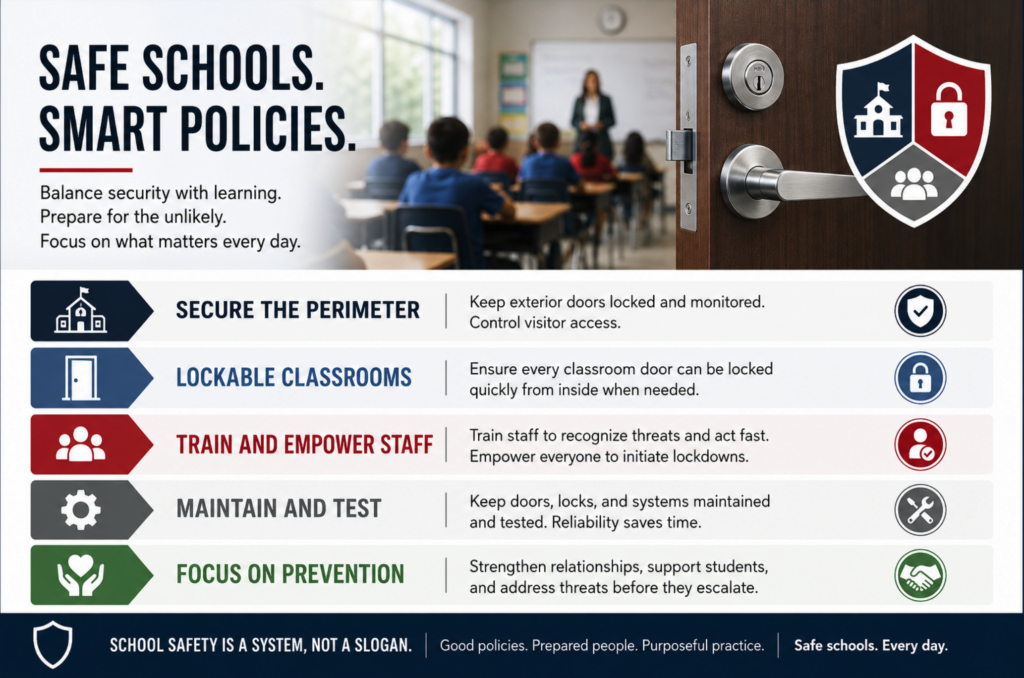
A more reasonable approach is:
- Outside campus kept free of loitering students, strangers, trespassers, and others
- Exterior school doors secured and monitored/checked
- Visitor access controlled
- Classroom doors capable of being locked quickly from inside
- Staff trained and empowered to lock down immediately when needed
- Security hardware maintained and functioning properly
- Threat assessment and prevention systems strengthened
- Active supervision and situational awareness emphasized
This approach improves safety without unnecessarily disrupting teaching and learning.
Most importantly, it recognizes that school safety should support the educational mission, not inadvertently interfere with it.

School Safety Decisions Should Remain Local Decisions
The ALERRT report provides useful information. However, it does not justify statewide legislative mandates requiring every teacher in every school to teach behind locked classroom doors all day long.
Local school leaders understand their buildings, staff, students, operational realities, and community expectations better than state legislators or door hardware vendors.
A small elementary school may choose a different approach than a large comprehensive high school. A rural district may face different challenges than an urban district.
Flexibility allows schools to tailor security measures to their specific circumstances while maintaining strong perimeter security and rapid lockdown capabilities.
State laws should establish broad safety expectations. They should not micromanage day-to-day classroom operations.
It is one thing if a principal and school-community choose to create and consistently enforce a mandatory locking down of classroom doors while teachers teach.
It is another thing, however, if a state mandates teaching behind locked classroom doors.
Let’s focus on a balanced and well-reasoned approach to school safety that recognizes the value of local decision-making and does not create unintended consequences.
Dr. Kenneth S. Trump is President of National School Safety and Security Services
National School Safety and Security Services
Experts You Can Trust!
Connect with Dr. Ken on Linkedin: www.linkedin.com/in/kentrump/
Follow Dr. Ken on X(Twitter) @safeschools
Visit and “Like” Our Facebook School Safety News Channel at: www.facebook.com/schoolsafety