
When school leaders think about school safety and security, they often think first about administrators, school resource officers, security personnel, emergency plans, cameras, access control systems, and other security measures.
They should also be thinking about the people working in the front office.
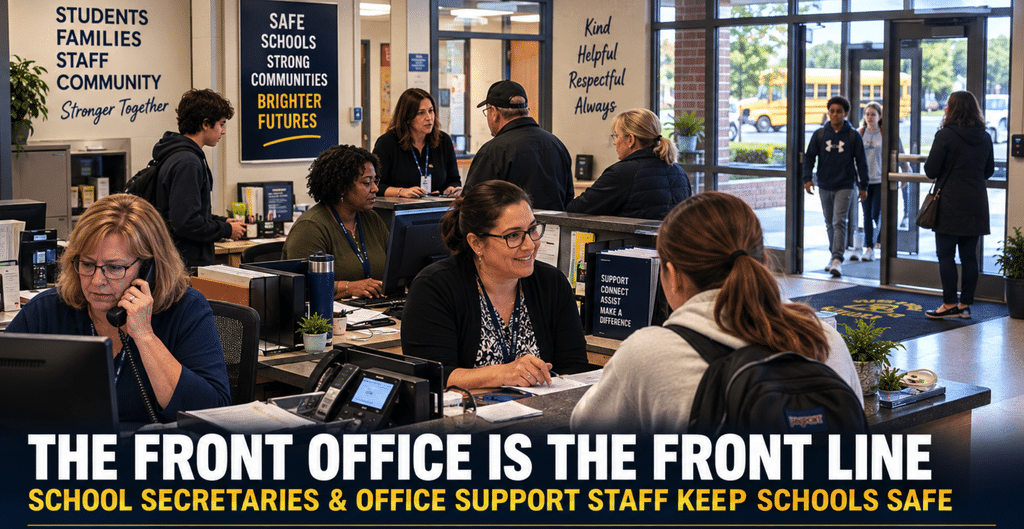
School secretaries and office support staff are among the most important frontline school safety professionals in any school. Yet after more than four decades of working with schools and school districts across the country, I have consistently found that they are also among the staff members most likely to be overlooked when it comes to school safety training, emergency planning, crisis teams, and security decision-making. That needs to change.
During an ordinary school day, secretaries and office staff may screen visitors, control access to secured entrances, encounter angry parents, receive threatening telephone calls, direct contractors, manage student release, assist students in distress, communicate with first responders, and provide basic medical assistance when a nurse is unavailable.
And they typically do several of these things at once. In some cases, there may even only be one school secretary to run the front office the entire day!
Your School Main Office Is a Security Function
The main office is one of the most important security locations in a school.
Office support staff are often the first employees to see, hear, or speak with someone attempting to enter the building. A secretary may be the person looking through an intercom camera and deciding whether to unlock the door. They may recognize that a parent’s behavior is different from previous visits or that someone’s explanation for being at the school does not make sense.
They may have seconds to decide whether something is routine or potentially dangerous. In one school incident, a secretary noticed unusual behavior by a parent seeking entry. Rather than automatically buzzing him inside, she questioned him, recognized warning signs, contacted police, and initiated a lockdown after seeing a weapon. The individual subsequently fired multiple rounds outside the school but never gained entry.
The technology helped. The person operating it made the critical decisions. That distinction should be central to school access control and visitor management planning.

Access Control Is More Than Buzzing People Through a Door
Schools have invested heavily in secured vestibules, cameras, electronic access controls, visitor management systems, intercoms, and identification technology. Their effectiveness still depends heavily on the people using them.
School secretaries and other office support staff need clear procedures and practical training for:
- Visitors who refuse to provide identification or explain why they are at the school
- Parents demanding immediate access to a child, teacher, administrator, or classroom
- Custody disputes, protection orders, and restricted-access individuals
- Former students or employees attempting to enter
- Employee family members seeking access to school employees during work hours
- Contractors, vendors, delivery drivers, and other legitimate visitors who still require verification
- People attempting to follow authorized visitors through secured entrances
- Suspicious packages, unusual behavior, threatening communications, or concerning statements
- Individuals who become angry when denied entry or asked to wait
A visitor management system is a tool. School safety still depends on whether the person behind the desk recognizes something that does not look or feel right and knows what to do next.
“Hello, May I Help You?” Is a School Security Strategy
One of the simplest and most powerful school safety practices is also one of the least expensive: acknowledging people.
A professional, confident “Hello, may I help you?” establishes that visitors have been noticed and that access to the school is actively managed rather than passively observed. School secretaries do this every day.
Experienced office staff often know regular parents, students, substitutes, contractors, delivery personnel, and community members. They recognize when someone who normally appears calm arrives visibly agitated. They may know about a contentious custody situation, an upset parent expected to arrive, or a student experiencing a difficult day. That institutional knowledge is a school safety asset.
Learn more about why Hello, May I Help You? can be four of the most powerful words in school safety.
Custody Disputes and Student Release Require Clear Procedures
Few front-office situations can become complicated as quickly as custody disputes, protection orders, and disagreements over who is authorized to see or remove a student from school. School secretaries and other office support staff are often the employees expected to verify identification, review student records, determine who is authorized for pickup, and tell an upset parent or family member that access to a child will not be permitted.
These situations can become emotionally charged and, in some cases, create safety and security concerns. Main-office personnel need clear district procedures for student release, custody restrictions, protection orders, identification requirements, and when to immediately involve an administrator or law enforcement. They should know where current information is maintained, how restrictions are clearly flagged, and what to do when records are unclear, adults provide conflicting information, or someone attempts to circumvent normal pickup procedures.
School secretaries should not be expected to interpret complicated court orders or resolve custody disputes at the front counter. Their role is to follow established procedures, verify information, protect the student, and quickly elevate unusual or disputed situations to the appropriate administrator. Schools should also plan for the practical security implications: What happens when an unauthorized adult refuses to leave, becomes increasingly agitated, attempts to follow someone through a secured door, tries to physically remove a student without authorization, or waits outside for the student at dismissal?
Student release procedures are not simply administrative procedures. They are part of school safety and access control.

School Secretaries Need Verbal De-escalation Training
Front-office staff routinely encounter people who are angry, frustrated, frightened, confused, impatient, or emotionally overwhelmed.
The issue may have nothing to do with school safety when the conversation begins. A parent may be upset about discipline, transportation, attendance, grades, special education services, athletics, bullying, or an inability to immediately see an administrator. But ordinary conflicts can escalate.
School secretaries and other office support staff should receive practical verbal de-escalation and conflict-management training. They should learn how to recognize escalating behavior, maintain appropriate physical distance, use calm and professional communication, establish boundaries, summon assistance discreetly, disengage when necessary, and recognize when an encounter has moved beyond customer service into a potential safety threat.
Their job is not to physically confront or personally manage a dangerous individual. The goal is not to turn secretaries into security officers. It is to prepare them for the security-related responsibilities they already encounter.

Bomb Threats, Swatting, and Threatening Communications
The telephone rings in the school office. A caller says there is a bomb in the building. Someone reports a person with a gun approaching the school. A caller claims shots have already been fired. An email threatens violence.
Who receives that first communication? Very often, it is a school secretary or other office support employee.
Secretaries should be specifically trained for bomb threats, shooting threats, swatting incidents, suspicious communications, and other threats of violence. They need to know how to remain as calm as possible, gather and preserve potentially important information, immediately notify appropriate school and public safety officials, and follow established emergency protocols.
Bomb Threat Checklists Need More Than a Place Beside the Phone
A bomb threat checklist should be readily accessible to employees who routinely answer school telephones. But putting a checklist next to a telephone is not training. Employees should understand how to use it.
They may have an opportunity to capture the caller’s exact words, voice characteristics, background sounds, information about a claimed device or location, and other details useful to administrators and law enforcement.
School leaders should periodically review bomb threat procedures with front-office personnel rather than discovering during an actual threat that employees have never used or even seen the checklist.
See our guidance on school bomb threats and school security, including bomb threat planning, checklists, suspicious devices, evacuation considerations, and staff training.
Swatting Creates Different Challenges
Schools across the country have experienced swatting and other hoax threats involving false reports of shootings, armed intruders, bombs, and other violence intended to generate an emergency law enforcement response.
The fact that a threat may ultimately prove to be a hoax does not mean it can be casually dismissed. Threats need to be documented, communicated, assessed, and managed in coordination with law enforcement and other appropriate public safety partners.
Main-office staff should know what information to capture, who to immediately notify, how to preserve caller information and electronic communications, and what emergency notifications they are authorized to initiate. They also need to know what to do when frightened parents begin calling or arriving at the school.
Receiving and documenting a threat is different from determining its credibility. A school secretary should not be left to independently decide whether a threat is real or whether a school should evacuate or take other protective action. Those decisions should follow established protocols involving designated school leaders and appropriate public safety partners.
See our resources on school shooting swatting threats and hoaxes and school threat assessment, social media, texting, and rumors.

School Secretaries Are Often Emergency Medical Responders Too
School secretaries frequently become part of the first response to student and staff medical emergencies, particularly when a school nurse is not continuously present. They often know which students have medications that need to be taken during school hours. They know who is diabetic and how to handle sugar drops. They have even saved the lives of students who are choking.
Office support staff should receive appropriate CPR, AED, first aid, and emergency medical response training, along with clear guidance on their responsibilities when the nurse is unavailable.
They should know where emergency equipment is located and how to rapidly summon administrators, nurses, emergency medical services, and other trained personnel. School emergency preparedness extends well beyond acts of violence.

School Secretaries Belong on School Safety and Crisis Teams
One common mistake in school emergency planning is deciding who belongs on a safety or crisis team based primarily on job titles. School leaders should instead ask: Who knows what actually happens in this building every day?
School secretaries know where parents congregate. They know how visitors actually enter and exit. They know which doors create recurring problems. They know how student dismissal really works. They know where contractors show up unexpectedly. They know what happens when the nurse is absent, the principal is in a meeting, the radio does not work, or three upset parents arrive simultaneously.
That operational knowledge matters. Secretaries and other appropriate office support personnel should have meaningful representation on school safety, security, emergency preparedness, and crisis teams. They should participate in drills, tabletop exercises, after-action reviews, and discussions about improving procedures.
Do not simply give them the plan. Give them a seat at the table when the plan is developed.
Include Front-Office Staff in Security Design and Remodeling
School secretaries should have input when schools renovate entrances, construct security vestibules, relocate offices, install visitor management systems, or redesign reception areas.
Architects, security consultants, administrators, and technology vendors bring different perspectives. But the employees working behind the desk every day understand operational issues that may not appear on a blueprint.
Can staff clearly see people approaching the entrance? Can they communicate with visitors before granting access? Can a visitor bypass the office after entering? Where does an angry visitor stand in relation to employees? Can staff discreetly summon assistance? Is there a secondary exit or area of refuge?
And can employees maintain security awareness while answering telephones, assisting students, processing visitors, and performing their other duties?
Good school security design accounts for how people actually work, not simply how a floor plan looks.
Train Main-Office Staff for the Unexpected
School secretaries and office support staff need more than a once-a-year review of emergency procedures. Scenario-based training can help employees think through decisions before they have to make them under stress.
Ask front-office employees:
What would you do if…?
- Someone calls and says there is a bomb in the building?
- A caller claims someone with a gun is inside the school, but no one in the building has reported anything unusual?
- A threatening email arrives in the school’s general mailbox?
- Police suddenly arrive in large numbers responding to an incident no one inside the school knew had been reported?
- Someone at the entrance claims to be a parent but refuses to show identification?
- A parent you recognize appears unusually agitated and demands immediate access?
- Someone displays a weapon outside the secured entrance?
- An adult attempts to remove a student but is not authorized to do so?
- A student comes into the office reporting a threat, weapon, fight, or other immediate safety concern?
- A visitor or parent becomes increasingly aggressive while other students and visitors are in the office?
- A student or staff member suddenly experiences a serious medical emergency?
- A relative or significant other of a school employee unexpectedly show up and ask to go visit the employee?
- The principal and assistant principal are both unavailable when an emergency begins?
And perhaps one of the most important questions school leaders should ask front-office employees: What safety and security problems are you seeing every day that we do not know about?
School Safety Training Cannot Stop With Teachers and Administrators
School safety training often focuses heavily on administrators, teachers, school police, security personnel, and mental health professionals. Those employees need training. So do secretaries, receptionists, administrative assistants, attendance personnel, registrars, clerks, and other office support staff.
In many schools, these employees interact with visitors and parents more than almost anyone else in the building. They may control the first secured door. They answer the telephone when a threat is made. They receive the angry parent. They see the student who walks into the office frightened or injured. They may be the first person asked to call 911.
Yet too often, they receive little more than general staff training or instructions on operating a visitor management system. Technology training is not the same as school safety training.

Questions School Leaders Should Ask
Superintendents, principals, safety directors, and school boards should ask:
- Are school secretaries represented on building safety and crisis teams?
- Do they participate meaningfully in emergency planning, drills, exercises, and after-action discussions?
- Have they received verbal de-escalation and conflict-management training?
- Are they trained in visitor management beyond simply operating the technology?
- Do they know when not to unlock the front door?
- Are procedures clear for custody disputes and unauthorized student pickups?
- Do employees answering telephones know how to handle bomb threats, shooting threats, swatting calls, and other threatening communications?
- Is a current bomb threat checklist immediately accessible, and have employees actually practiced using it?
- Do staff know how to preserve threatening emails, voicemails, caller information, and other potential evidence?
- Do they know how to initiate emergency notifications and summon assistance?
- Are they trained in CPR, AED use, first aid, and appropriate medical emergency response?
- Are substitutes and temporary office staff adequately prepared?
- Are office personnel consulted when entrances, vestibules, reception areas, and security systems are designed or remodeled?
- Have school leaders asked them what safety and security problems they encounter during a typical day?
That last question may produce some of the most valuable information in the entire assessment.
School Security Leadership Starts in the Front Office
School safety is not created by technology alone. It is created by people who recognize problems, communicate effectively, exercise judgment, follow sound procedures, and act when something does not look right. School secretaries and office support staff do that every day.
They are often the eyes and ears at the school’s primary entrance. They are problem-solvers, information hubs, communicators, gatekeepers, student helpers, parent liaisons, and sometimes emergency responders.
Yet they are too often expected to perform safety and security functions without being treated as safety and security professionals when training, planning time, exercises, and team membership are allocated. That needs to change.
After more than four decades of conducting school security assessments, emergency preparedness consultations, training programs, and crisis-related work with schools across the country, one lesson continues to stand out: Some of the most valuable school safety knowledge is held by the people closest to the day-to-day operation of the school.
Very often, those people are sitting in the front office.
School leaders who want safer schools should make sure their school secretaries and office support staff are trained, included, listened to, and treated as the frontline school safety professionals they already are.