
A convicted sex offender walks past a distracted school front office employee and sexually assaults an elementary student. A third grader carrying a stolen handgun was allowed to enter school without passing through security weapons screening. An angry parent throws a vase at a school secretary who then pulls out her gun.
Three troubling incidents. Three different schools. One common question school leaders should be asking:
Are we adequately training the people responsible for managing the front lines of school security?
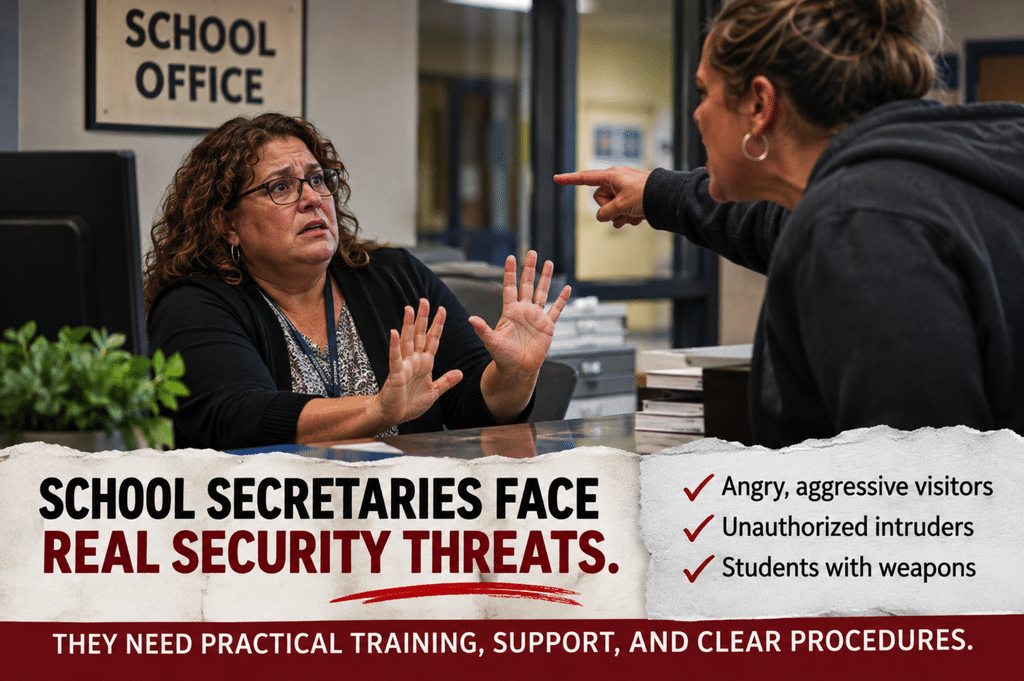
School secretaries and front office personnel are often the first line of defense in school safety and security. They manage visitors, monitor access, deal with upset parents, handle unexpected situations, and serve as critical communications links during emergencies.
Yet they are frequently among the least trained school employees in security, emergency preparedness, and crisis response.
We spend millions of dollars strengthening school entrances, installing secured vestibules, adding cameras, and purchasing access control technology. But how much time and attention are we investing in training the people sitting just beyond those secured doors?
Three Incidents That Should Get School Leaders’ Attention
1. Euclid, Ohio: Angry Parent Confronts Secretary Who Had Brought a Gun to School
In November 2026, an angry parent confronted a school secretary at the Euclid City School District’s Memorial Options Center, an alternative education facility near Cleveland.
According to police reports obtained by Cleveland’s FOX 8 I-Team, a heated confrontation escalated when the parent allegedly threw a glass vase. The secretary, who had brought a personal firearm to work, reportedly placed the loaded gun on her desk.
Perhaps even more troubling was the secretary’s reported statement to police that she had repeatedly told others she did not feel safe working at the school because of inadequate security.
The presence of an unauthorized firearm raises serious legal, policy, and safety concerns. But focusing exclusively on the employee’s conduct risks overlooking another important question: What happens when frontline school employees believe their safety concerns are not being heard or addressed?
Were there clear procedures for managing threatening parents? Had staff received practical de-escalation training? Did employees know when to disengage and summon assistance? Were previously reported safety concerns addressed?
Read the FOX 8 I-Team investigation
2. Phoenix, Arizona: Distracted Front Office, Unsecured Door, and Student Sexual Assault
At Orangewood Elementary School in the Washington Elementary School District, a convicted sex offender entered the school in November 2025 and allegedly sexually assaulted a 10-year-old student.
Newly released security records and video, reported by ABC15 in November 2026, revealed a troubling series of operational failures.
An internal door remained unlocked. The school’s sole front office technician was reportedly distracted by a DoorDash food delivery as the intruder entered. The man walked through school hallways for approximately eight minutes. Another employee questioned him but allowed him to continue despite his inability to produce a school identification badge.
The suspect subsequently took a student into an unlocked classroom, where the alleged sexual assault occurred.
As I told ABC15, these were cascading failures involving an unsecured door, a distracted office employee, and a staff member who questioned an unfamiliar individual but failed to follow through.
This case highlights why effective school security requires more than installing access controls. Employees must understand their responsibilities for maintaining situational awareness, challenging unauthorized individuals, verifying identities, and immediately reporting suspicious activity.
A secured entrance is only as effective as the people and practices responsible for keeping it secure.
Read the ABC15 investigation and findings from the district’s after-action review
3. Cleveland, Ohio: Third Grader With Stolen Gun Bypasses Security Screening
In November 2026, a third-grade student brought a loaded, stolen handgun into Oliver Hazard Perry School in the Cleveland Metropolitan School District.
According to reporting by the FOX 8 I-Team, the child arrived late and was reportedly allowed into the building by office personnel without undergoing required weapons screening.
A representative of the union representing district security officers stated that the security officer was conducting building rounds and reportedly was not contacted by office staff to screen the student.
The district acknowledged that required screening procedures had not been followed.
The incident raises important questions about how school office personnel and security officers coordinate during routine operations, particularly when students arrive late, security personnel are temporarily unavailable, or normal morning entry procedures have ended.
Having a security procedure on paper means little if employees do not understand, consistently follow, and reinforce that procedure.
Read the FOX 8 I-Team investigation
Target Harden Your People, Not Just Your School Entrances
For years, I have urged school leaders to look beyond physical target hardening and focus more attention on what I call target hardening your people.
Secured vestibules, electronic access controls, security cameras, and weapons detection systems may play important roles in school security. But these measures cannot replace trained employees who recognize unusual circumstances, anticipate potential problems, follow established procedures, and exercise sound judgment.
School secretaries are often juggling multiple competing demands: answering phones, helping students, dealing with parents, managing deliveries, communicating with administrators, and monitoring people entering and leaving the building.
That makes situational awareness, active supervision, effective communications, and practical decision-making particularly important.
We cannot expect school secretaries to function as frontline security personnel without providing them the training, authority, support, and clear procedures necessary to carry out their responsibilities.
Nor should we expect them to confront dangerous individuals or manage threatening situations alone.
Thirty Years as a School Secretary. One Safety Training Session.
During a recent school security and emergency preparedness assessment I conducted for a school district, a veteran school secretary shared something that stopped me in my tracks.
She told me that a recent districtwide meeting and safety training session for school secretaries was the first such training she had received in more than 30 years working as a school secretary in that district.
More than three decades. Think about that.
School secretaries have some of the most important daily responsibilities related to building access, visitor management, communications, and emergency response. Yet some spend entire careers with little, if any, meaningful job-specific school security training.
This is a significant blind spot in school safety leadership.
While teachers, administrators, security officers, and school resource officers may receive regular training, secretaries, custodians, cafeteria employees, and other support staff are too often overlooked.
What Should School Secretary Safety Training Include?
Training should go beyond reviewing the school’s emergency operations plan or showing employees how to operate a visitor management system.
At a minimum, school secretaries and front office personnel need practical, scenario-based training addressing issues such as:
- Visitor management and access control: Recognizing unauthorized entry, preventing tailgating, verifying identities, managing deliveries, and maintaining secured office and building doors.
- Situational awareness: Recognizing suspicious behavior, unusual activity, distractions, and circumstances that do not fit normal school routines.
- Angry parents and threatening visitors: De-escalation, setting boundaries, knowing when to disengage, and obtaining assistance before an encounter becomes dangerous.
- Student arrival and departure procedures: Coordinating with security personnel, enforcing late-arrival screening requirements, and managing custody or unauthorized pickup concerns.
- Emergency communications: Knowing when and how to notify administrators, school security, law enforcement, or 911.
- Crisis response responsibilities: Understanding front office roles during lockdowns, evacuations, medical emergencies, parent-student reunification, and other critical incidents.
- Reporting safety concerns: Ensuring employees have reliable ways to communicate concerns and confidence that administrators will take them seriously.
Equally important, school leaders need to examine whether front office employees have realistic workloads, adequate staffing, clear authority, and consistent administrative support to perform these responsibilities effectively.
Training alone cannot compensate for poorly designed procedures, inadequate staffing, conflicting job expectations, or a workplace culture that dismisses employee safety concerns.
School Safety Leadership Must Extend Beyond the Secured Vestibule
These three incidents should prompt school superintendents, principals, and school boards to ask a fundamental question:
When was the last time our school secretaries received meaningful, job-specific training in school security and emergency preparedness?
Not a generic presentation given to all employees. Not an annual reminder to review emergency plans. Not a demonstration of a new security product.
Actual training that addresses the challenging situations school secretaries encounter in their daily work.
School secretaries are not simply administrative employees who answer phones and greet visitors. They are essential participants in a school’s prevention, security, communications, and emergency preparedness operations.
They deserve to be trained, supported, and empowered accordingly.
We cannot continue to spend money hardening school entrances while neglecting to prepare the people responsible for what happens on the other side of those doors.
School Secretary and Support Staff Safety Training
National School Safety and Security Services provides independent, job-specific school safety and emergency preparedness training for school secretaries and front office personnel, custodians and maintenance employees, food service staff, and school bus drivers.
Our training focuses on practical responsibilities, real-world situations, human factors, and operational readiness rather than security products or generic presentations.
Learn more about our School Secretary and School Support Staff Safety Training programs.


Dr. Kenneth S. Trump
President, National School Safety and Security Services
Dr. Kenneth S. Trump is President of National School Safety and Security Services, an independent, non-product-affiliated school safety consulting firm. With more than 40 years of experience in PreK–12 school safety, security, and emergency preparedness, he provides independent analysis and strategic guidance to school leaders nationwide.