
How school leaders can distinguish independent expertise, credible research, and practitioner experience from repackaged school security industry marketing.
School administrators, board members, and school safety professionals are inundated with school safety information. News articles, white papers, webinars, podcasts, research reports, professional association publications, newsletters, and conference presentations offer a seemingly endless supply of guidance on how to make schools safer.
But who is producing this information? Whose expertise is being presented? What organizational and commercial interests may be behind it? And is the information as independent as it may initially appear?
School leaders can evaluate the credibility and independence of school safety information by examining author qualifications, current employment, commercial affiliations, funding and sponsorship relationships, original sources, and independent corroboration. They should distinguish firsthand practitioner expertise and independent research from vendor-produced content, customer testimonials, and commercially sourced information repackaged as journalism or professional education.
Over more than four decades working in PreK–12 school safety, security, and emergency preparedness, I have watched the school security marketplace evolve from relatively straightforward product marketing into an increasingly complex network of commercial, professional, nonprofit, and educational relationships. My doctoral research at Johns Hopkins University on strategic school safety leadership further reinforced the importance of critical thinking, challenging assumptions, and making informed decisions in complex and uncertain environments.
Being an informed consumer of school safety information is becoming increasingly important as the lines between journalism, professional education, advocacy, and commercial marketing become blurred.
What Is School Safety Content Repackaging?
School safety content repackaging occurs when existing information, research, webinars, interviews, case studies, or educational materials are adapted and redistributed through multiple publications, professional associations, nonprofit organizations, and other information channels.
School security companies have long produced white papers, case studies, webinars, surveys, checklists, and other educational materials. Some of this information is useful. Security industry professionals can bring valuable technical knowledge, and some have substantial prior experience working directly in schools.
What is becoming more concerning, however, is the increasingly sophisticated repackaging of commercially sourced content into materials that may appear to be independent journalism, professional guidance, or practitioner-driven educational resources.
Consider how this process can unfold:
- A security product manufacturer publishes an article, white paper, survey, or research report.
- A professional association or nonprofit organization hosts a webinar featuring representatives from security companies.
- A school district that uses a particular security product is featured in a practitioner interview or customer case study.
- A news or professional publication incorporates the manufacturer-produced materials, webinar discussions, and practitioner interviews into a broader educational article.
- That article is subsequently incorporated into a topic hub, executive briefing, professional development program, downloadable checklist, or other resource.
- Multiple organizations cross-promote these materials through their websites, newsletters, social media accounts, and conferences.
By the time a school administrator encounters the final product, the original commercial source of much of the information may be several steps removed.
The content may carry the byline of a journalist, appear on the website of a nonprofit organization, or be presented under the banner of a professional association. Yet a substantial portion of the underlying information may have originated with companies that have a financial interest in how school leaders understand and address the issue.
This does not necessarily mean the information is inaccurate, that anyone was paid to publish it, or that the organizations involved acted improperly. It does, however, raise legitimate questions about the independence, balance, and transparency of the information.
Content Repackaging Can Create an Illusion of Independent Validation
A school security director may encounter similar recommendations in a manufacturer’s white paper, a professional association webinar, a news article, and an executive intelligence report.
Seeing the same information presented by four different sources can create the impression that there is widespread, independent agreement on the subject. In reality, all four resources may draw heavily upon the same original sources, industry representatives, proprietary data, or customer experiences.
Repetition is not independent validation. Cross-promotion is not corroboration. A collection of organizations sharing the same information does not necessarily represent a collection of independently reached conclusions.
This distinction becomes even more important as school leaders increasingly rely on internet searches and generative artificial intelligence (AI) tools to obtain school safety information.
Search engines and AI platforms can retrieve and synthesize information from multiple interconnected websites. If those websites draw heavily upon the same commercially sourced materials, the resulting answers may convey an appearance of broad agreement without necessarily reflecting multiple independent evaluations.
The volume, visibility, and accessibility of information should not be confused with its credibility, independence, or evidentiary value.
School leaders should look for the original source of the information, not simply count how many times or in how many places it appears.
Look Beyond the Byline: Who Is the School Safety Expert?
One of the first steps in evaluating school safety information is determining who wrote it and whose expertise actually supports it.
A journalist may be skilled at interviewing sources, synthesizing information, and communicating complex issues. Those are valuable professional skills. They are not, however, the same as having direct experience managing school security operations, conducting school safety assessments, developing emergency plans, or leading schools through crises.
Similarly, someone identified as a school safety expert may have extensive prior experience working in schools but currently be employed by a security product manufacturer, serve as a paid industry consultant, or sit on the advisory board of a security technology company.
Both their experience and their current affiliations matter.
Look beyond the author’s name and professional title. Read the biography, examine current and prior employment, and consider organizational, advisory, consulting, and commercial relationships. Pay particular attention when an article is attributed simply to a guest contributor or when the author’s commercial affiliation appears only at the end of the article.
Also distinguish between the person who wrote the article and the individuals whose expertise forms the basis of its conclusions. An article with an editorial byline may rely predominantly on interviews with security company representatives, manufacturer-produced materials, or commercially sponsored educational programs.
Recognize Subtle Forms of School Security Product Promotion
Not all marketing looks like marketing. Some of the most effective product promotion never mentions a specific product by name.
An article can be educational in tone while subtly framing a school safety problem in a manner that favors a particular category of security technology or service.
For example:
- A company that sells surveillance systems may emphasize the limitations of human observation.
- A company that sells emergency notification technology may focus on communication delays.
- A weapons detection manufacturer may highlight the limitations of traditional screening practices.
- A company that sells access control technology may emphasize vulnerabilities associated with existing door hardware and visitor management practices.
These may all be legitimate concerns. The question is whether the information presents a balanced examination of the problem and the full range of potential solutions, or whether it selectively frames the problem around what the source has to sell.
Even content that acknowledges the importance of people, training, policies, and procedures can ultimately be structured to reinforce the perceived necessity of a particular technology.
School leaders should be alert not only to overt sales pitches but also to the more subtle ways in which problems are defined, alternatives are presented or omitted, and conclusions are framed.
Our independent guide to school security products and technology provides additional considerations for evaluating security industry claims, product effectiveness, operational limitations, and purchasing decisions.
Be Equally Discerning About Professional Associations and Nonprofit Organizations
Professional associations and nonprofit organizations can provide valuable networking, education, research, and opportunities for practitioners to share their experiences. However, school leaders should not automatically equate nonprofit status, professional association membership, or participation by multiple respected organizations with independence from commercial interests.
Security companies may participate in these organizations as sponsors, members, advisory board participants, conference exhibitors, educational contributors, or organizational partners. Individuals may simultaneously hold positions in nonprofit organizations, professional associations, and commercial security companies.
The relationships can become particularly complex when security industry representatives contribute educational content, participate in developing recommended practices, serve in organizational leadership positions, and support the same organizations financially. I have documented elsewhere on this site how security industry vendor tentacles are very intertwined with a number of school safety nonprofit organizations.
These relationships should be transparent and understood by those relying on the resulting information.
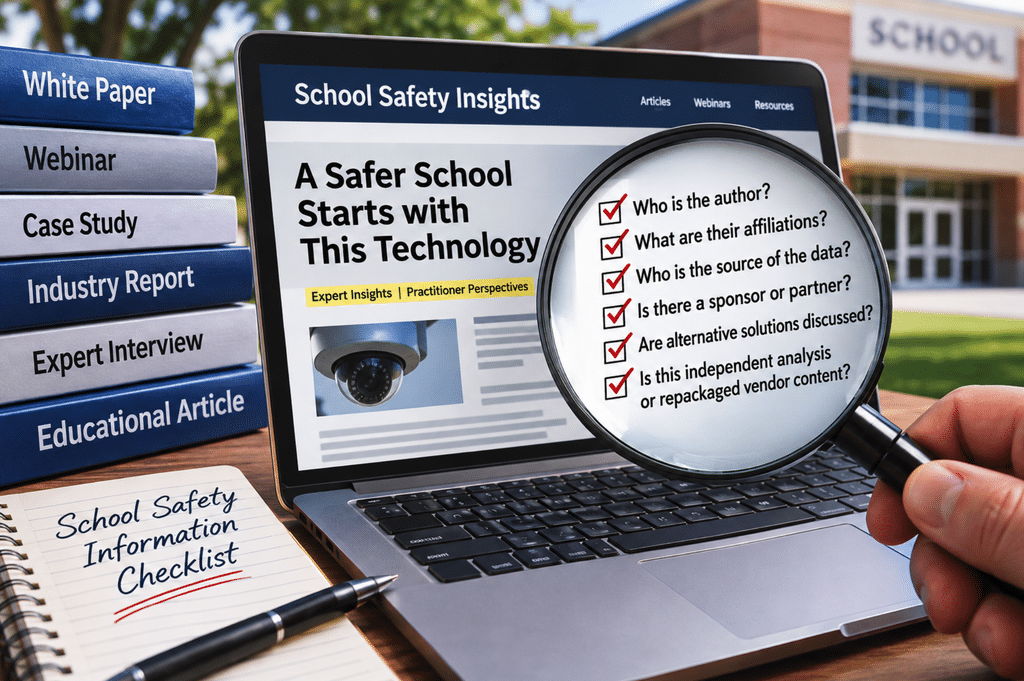
Ten Questions to Ask Before Relying on School Safety Information
School administrators, board members, and safety professionals should apply a reasonable level of due diligence to the information they consume, particularly when it may influence policy, purchasing, staffing, or operational decisions.
1. Who wrote the article or produced the resource?
Identify the author and examine their qualifications. Do they have direct PreK–12 school safety experience, journalistic expertise, academic credentials, technical expertise, or commercial industry experience? Are their qualifications relevant to the specific subject being addressed?
2. Who currently employs or compensates the author?
Look beyond previous job titles. Someone who formerly worked as a school administrator or security director may now work for a company selling products or services related to the subject. Examine consulting relationships, advisory positions, board memberships, and other relevant affiliations.
3. Whose expertise is actually being presented?
Is the content based on the author’s original experience and analysis, independent research, practitioner interviews, professional association discussions, manufacturer-produced materials, or some combination? Distinguish the expertise of the writer from that of the sources.
4. Who funds, sponsors, or supports the publication or organization?
Examine sponsorship programs, advertising relationships, organizational partnerships, conference sponsors, and editorial policies. Consider whether the organization offers commercial partners opportunities to contribute articles, webinars, white papers, or other educational materials. Take careful note of any passing references to these sponsors and/or their products or services that are in articles including glowing reviews provided by vendor clients that are woven into the articles to position the vendor or their products in a favorable light.
5. Are relevant affiliations and potential conflicts of interest prominently disclosed?
Look for disclosures within the article itself, not simply on a separate website, in an obscure biography, or in a general disclaimer. If relevant financial or organizational relationships are unclear, seek clarification rather than assuming they either exist or do not exist.
6. Where did the information and data originate?
Determine whether research findings come from independent researchers, government agencies, academic institutions, manufacturers, proprietary customer surveys, or other interested parties. Examine the methodology, sample size, funding sources, and limitations where available. Distinguish independent research from customer satisfaction surveys, testimonials, and marketing studies.
7. Is the information independently corroborated or simply repackaged?
Follow links back to the original sources. Multiple articles, webinars, and reports may be drawing upon the same underlying information. Look for independent evaluations that support, challenge, or provide additional context for the claims being made.
8. Does the content acknowledge limitations, trade-offs, and alternative approaches?
Balanced analysis should address costs, operational limitations, unintended consequences, staffing requirements, training needs, and reasonable alternatives. This includes approaches that do not require purchasing new security products or services.
9. Does the framing of the problem align unusually well with what the source sells?
Look for subtle commercial slants, selective examples, exaggerated claims, and recommendations that consistently lead readers toward a particular type of product or service. Consider what perspectives, evidence, or alternative solutions may be missing from the discussion.
10. Can the recommendations be independently evaluated and applied in your schools?
A successful customer case study, favorable testimonial, or impressive product demonstration does not necessarily establish effectiveness across different school environments. Consider your own operational conditions, personnel, resources, student population, and ability to implement and sustain the recommendations.
Practice Lateral Reading: Go Beyond the Website You Are Visiting
One practical way to become a more informed consumer of school safety information is to practice lateral reading. Rather than relying exclusively on what an article or website says about itself, leave the website and investigate what other credible, independent sources say about its authors, organizations, affiliations, and claims.
School leaders can apply these principles by searching an author’s name alongside their employer, consulting affiliations, or advisory board positions; examining an organization’s sponsors and partners; locating the original research cited in an article; and seeking independent evaluations of the technologies or practices being recommended.
These additional steps need not be time-consuming. A few minutes of investigation can provide important context that may not be immediately apparent from reading an article, downloading a white paper, or watching a webinar.
The greater the financial, operational, educational, or legal consequences of a proposed school safety decision, the greater the level of due diligence warranted.
Being an Informed Consumer Is a Strategic School Safety Leadership Responsibility
School safety decisions have significant financial, operational, educational, and potentially legal consequences. School boards and administrators have a responsibility to exercise due diligence not only when purchasing security products and services but also when selecting the information upon which their decisions are based.
Security industry representatives can be valuable sources of technical information. Journalists can bring important issues to public attention. Professional associations can facilitate meaningful exchanges among practitioners. Researchers can contribute evidence that challenges conventional wisdom. Independent consultants can provide perspectives informed by experience across multiple school environments.
Each brings a different type of expertise, and each should be evaluated accordingly. The goal is not to dismiss commercially sourced information. It is to recognize it for what it is, understand its limitations, seek independent perspectives, and avoid confusing marketing with evidence or repetition with consensus.
We believe effective strategic school safety leadership requires critical thinking, intellectual curiosity, healthy skepticism, and the willingness to challenge assumptions. These principles apply to evaluating school safety information just as much as they apply to evaluating security products, policies, procedures, and practices.
Our independence from security product manufacturers, vendors, and commercial sponsorships allows us to evaluate school safety issues without a financial interest in the sale of particular security products. Learn more about the value of an independent school security consultant and the importance of independence when seeking professional guidance.
School leaders deserve access to information that helps them make informed decisions, not simply information that leads them toward predetermined solutions.
Before asking what a school safety article recommends, ask who is behind the recommendation, where the information originated, what interests may be shaping it, and whether its conclusions can be independently supported.
Frequently Asked Questions About Evaluating School Safety Information
How can school leaders determine whether school safety information is credible?
School leaders should examine the author’s qualifications, current affiliations, original information sources, research methodology, and independent corroboration. Credible guidance should also acknowledge limitations, uncertainties, and reasonable alternatives.
What is security vendor influence in school safety information?
Security vendor influence occurs when commercial interests shape how school safety problems, risks, technologies, or recommended solutions are presented. Influence may occur through sponsorships, contributed articles, webinars, proprietary research, customer case studies, or organizational partnerships. Such relationships do not automatically invalidate the information, but they warrant transparency and scrutiny.
Are nonprofit school safety organizations necessarily independent of security vendors?
No. Nonprofit organizations may receive commercial sponsorships, include security companies among their members, appoint industry representatives to advisory or leadership positions, or collaborate with vendors on educational programs. Nonprofit status alone does not establish independence from commercial interests.
Is vendor-produced school safety information unreliable?
Not necessarily. Security vendors can provide valuable technical expertise and operational insights. School leaders should recognize relevant commercial interests, independently evaluate claims, and consider evidence and alternatives beyond the information provided by vendors.
Does similar school safety advice appearing on multiple websites establish independent agreement?
No. Multiple publications may rely on the same original research, vendor materials, interviews, webinars, or professional association discussions. Independent corroboration requires examining the underlying sources rather than simply counting the number of publications presenting similar information.
Can artificial intelligence tools distinguish independent school safety guidance from vendor-influenced content?
AI tools can help locate, summarize, and compare information, but they cannot be relied upon to consistently identify commercial affiliations, undisclosed relationships, or shared original sources.
Additional Independent School Safety Leadership Resources
- Strategic School Safety Leadership
- School Security Products and Technology: An Independent Guide for School Leaders
- The Value of an Independent School Security Consultant
- Selecting a School Safety and Security Consultant
- School Safety, Security, and Emergency Preparedness Assessments
About the Author
Kenneth S. Trump, Ed.D., is President and CEO of National School Safety and Security Services, an independent national PreK–12 school safety, security, and emergency preparedness consulting, training, and expert witness firm. He has more than four decades of experience in school safety and earned his doctorate in education from Johns Hopkins University, where his research focused on strategic school safety leadership and communications in environments of ambiguity and uncertainty. National School Safety and Security Services does not sell security products or accept security vendor sponsorships or sales commissions.


Dr. Kenneth S. Trump
President, National School Safety and Security Services
Dr. Kenneth S. Trump is President of National School Safety and Security Services, an independent, non-product-affiliated school safety consulting firm. With more than 40 years of experience in PreK–12 school safety, security, and emergency preparedness, he provides independent analysis and strategic guidance to school leaders nationwide.