
Claims That School Lockdowns Are Legally Obsolete Are Not Supported by the Evidence
Are Schools Legally Required to Use Run-Hide-FIght or Other Multi-Option Active Assailant Response Programs?
For years, school leaders have been told that traditional lockdowns are outdated and that schools face increased legal liability if they do not adopt multi-option active assailant response models such as ALICE or Run-Hide-Fight.
Those are bold claims. They are also claims that deserve careful scrutiny.
Some consultants have gone beyond advocating for multi-option responses and now argue that they represent the legal standard of care for K-12 schools. Yet there is little evidence that courts, legislatures, insurers, or the broader school safety profession have reached that conclusion.
The distinction matters.
School leaders should make emergency preparedness decisions based on sound research, operational realities, and established risk management principles, not marketing claims or unsupported legal assertions.
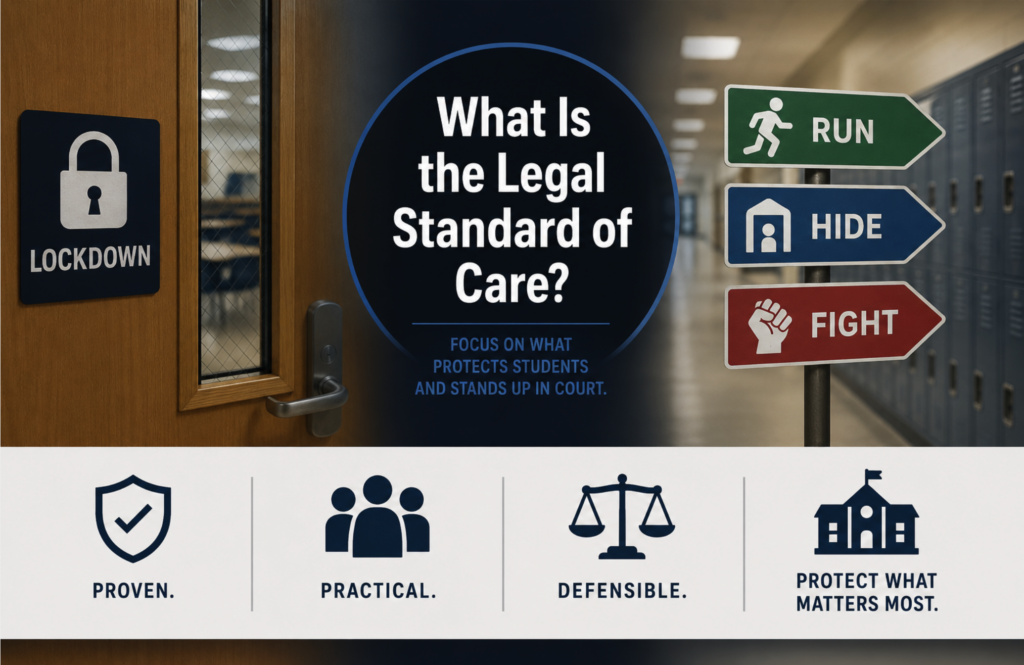
Why Lockdown Remains the Foundation of School Active Assailant Response
Lockdown remains one of the most widely used and operationally practical protective actions in American schools.
While evacuation may be appropriate under certain circumstances during an active assailant event, that does not mean schools should abandon or minimize lockdown as a foundational response.
In fact, when our consultants conduct school safety and security assessments across the country, we may hear districts say they use ALICE, Run-Hide-Fight, or another multi-option program.
But when we ask detailed questions about what staff actually practice, the answer is often revealing.
Most are still primarily training, drilling, and implementing lockdowns.
The terminology may have changed The operational reality often has not.
Do Multi-Option Active Assailant Response Models Create New Liability Risks?
Advocates of multi-option response models emphasize flexibility and individual decision-making during violent incidents.
Those concepts have merit. However, schools are not office buildings or corporate campuses.
They are complex environments filled with young children, substitute teachers, students with disabilities, visitors, and staff with varying levels of training and experience.
Adding multiple response options also adds complexity.
Complexity increases training demands, creates opportunities for inconsistent implementation, and may increase confusion during rapidly evolving emergencies.
A response plan is only as effective as the ability of staff and students to execute it under extraordinary stress.

What Does the Research Say About Lockdowns and Multi-Option Response?
School leaders should also take a close look at the research being used to support sweeping claims about multi-option response programs.
Some of the most frequently cited studies have involved researchers who also had professional involvement with the very training programs being evaluated, raising legitimate questions about potential conflicts of interest and confirmation bias. Independent research should always carry greater weight when evaluating school safety practices.
At the same time, research by Dr. Jaclyn Schildkraut and her colleagues has highlighted the protective value of properly implemented lockdown procedures while emphasizing that lockdown drills and options-based active assailant programs are often incorrectly treated as though they are the same thing. Her work reinforces that lockdown remains an important evidence-based component of comprehensive school emergency preparedness.
Does Adopting a Multi-Option Response Program Reduce Legal Liability?
Perhaps the biggest misconception is the belief that adopting a particular active assailant response program somehow reduces legal liability.
History tells a different story. Schools using multi-option response programs have still faced significant litigation following violent incidents.
In the courtroom, lawsuits rarely focus solely on whether a district selected lockdown or a multi-option model.
Instead, they examine whether school officials acted reasonably based on accepted practices, recognized threats, supervision, communications, emergency planning, and fidelity of implementation issues.
There is no training program that creates immunity from litigation.

Learn More: Why Lockdown Is Still a Legally Defensible School Safety Strategy
The debate should not be framed as lockdown versus multi-option response.
The real question is whether schools are implementing emergency procedures that are practical, consistently trained, operationally achievable, and legally defensible.
If your district is evaluating active assailant response policies, this is a conversation worth having before assuming that newer always means better.
Our new in-depth analysis examines the legal claims, research, operational realities, and liability issues surrounding this important debate. It also explains why lockdown remains a foundational school safety strategy and why assertions that multi-option response has become the legal standard of care are not supported by the available evidence.
Dr. Kenneth S. Trump is President of National School Safety and Security Services
National School Safety and Security Services
Experts You Can Trust!
Connect with Dr. Ken on Linkedin: www.linkedin.com/in/kentrump/
Follow Dr. Ken on X(Twitter) @safeschools
Visit and “Like” Our Facebook School Safety News Channel at: www.facebook.com/schoolsafety