
Claims That School Lockdowns Are Legally Obsolete Are Not Supported by the Evidence
Some school safety consultants and active shooter trainers – many who never worked in PreK-12 schools – argue that schools face increased legal liability if they rely on lockdown procedures and that multi-option active assailant response programs have become the modern legal standard of care for elementary and secondary schools.
That is a bold claim.
It is also a claim that school leaders, attorneys, insurers, and risk managers should approach with caution.
There is an important distinction between acknowledging that evacuation may sometimes be appropriate during an active assailant event and claiming that multi-option response models are now the legally required approach for schools.
The evidence simply does not support that conclusion.
While some practitioners continue to advocate for that position, there remains no clear legal precedent establishing Run-Hide-Fight, ALICE, or other multi-option programs as the required standard of care for K-12 schools.
What does exist is decades of widespread reliance on lockdown procedures and extensive experience demonstrating their value as a protective action during school emergencies.
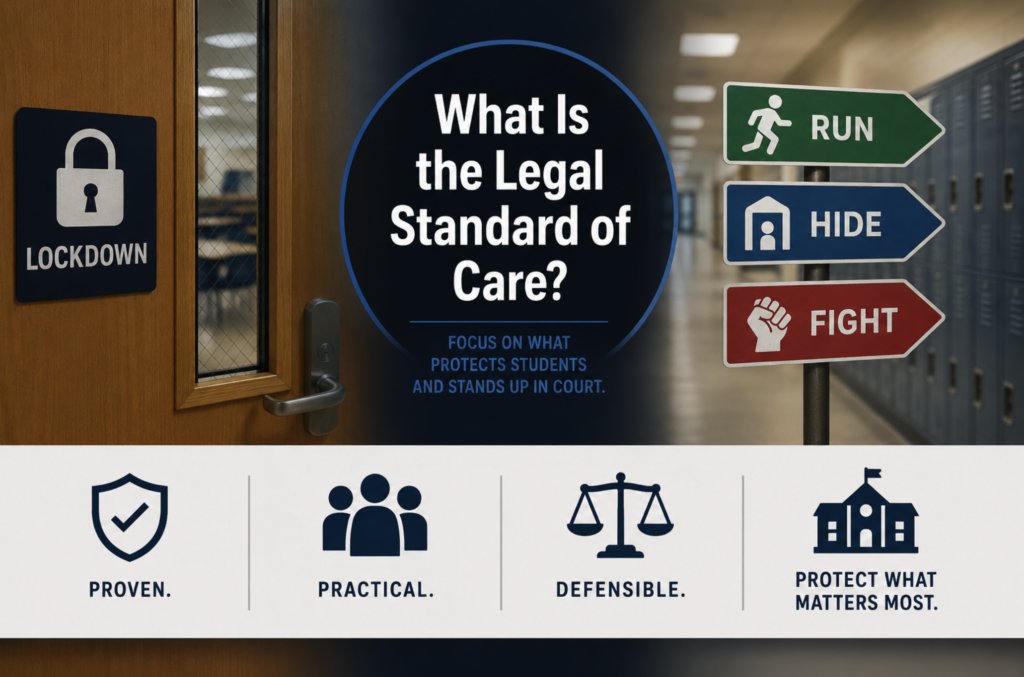
What Is the Legal Standard of Care for School Active Assailant Response?
One of the most problematic aspects of the argument is the assumption that a tactic becomes a legal standard simply because some experts advocate for it.
That is not how standards of care are established.
Courts generally evaluate whether actions were reasonable under the circumstances based on accepted professional practice, applicable policies, training, available information, and foreseeable risks.
The existence of competing approaches does not automatically elevate one approach into a legally required practice.
Thousands of schools continue to use lockdown as their primary active assailant response strategy. Numerous state agencies, law enforcement organizations, emergency management professionals, and school safety practitioners continue to support lockdown as a foundational protective action.
If multi-option response models truly represented the established legal standard of care, we would expect to see clear court rulings, statutory requirements, or broad professional consensus among school administrators, other educators, and school safety professionals.
Those indicators do not exist.

What School Security Assessments Reveal About Multi-Option Training
The theory behind multi-option response often differs from actual practice in schools.
When conducting school security assessments, we have encountered districts that claim they use Run-Hide-Fight, ALICE, or similar multi-option approaches.
But when discussions move beyond what they have written in their school emergency plans and what they call it in their verbiage, a different reality often emerges.
Answers to our questions such as these are revealing:
• Tell us what a Run-Hide-Fight (or other multi-option drill) looks like here at your school?
• Have you trained your children to run? Have your trained them to fight? Have you practiced these?
• How do staff determine whether it is safer to evacuate than lockdown?
• What are your qualifications as a school administrator to train staff and students when and how to run and to fight?
• How are students with disabilities accommodated? Why are they treated differently by only locking down while your self-imposed standard is for other students to also run or fight?
• How frequently are decision-making skills practiced under realistic conditions?
The answers are eye-opening:
• We “opted out” of the fight part of Run-Hide-Fight (or the “Counter” part of ALICE).
• We tell the kids they can run but we never really practiced it or did anything besides tell them they can run.
• Our special needs classes just do lockdowns. Everybody else does Run-Hide-Fight (or ALICE).
• If the teachers think it is safe to leave a secured classroom, we tell them they can decide whether or not to run. But we haven’t really discussed how to make those decisions.
• We don’t have any way of really accounting for students if they run, but we will have to figure that out after they really have to do it in a real emergency.
In the vast majority of cases, schools claim they are using Run-Hide-Fight or ALICE, but in reality they are practicing lockdown procedures.
The terminology may have changed. The posters may be different. The emergency plans and training materials may reference multiple options.
Operationally, however, lockdown remains the response most staff understand, practice, and are prepared to implement.
That raises a legitimate question:
If schools are not consistently training and practicing multi-option responses with fidelity, does adopting the model they claim in name increase potential liability rather than reduce it?
The Origin of Run-Hide-Fight and Subsequent Guidance Paints a Picture of Restraint on School Drills
Run, Hide, Fight is a program that originated in Houston focused on businesses. In fact, the city listed the program on its web site as their registered trademark. A video produced by the city with funding from the U.S. Department of Homeland Security spread like wildfire years ago. The Department of Homeland Security, along with many other homeland security state agencies, subsequently pointed to the program as their model for active shooter responses.
The Houston model, however, was designed for the workplace, not for schools. In a July 9,2014, Emergency Management article in govtech.com, the chief policy officer for the Houston Mayor’s office stated that the “fight” component of Run, Hide, Fight video is not a component that is transferable to school settings.
Furthermore, the former director of the U.S. Department of Education’s Office of Safe and Healthy Students, David Esquith, was attributed in a Sept. 27, 2015, Charleston (W.Va) Gazette-Mail news story as saying his department did not recommend students fight shooters, even as a last resort and even if they are of high-school age.
This backing away from the “fight” or “counter” components of options-based training has grown in recent years with concerns about the potential psychological trauma of some drills. It has been raised recently in a study by the National Academies of Sciences, Engineering, and Medicine (NASEM). A growing number of states have also enacted laws to put constraints on excessive school active assailant drills to protect students from harm caused by drills that cross the line of “do no harm” and risk causing trauma to children.

The Liability Risks of Multi-Option Active Assailant Response in PreK-12 schools
Advocates often focus on the potential advantages of evacuation. Those advantages end up being real under certain circumstances
But what is discussed less often are the challenges and liabilities associated with implementation.
Unlike adult workplaces, schools contain young children, students with disabilities, substitute teachers, visitors, and staff with varying levels of training and experience. And in PreK-12 school settings, educators have long been held to the standard of acting in loco parentis, a legal term meaning educators act in the place of the parent.
Active assailant incidents unfold rapidly. Decision-making occurs under extreme stress. Adding multiple response options can increase uncertainty, hesitation, confusion, and inconsistent actions
Most educators are not wired for making these types of decisions as would be a police or military professionals.
A response model is only as effective as its implementation. The more complex the model, the greater the training burden and the greater the risk of inconsistent execution.

Does Research Prove Multi-Option Response Is Superior?
Supporters frequently cite research supporting multi-option response programs. School leaders should examine those research claims carefully.
Some of the most significant independent academic recent research on school emergency response procedures has actually focused on lockdowns rather than multi-option models. Research by Dr. Jaclyn Schildkraut and her colleagues has found that lockdown drills can improve preparedness, increase familiarity with emergency procedures, build skill mastery, and enhance participants’ ability to correctly implement lockdown protocols.
Her work examining school violence incidents has also found that lockdowns can have a protective effect, helping reduce injuries and fatalities when properly implemented and supported by training. Dr. Schildkraut’s findings suggest that the value of lockdown is not merely theoretical but is grounded in both research and real-world incident analysis.
Contrast that with some supporters of multi-option response models who point to one single study supporting their position. That study deserve scrutiny. This more frequently referenced research was been conducted by individuals who were actively involved in developing, promoting, or delivering the very training programs being evaluated.
That may not automatically invalidate the findings. It does, however, raise legitimate questions regarding objectivity, confirmation bias, and potential conflicts of interest.
Independent evaluation matters. School safety decisions should be guided by objective evidence, not advocacy.
Schools Using Multi-Option Response Have Still Faced Major Lawsuits
Another overlooked reality is that schools using multi-option response models have not been immune from litigation.
In fact, veteran school safety expert Michael Dorn has noted that districts implementing these approaches have nevertheless faced significant lawsuits and settlements following school violence incidents.
No active assailant response model creates legal immunity.
When litigation occurs, attorneys typically also focus on broader issues, such as:
• Threat assessment and management leading up to the incident
• Supervision failures
• Security procedures
• Communication breakdowns
• Emergency preparedness
• Policy implementation
• Training
• Failure to follow established protocols
…and other fidelity of implementation issues.
The notion that adopting a particular active assailant response program automatically reduces liability is unsupported by available evidence.

Why Lockdown Remains a Defensible School Safety Strategy
None of this means evacuation should never occur. Nor does it mean staff should be prohibited from making life-saving decisions when circumstances clearly warrant them.
But that is very different from declaring lockdown outdated, unreasonable, or legally indefensible.
Lockdown remains one of the most widely understood, widely practiced, and operationally achievable protective actions available to schools.
It provides a simple and familiar response that can be implemented quickly across diverse educational environments.
Most importantly, lockdown and sound judgment are not mutually exclusive.
Schools can teach flexibility without abandoning the value of lockdown procedures.

The Bottom Line: Multi-Option Response Is Not the Established Legal Standard of Care for PreK-12 Schools
The debate should not be framed as lockdown versus multi-option response.
The real question is whether schools are implementing practices that can be trained effectively, executed consistently, understood by staff and students, and defended as reasonable under the circumstances.
Claims that ALICE, Run-Hide-Fight, or other multi-option active assailant response models represent the legal standard of care go well beyond the available evidence.
If multi-option response models truly represented the established legal standard of care, we would expect to see clear court rulings, statutory requirements, or broad professional consensus and common practice among school administrators, other educators, and school safety professionals.
Those indicators do not exist.
Lockdown remains legally defensible, operationally practical, and widely utilized throughout American schools.
Before school leaders are persuaded that litigation demands abandoning lockdown-focused approaches, they should ask a simple question:
Where is the legal precedent establishing that claim?
To date, the answer remains the same:
It has not been clearly established.
Dr. Kenneth S. Trump is President of National School Safety and Security Services
National School Safety and Security Services
Experts You Can Trust!
Connect with Dr. Ken on Linkedin: www.linkedin.com/in/kentrump/
Follow Dr. Ken on X(Twitter) @safeschools
Visit and “Like” Our Facebook School Safety News Channel at: www.facebook.com/schoolsafety