

When school leaders discuss #schoolsafety and #schoolsecurity, the conversation often centers on active shooters, access control, weapons detection systems, panic buttons, and other visible security measures.
Yet one of the most complex and frequently overlooked aspects of school emergency preparedness is far less likely to make headlines:
Parent-student reunification following a school evacuation.
Many school districts have designated evacuation and reunification sites identified in their emergency operations plans. The challenge is that what appears workable on paper may not hold up under real-world conditions.
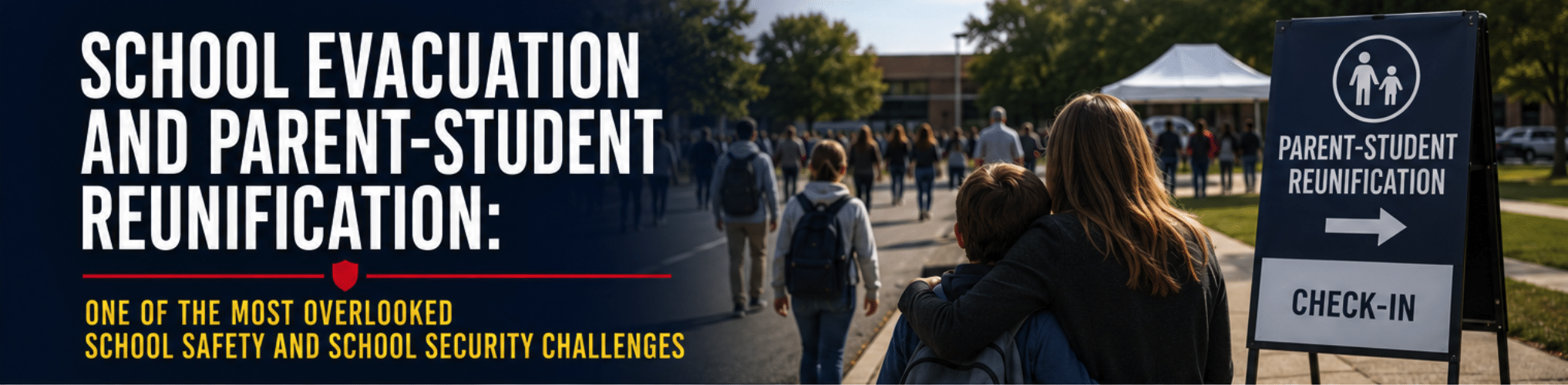
#Schoolleaders may identify a nearby church, community center, or other facility as a reunification site. But have administrators actually walked the route? Evaluated traffic flow? Considered severe weather conditions? Assessed accessibility concerns? Determined whether the location can realistically accommodate hundreds or even thousands of students and parents?
These practical questions often reveal planning gaps that are not apparent when reviewing a written plan.
Research and emergency planning literature have long noted that parent-student reunification is one of the most frequently overlooked or underdeveloped components of school crisis planning. Poorly executed reunification efforts can create confusion, delays, accountability problems, and unnecessary stress for students, parents, and staff.

Reunification is not simply a logistics exercise. It is a human challenge involving frightened students, anxious parents, emotional staff, media attention, social media rumors, and coordination with first responders. Schools that focus solely on moving students from one location to another often underestimate these human factors.
Effective parent-student reunification also depends heavily on communication. Parents need timely and accurate information regarding where to go, when to go, what identification may be required, and what procedures will be followed. Schools that fail to communicate clearly during an emergency can unintentionally contribute to traffic congestion, confusion, and operational challenges at both the school and reunification site.
The strongest school safety plans go beyond compliance. They involve physically visiting reunification sites, walking evacuation routes, coordinating with community partners, identifying backup locations, and testing assumptions through exercises and drills.
Ultimately, the goal is not simply to have a reunification site listed in an emergency plan. The goal is to have a reunification process that works when students, parents, staff, and first responders need it most.
A plan in a binder is not the objective. A plan that works is.
For school leaders, evacuation and parent-student reunification should not be viewed as secondary considerations in emergency preparedness planning. They are among the most visible and emotionally charged aspects of emergency response. When handled effectively, they can help build confidence and trust. When handled poorly, they can quickly expose weaknesses in planning and execution.
Read the full resource article:
School Evacuation and Parent-Student Reunification: One of the Most Overlooked School Safety and School Security Challenges
Dr. Kenneth S. Trump is President of National School Safety and Security Services
National School Safety and Security Services
Experts You Can Trust!
Connect with Dr. Ken on Linkedin: www.linkedin.com/in/kentrump/
Follow Dr. Ken on X(Twitter) @safeschools
Visit and “Like” Our Facebook School Safety News Channel at: www.facebook.com/schoolsafety