

School safety discussions often focus on active shooters, weapons detection systems, panic buttons, visitor management systems, and other high-profile security measures. Yet one of the most challenging, disruptive, and consequential school safety functions receives far less attention:
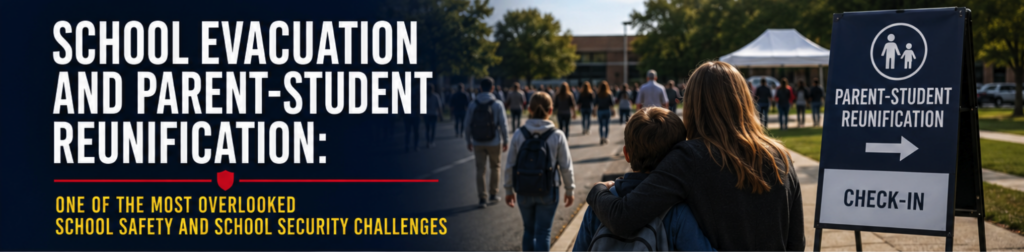
School evacuation and parent-student reunification.
In our experience working with school districts nationwide, few areas of emergency preparedness are more likely to expose planning gaps, operational weaknesses, and leadership challenges than a large-scale evacuation requiring reunification of students with parents or guardians.
School Safety Planning Gap: Why Parent-Student Reunification Gets Overlooked
In our school safety and emergency preparedness assessments nationwide, we have become increasingly concerned about school evacuation and reunification planning.
Far too often, school administrators and their teams identify evacuation locations and reunification sites on paper without fully considering the practical realities of moving hundreds or even thousands of students and staff to those locations under stressful conditions.
Many school teams have never physically walked the routes. Many school safety teams and school staff have never visited the designated sites. Many have never evaluated whether their plans are realistic under actual emergency conditions.
As a result, what looks good in a written emergency operations plan may prove far more difficult when tested in the real world.
School Evacuation and Reunification Planning: The Reality Check
Consider a common scenario: A school’s safety and administrative team designates a nearby church, community center, or other facility as an evacuation and reunification site. The location appears reasonable when viewed on a map.
However, we find that important questions often go unasked:
- Have school administrators actually walked the route?
- How long would it take to move students there?
- What happens during severe weather?
- What if students have mobility limitations?
- What if staff members have mobility limitations?
- What if the route crosses major roads or traffic hazards?
- What if parents arrive before students?
- What if the site lacks sufficient parking, restrooms, shelter, or communications capability?
The answers to these and many other questions often reveal significant vulnerabilities.

Why Just Naming a Walking Distance on Paper Is Not a School Emergency Preparedness Strategy
An odd but emerging pattern we find is that rally points are used interchangeably in terminology as evacuation sites.
Rallying points are often identified for outside locations when the school is evacuated but students remain on campus. Walking distance evacuation sites, however, are where students and staff relocate off campus and reunification processes are typically activated. The two are generally separate things, yet we find school officials referring to rallying points as being evacuation sites – hard stop.
One of the most common assumptions we also encounter is that a reunification site is acceptable simply because it exists within walking distance and school administrators can check the box that they have identified a site.
Walking distance alone is not a meaningful planning effort. A more useful question is:
Can hundreds or thousands of students, along with school staff, be moved safely, efficiently, and realistically to this location under actual emergency conditions?
A route that appears manageable on a sunny afternoon may become far more challenging during:
- Heavy rain
- Snow and ice
- Extreme heat
- Darkness
- Traffic congestion
- Community panic
- Media presence
- Law enforcement operations
We are seeing school leaders given some well-intended, but questionable and downright bad, advice on reunification sites. One district was told by local first responders to use nearby public parks as reunification sites. Really? In the rain and other bad weather, without Internet access, and easily accessible for someone to grab students and go?
In another school district, a building team engaged in a vibrant discussion about the church down the street that they identified as an evacuation site. The conversation went on for minutes and was very engaging. And then, one quiet staff member gently spoke up and said: “That church closed two years ago.”
Why does this happen? It’s not because principals and other school leaders do not care. They do. But it’s typically because they are challenged by the only thing they have less of than money: Time!
Emergency plans should account for real-world conditions, not ideal conditions.

School Safety Plans vs. Operational Reality During Emergencies
One of the biggest dangers in school safety planning is confusing documentation with preparedness. This is becoming more evident as states and other organizations provide school leaders with school emergency plan templates with dozens of “fill in the blank” pages.
Boxes get check and plans gets submitted. A plan may satisfy a compliance requirement. But that does not mean it will work.
School leaders should ask questions such as:
- Have we physically visited our evacuation and reunification sites?
- Have we walked the routes with key personnel?
- Have we evaluated the sites during different weather conditions?
- Have we considered students with disabilities and medical needs?
- Have we coordinated with law enforcement, fire, EMS, and transportation personnel?
- Have we identified backup locations if the primary site becomes unavailable?
- Have we tested portions of the plan through tabletop exercises or drills?
- Have we identified and tested tools for communicating internally as a staff and externally with parents and community partner agencies?
If the answer to these questions is “no,” then the district may be operating on assumptions rather than preparedness.
Parent-Student Reunification Is a Human Challenge, Not Just a School Security Logistics Challenge
Parent-student reunification is not simply about moving students from one place to another.
It involves managing:
- Frightened students
- Anxious parents
- Emotional staff
- Media inquiries
- Social media rumors
- Traffic management
- Accountability systems
- Documentation requirements
- Law enforcement and other first responder coordination
A reunification event can quickly become chaotic if these factors have not been anticipated and practiced.
The human side of reunification is often far more difficult than the physical movement of students.
Questions School Leaders Should Ask About School Evacuation and Reunification
School administrators should challenge their teams to answer basic but critical questions such as:
- What criteria and threat assessment guidelines will we use when considering to evacuate our school?
- Have we physically visited every evacuation and reunification site?
- Have we walked designated routes?
- Are we relying on assumptions rather than observations?
- Do we have multiple evacuation options?
- Have we evaluated weather-related challenges?
- Can our sites realistically accommodate the number of students and parents involved?
- How will our presence impact those at the evacuation and reunification site?
- Have we coordinated plans with first responders and evacuation site owners?
- How do we mobilize our transportation department bus response and what is a reasonable response time to fully evacuate via buses to a reunification site outside of the area where our school is located?
- Have we exercised the plan beyond simply discussing it in meetings?
- How are going to communicate internally as leadership and as a school staff, and then externally with parents and out community partner agencies?
These are just a few of many areas to discuss when getting “in the weeds” of planning!

Moving Beyond Compliance to Effective School Safety and School Security Preparedness
Effective school safety planning requires more than checking boxes and maintaining binders. It requires leaders to move beyond compliance and into operational reality.
The strongest emergency plans are not necessarily the longest plans. In many situations, less is more. The best plans may be those that have been tested, questioned, challenged, and validated through practical experience.
When it comes to school evacuation and parent-student reunification, school leaders should spend less time looking at maps and more time walking routes, visiting sites, and stress-testing assumptions.
Effective School Evacuation and Parent-Student Reunification Requires School Leaders and Their Teams Getting into the Weeds of Planning
Because during a real emergency, the question will not be whether the plan existed. The question will be whether the plan actually worked.
School safety is not about what looks good on paper. It is about what works in practice.
For school leaders, emergency preparedness is more than developing evacuation procedures and identifying reunification sites. It is about validating that those plans can be executed under the most challenging circumstances, when students, staff, parents, and first responders are depending on them.
The strongest school safety and school security programs recognize a simple truth:
A reunification site listed in a binder is not the goal. A reunification plan that works is.
Evacuation and reunification processes will be chaotic no matter how well you are prepared. “Organized chaos” is better than “Unorganized chaos.”

Dr. Kenneth S. Trump is President of National School Safety and Security Services, an independent school safety consulting firm providing school safety assessments, school security evaluations, emergency preparedness reviews, strategic school safety leadership consultations, and litigation expert witness services for PreK-12 schools and attorneys nationwide.
To learn more about this topic or our services, contact Ken: ken@schoolsecurity.org