
What is school security leadership? Effective school security leadership combines ethics, independence, sound judgment, competence, transparency, strategic thinking, and the courage to make difficult decisions in the best interests of students, staff, and schools.
School security leadership is more than managing security technology, writing emergency plans, conducting drills, or responding to the latest school safety headline. It is about leading people, making defensible decisions, managing competing pressures, and maintaining public trust.
I was struck by numerous public and private messages following some of my recent articles examining relationships among school security vendors, consultants, associations, nonprofits, and others operating in the school safety space.
One comment stood out:
“This industry has lost its moral compass.”
Another asked:
“What happened to ethics in the school security industry?”
Those are uncomfortable questions. But they are good and timely questions to explore.
School Security Has Become Big Business
When I entered this work more than four decades ago, before school security was even remotely recognized as a professional field, there was no massive school security marketplace.
There were few people calling themselves school security consultants. School leaders were not bombarded with technology pitches. Vendors exhibited in conference halls rather than buying their way onto educational stages. Private equity firms were not looking at school security companies as investment opportunities. Vendor-supported nonprofits and coalitions were not positioning themselves as independent voices while having tentacles of companies selling products to schools.
Things began changing after Columbine. Target-hardening (think: physical security – products and technology) commercialization accelerated after Sandy Hook and continued following Parkland, Uvalde, and other tragedies.
Today, school security is estimated to be a multi-billion dollar business. There is nothing inherently wrong with companies making money by providing legitimate products and services to schools. Schools need cameras, communications systems, access controls, locks, radios, software, and other products.
The problem begins when selling becomes disguised as educating, marketing becomes disguised as research, sponsorship becomes disguised as expertise, or financial relationships are not clearly disclosed.
When School Security Relationships Cross the Line
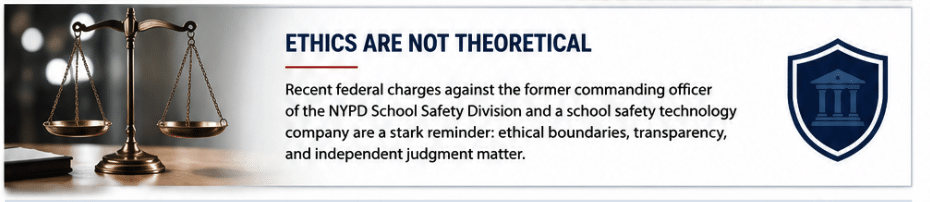
The need for ethical boundaries is not theoretical.
In February 2026, federal prosecutors charged the former commanding officer of the NYPD School Safety Division, and the founder and CEO of Florida-based SaferWatch, with bribery-related offenses involving the company’s efforts to sell its school safety technology to New York City.
Federal prosecutors allege the NYPD commanding officer received tens of thousands of dollars in cash and benefits while using his position to help the company obtain government business, including a no-bid pilot and an agreement allegedly valued at more than $11 million. The technology included mobile panic-alert capabilities marketed for schools and other settings. Both men were charged, and the allegations remain to be proven in court.
The U.S. Attorney’s Office allegations and indictment provide a sobering example of why school security leaders need clear ethical boundaries with companies seeking their business.
This case does not mean vendor relationships are inherently improper. They are not.
It reminds us why disclosure, competitive procurement, arm’s-length relationships, ethical standards, and independent judgment matter.
What Are 7 Characteristics of Effective School Security Leadership?
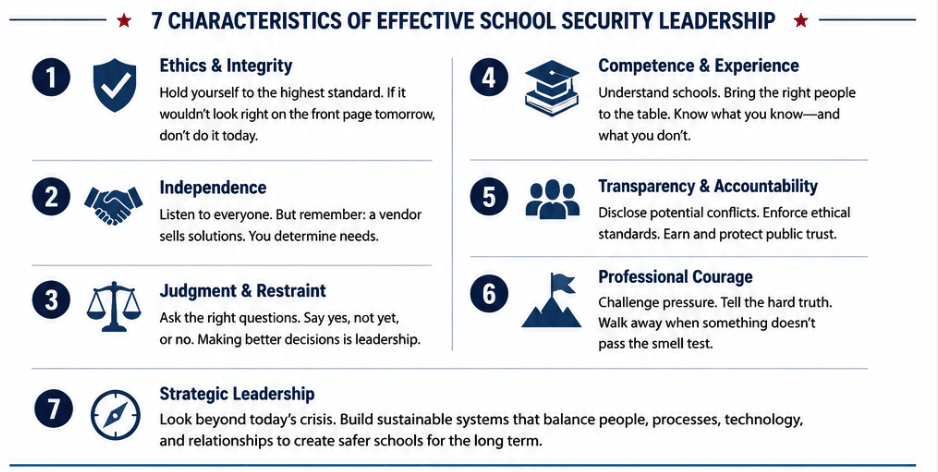
True school security leadership starts with integrity, but it does not end there. Let’s take a look at seven characteristics of effective school security leadership:
1. Ethics and Integrity
School security leaders are entrusted with children’s safety, public money, confidential information, and significant influence over decisions that can cost thousands or millions of dollars. That demands a high standard of integrity.
School districts should have clear policies addressing gifts, travel, meals, vendor-sponsored events, outside employment, consulting relationships, conflicts of interest, and disclosure requirements. But policies cannot substitute for personal judgment.
A useful test is simple: Would I be comfortable if this relationship, gift, trip, dinner, sponsorship, or financial arrangement appeared publicly in tomorrow’s headlines?
If the answer is no, you may want to reconsider it.
I recall early on in my school security leadership experience in a district when someone in a powerful position who was associated with people and things that did not pass the ethical (or legal) smell test told me, “You need to learn to be a team player.” My response: “I can be a team player when appropriate, but it won’t be on a prison courtyard team.”
I also recall meeting a now-long retired superintendent for a dinner meeting while in town working on a project in her district many years ago. When we began to order our meals, she immediately said, “Separate checks. I’m not going to prison or be in the headlines for a dinner and coffee.”
She would have been well within the parameters of her board’s policy had I paid for our dinners. But she chose not to go anywhere close to doing anything that might even appear improper.
I had always respected her and this was one small illustration of why I did. She walked the walk. She also retired with not only a strong academic leadership career, but also a good name and reputation.
2. Independence
School security leaders should listen to vendors, educators, law enforcement, emergency managers, mental health professionals, students, parents, attorneys, insurers, researchers, and others. But they should not become extensions of any of them.
A security vendor’s job is to sell their product, technology, and/or service. A school security leader’s job is to determine whether the school actually needs it and if it would actually work in a school on a day-to-day basis.
There are many very good people who are career security vendors. They are experts in their products and often beyond that in their part of the industry. And they still are also experts at selling (or at least most try to be).
Professional relationships with vendors should remain just that: Professional. They should be professional, transparent, and appropriately at arm’s length.
3. Judgment and Restraint
School security leadership is not measured by how much security technology a district buys.
Sometimes leadership means saying yes. Sometimes it means not yet. And sometimes it means no.
After a frightening school security incident, boards want answers, parents want reassurance, and vendors arrive with solutions. Strong school security leaders slow the process down enough to ask:
- What problem are we actually trying to solve?
- What evidence supports this security product or technology?
- What unintended consequences could it create?
- What will it cost to sustain?
- What people, policies, procedures, training, and supervision will make it work?
Doing more is not automatically school security leadership. Making better decisions is.
4. Competence and Experience
School security leadership requires understanding schools, not simply understanding security.
Schools are complex organizations and systems involving children, educators, parents, boards, administrators, first responders, attorneys, community groups, and political pressures.
A technically sound security recommendation can fail if the person making it does not understand school culture, child development, operations, communications, implementation, community dynamics, budgets, and school politics.
Experience matters. So does recognizing what fits for your school, your district, and your community.
5. Transparency and Accountability
Public confidence depends heavily upon transparency.
School boards should establish written ethical standards and conflict-of-interest policies applicable from the boardroom throughout the organization. Employees should know the expectations, receive appropriate training, and understand the consequences for violations. Districts should periodically review compliance rather than waiting for controversy to expose problems.
Relationships with vendors, consultants, nonprofits, associations, and other outside organizations that could reasonably influence school security recommendations should be appropriately disclosed.
Disclosure does not automatically mean a relationship is improper. It allows others to evaluate the relationship for themselves.
6. Professional Courage
One of the least discussed characteristics of school security leadership is courage. Not tactical courage. Professional courage.
- The courage to tell a superintendent that a popular proposal is a bad idea.
- The courage to tell a school board there is no quick technological fix.
- The courage to challenge exaggerated claims following a tragedy.
- The courage to resist pressure to make a quick purchase simply because everyone wants to do something.
- And the courage to walk away from a vendor, consultant, conference, organization, or opportunity when something does not pass the smell test.
I’ve been outspoken and candid throughout my career. I don’t sell security products or technology. Security vendors mistakenly suggest I feel they are competing with me for “marketshare,” but they fail to realize that we are not even in the same type market space. More importantly, when they come out talking “marketshare” it sends off alarms where their minds are: Owning more of the market. (Thanks for making my points for me.)
I’ve walked away from speaking opportunities when conferences crossed lines I was unwilling to cross. I pick and choose my work and turn down opportunities that aren’t a good fit.
I’ve never built my business by kissing behinds or withholding my professional opinions, recommendations, and critical analysis of issues. That has undoubtedly cost me money over my 40+ years in school security because I don’t travel in vendor-influenced circles, but it has brought me work with those school leaders who truly value an independent, trusted advisor with no hidden agendas or shadow affiliations. It isn’t something I’m going to change now.
Your credibility is worth more than the next contract when you are a school security consultant.
Your credibility is also worth more than a dinner, trip to a conference, advisor title, appearance in a vendor info-mercial, or strokes to your ego when you are a school security leader.
7. Strategic School Security Leadership
Perhaps the biggest difference between managing school security and leading school security is the ability to think strategically. Reactive leaders chase incidents. Strategic school security leaders build and navigate systems.
They look beyond today’s headline, product demonstration, grant opportunity, mandate, or community pressure and ask where the district needs to be three, five, or ten years from now.
That means balancing security technology with people, policies, procedures, training, supervision, communications, student supports, emergency preparedness, and relationships with first responders.
It also means thinking about sustainability. Who will maintain the technology? Who will train new employees? How will procedures survive leadership turnover? Are security practices actually being implemented consistently? How will effectiveness be measured?
Most importantly, strategic school security leadership recognizes that school safety is an ongoing process, not an event and not a collection of products.
The goal is not to accumulate security measures. The goal is to build organizational capacity to prevent, prepare for, manage, and recover from safety threats and emergencies. And you do that in part by building credibility and trust as a school security leader.
School Security Leadership Is Ultimately About Trust
Policies, procedures, technology, and training matter. But leadership determines how all of them are used.
School safety leaders are entrusted with children’s safety, taxpayer dollars, public confidence, and sometimes life-and-death decisions. That responsibility demands more than technical knowledge or a title on an organizational chart.
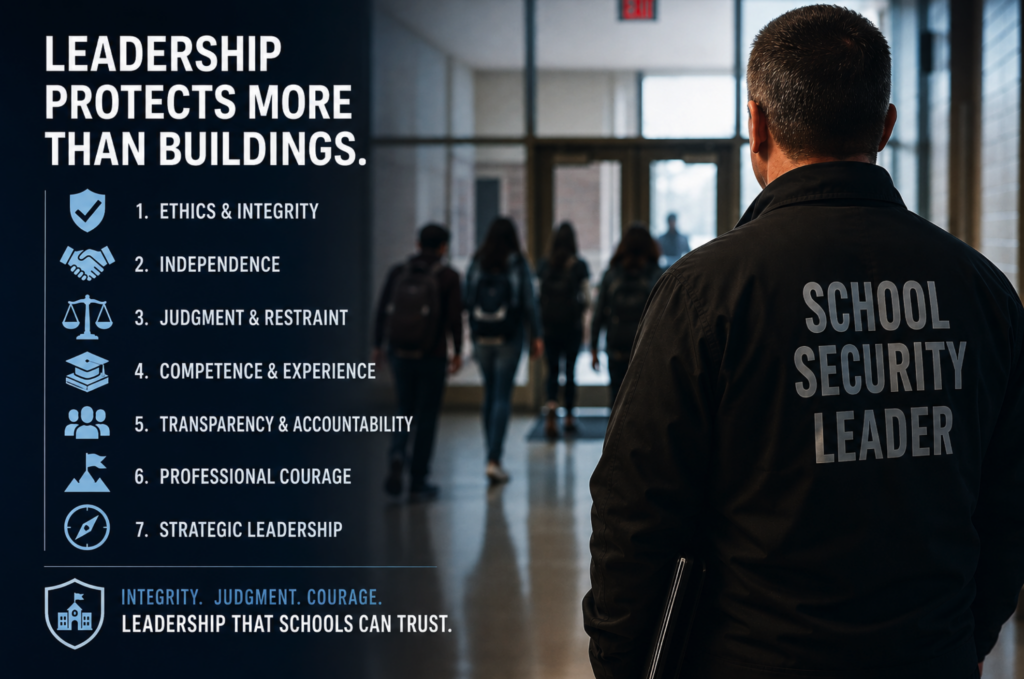
Effective school security leadership requires ethics and integrity, independence, judgment and restraint, competence and experience, transparency and accountability, professional courage, and strategic thinking.
It requires leaders who can withstand pressure, challenge assumptions, separate needs from wants, make defensible decisions, and keep the focus on people rather than products.
School security leadership is ultimately about trust: earning it, protecting it, and having the judgment and courage to lead when it matters most.
Also see my article on: School Security Ethics: Conflicts of Interest, Vendor Influence, and Ethical Leadership in K-12 School Safety
Dr. Kenneth S. Trump is President of National School Safety and Security Services
National School Safety and Security Services
Experts You Can Trust!
Connect with Dr. Ken on Linkedin: www.linkedin.com/in/kentrump/
Follow Dr. Ken on X(Twitter) @safeschools