
As the school security industry has grown into a multi-billion-dollar marketplace, the ethical lines separating school leaders, security directors, nonprofit organizations, conference organizers, and school security vendors have become increasingly blurred. The result is growing concern over conflicts of interest, vendor influence, procurement integrity, and maintaining independent school security leadership.
School safety depends on trust.
Parents trust school leaders to make decisions based on what is best for children. School boards trust administrators to spend taxpayer dollars wisely. Communities trust school security professionals to provide objective advice that is free from commercial influence.
That trust is becoming more difficult to maintain.
Over the decades, the rapid growth of the school security industry has created new and increasingly complex relationships between school districts and private companies. Many of these partnerships have produced valuable innovations and improved safety practices. Others have raised legitimate questions about ethics, transparency, and conflicts of interest.
The issue is not whether school security vendors have an important role to play. They absolutely do.
The issue is whether some relationships between public officials and private companies have become so intertwined that they compromise, or appear to compromise, independent decision making.
That question deserves thoughtful discussion throughout the school safety profession.
Key School Security Leadership Takeaways
School Security Ethics at a Glance
- Public trust depends on independent school security leadership.
- Even the appearance of a conflict of interest can damage credibility.
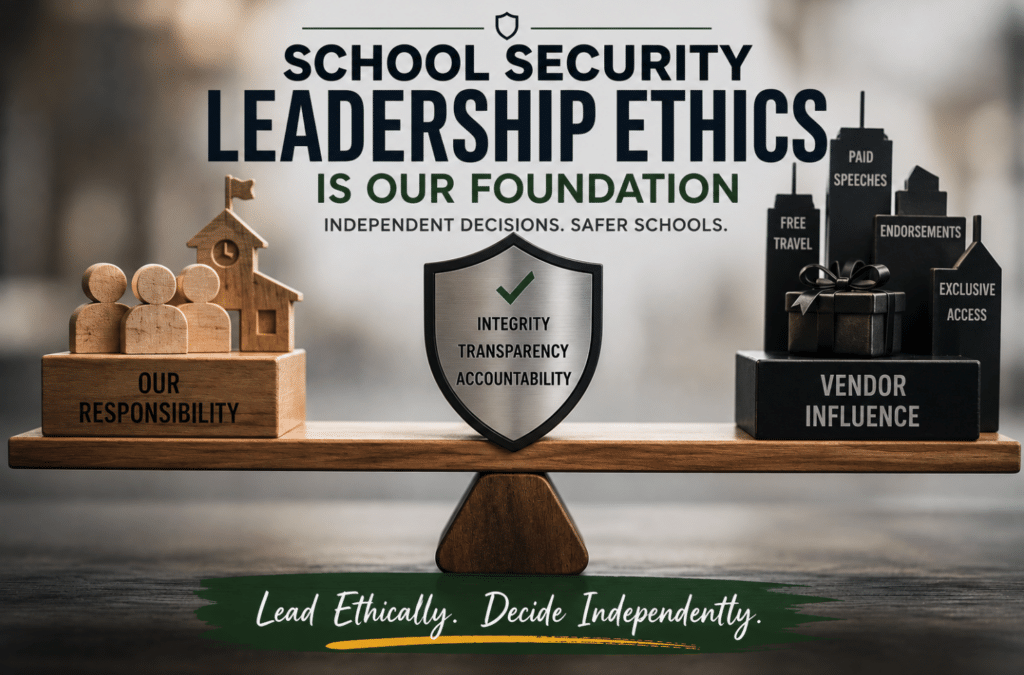
- Vendor-funded travel, testimonials, conference presentations, and marketing partnerships deserve greater transparency.
- Procurement decisions should be based on documented needs, evidence, and objective evaluation rather than personal or commercial relationships.
- Strong ethical standards protect students, school districts, taxpayers, and the credibility of the entire school security profession.
How School Security Ethics Have Changed Over the Past Four Decades
There was a time when the ethical boundaries within school security were much clearer.
School administrators worked for students, employees, and taxpayers. School security directors evaluated products and services independently. Vendors sold products in a straightforward manner as vendor salespersons.
Professional associations provided education with professional speakers selected based upon education, training, and experience. Conference organizers hosted learning opportunities, not learning sessions influenced by school security vendors.
While these groups interacted professionally, each generally stayed within its own lane. Attendees came for new information. Professional presenters were featured on the stage. Vendors stayed in the exhibit hall.
School officials were typically unable to publicly endorse commercial products. Many districts maintained strict policies regarding gifts, travel reimbursements, and vendor relationships. Even the appearance of favoritism could damage a professional reputation or trigger scrutiny from supervisors, auditors, or school boards.
Today, those distinctions are far less defined.
How School Security Vendors Try To Build Credibility Through Public Officials
Across the country, it has become increasingly common to see:
- School security directors appearing in vendor marketing videos and testimonials.
- School administrators featured prominently on company websites promoting products their districts purchased.
- Public officials participating in vendor-sponsored webinars presented as educational programs.
- Conference panels where school officials travel and participate using vendor-funded registration, lodging, or travel expenses.
- Current practitioners serving as unofficial ambassadors for products while still employed by public school districts.
- Former school security directors quickly transitioning into sales, consulting, marketing, and conference roles for the very companies whose products they previously evaluated, recommended, or purchased while serving in public education.
None of these activities is automatically unethical. However, each raises legitimate questions regarding school security ethics, procurement integrity, transparency, and maintaining independent school security leadership.

Why the Appearance of a Conflict of Interest Matters in School Security
Public ethics has long recognized an important principle: Avoiding actual conflicts of interest is not enough. Public officials should also avoid the appearance of conflicts of interest.
Parents rarely know who paid for conference travel. School boards often do not know whether vendors covered registration fees, meals, receptions, or lodging. Conference attendees frequently cannot distinguish between independent education and sophisticated product marketing.
Even when everyone involved acts with good intentions, public confidence can be weakened when professional relationships appear too close for comfort.
In school security, perception matters because trust matters.
The Growing Use of Practitioners as Marketing Assets
One of the most effective marketing strategies available to school security vendors is not advertising. It is borrowed credibility.
It happens when respected school administrators appear in promotional videos, school security directors provide glowing testimonials, when superintendents repeatedly share conference stages with vendor executives, and when practitioners become recognizable faces associated with particular products.
Companies gain something advertising alone cannot buy: Professional credibility.
Why? Because school leaders naturally trust fellow practitioners who have faced similar challenges.
That trust is valuable. It should never be exploited without full transparency.
When Vendor Relationships Become Procurement and Ethics Risks
Most vendor relationships never become criminal investigations. However, recent events demonstrate why strong ethical boundaries remain essential.
Federal prosecutors have alleged that a former public safety official responsible for school security accepted significant personal benefits while allegedly attempting to influence the procurement of a school safety technology system. Although the criminal case remains unresolved and the defendants have denied wrongdoing, the allegations illustrate how blurred relationships between vendors and public officials can attract intense legal scrutiny.
Investigative reporting has also examined situations where school safety leaders accepted vendor-funded travel or participated in nonprofit conferences and advisory groups closely connected with companies marketing school security products. Even where no laws were alleged to have been violated, these arrangements generated legitimate public questions about transparency and procurement integrity.
Following the Oxford High School tragedy and an after-action report pointing blame at now-former top school administrators, parents publicly questioned aspects of school safety leadership, transparency, and governance. They were especially frustrated when a former assistant superintendent named in the report left the district and went to work for a weapons detection vendor, doing keynote presentations nationally as a school safety expert, leveraging the Oxford district shooting. Parents were further frustrated when her replacement recently left the district, after spending time gaining training and networking nationally with vendors, to go to work for a vendor.
While those concerns extended beyond vendor relationships, they illustrate how quickly public trust can erode with stakeholders.
These examples should not be viewed as isolated events. Rather, they demonstrate why school security ethics deserve greater attention before controversies emerge, not afterward.
The Revolving Door Between School Districts and School Security Vendors
School districts spend years developing experienced school security leaders. Increasingly, some of those leaders leave public education, soon to join companies whose products they previously recommended, implemented, or promoted.
There is nothing inherently wrong with changing careers. Former educators often bring valuable real-world expertise to the private sector.
The ethical concern arises when relationships developed in public service later become commercial marketing assets.
A school security director who once evaluated competing products for a public school district may later return to conferences as a paid representative promoting those same products to former colleagues.
The distinction between independent professional advice and commercial advocacy becomes increasingly difficult for attendees to recognize.
School Safety Conferences: Independent Education or Vendor Marketing?
Professional conferences should expose attendees to diverse viewpoints, emerging research, independent experts, and healthy debate.
Too often today, conference agendas increasingly feature:
- Vendor-sponsored educational sessions.
- Panels moderated by companies selling products.
- Practitioners closely aligned with specific vendors.
- Sessions that function more as product demonstrations than objective educational programs.
- Speakers whose travel or participation has been funded by companies with commercial interests.
Conference attendees deserve transparency. Knowing who sponsors a presentation does not diminish its value. Failing to disclose those relationships can.
Transparency is not anti-business. It is pro-integrity.

Why Ethics and Independence Matter in School Security Leadership
School security decisions affect millions of students every day.
Districts routinely invest hundreds of thousands or even millions of dollars in security technologies, consulting services, and emergency preparedness initiatives.
Taxpayers deserve confidence that these decisions are based upon:
- Documented needs assessments
- Independent evaluations
- Evidence-informed practices
- Competitive procurement processes
- The best interests of students and staff
Not marketing relationships, personal friendships, conference networking, or who paid for dinner and a trip.
Best Practices for Ethical School Security Leadership
The school safety profession would benefit from recommitting to ethical principles that were once widely understood.
These include:
- Maintaining clear professional boundaries between public officials and vendors.
- Public disclosure of vendor-funded travel, lodging, meals, honoraria, and conference participation.
- Avoiding commercial product testimonials by current public employees.
- Clearly identifying vendor-sponsored educational programming.
- Strengthening school district conflict-of-interest policies.
- Considering reasonable cooling-off periods before former public officials market products to agencies they recently served.
- Making procurement decisions through documented, transparent, evidence-informed processes.
None of these recommendations discourage innovation.
Instead, they reinforce that school security is first and foremost a public trust.

Protecting Public Trust Through Ethical School Security Leadership
School security vendors play an essential role in helping schools improve safety. Many companies operate with professionalism, integrity, and a genuine commitment to protecting children.
Likewise, the overwhelming majority of school administrators and school security directors serve with honesty, dedication, and professionalism.
Yet ethical standards exist precisely because good people can find themselves navigating increasingly complicated relationships. As the school security marketplace continues to expand, maintaining clear boundaries between public service and private profit becomes even more important.
School safety depends on public trust. Once that trust is compromised, it is extraordinarily difficult to rebuild.
Dr. Kenneth S. Trump is President of National School Safety and Security Services
National School Safety and Security Services
Experts You Can Trust!
Connect with Dr. Ken on Linkedin: www.linkedin.com/in/kentrump/
Follow Dr. Ken on X(Twitter) @safeschools
Visit and “Like” Our Facebook School Safety News Channel at: www.facebook.com/schoolsafety
Frequently Asked Questions About School Security Leadership Ethics
What is a conflict of interest in school security?
A conflict of interest occurs when a school official’s personal, financial, or professional relationships could influence, or appear to influence, decisions about security products, services, procurement, or policy.
Should school administrators endorse school security products or technology?
School districts should carefully consider whether public endorsements create actual or perceived conflicts of interest. Even well-intentioned testimonials can affect public confidence in procurement decisions.
Is vendor-paid travel for school officials to go to conferences appropriate?
District policies vary. At a minimum, vendor-funded travel, lodging, meals, and honoraria should be fully disclosed and evaluated under applicable ethics laws and local board policies. Then consideration should be given as to whether that traveler should recuse themselves from future procurement matters which may involve the vendor paying for the travel.
Why is vendor influence a growing issue in school security?
The rapid growth of the school security industry has increased partnerships between schools and private companies. While many collaborations are appropriate and beneficial, others raise questions about independence, transparency, and procurement integrity.
How can school districts reduce conflicts of interest?
Districts can strengthen ethics policies, require disclosure of vendor relationships, promote competitive procurement practices, provide ethics training, and emphasize independent, evidence-informed decision making.
Very well written. I agree with you with almost all you said. At my superintendent request I was asked to do a video for a vendor and they never felt good. I personally will not take a vendors trip nor will I go to lunch with a vendor. You put a lot of thought into this as a 35 year security professional I think this article is very timely.
It is almost criminal to see the number of security directors ending up in the vendor lane. Thank you for Holding your own, I thought I was the only one.
Thanks, Larry. You’ve been through this long journey. I agree and support your feelings. I’m not sure where we lost the “ethics” laws, rules, and just moral compass, but I do know there are others like you who feel the same as we do. They just can’t go public with their thoughts. Stay safe and take care.