
Take emergency plans off the shelf and put them to work before a real crisis does it for you.
School emergency plans are only as useful as the people who understand them, practice them, and can adapt when real events do not unfold exactly as expected.
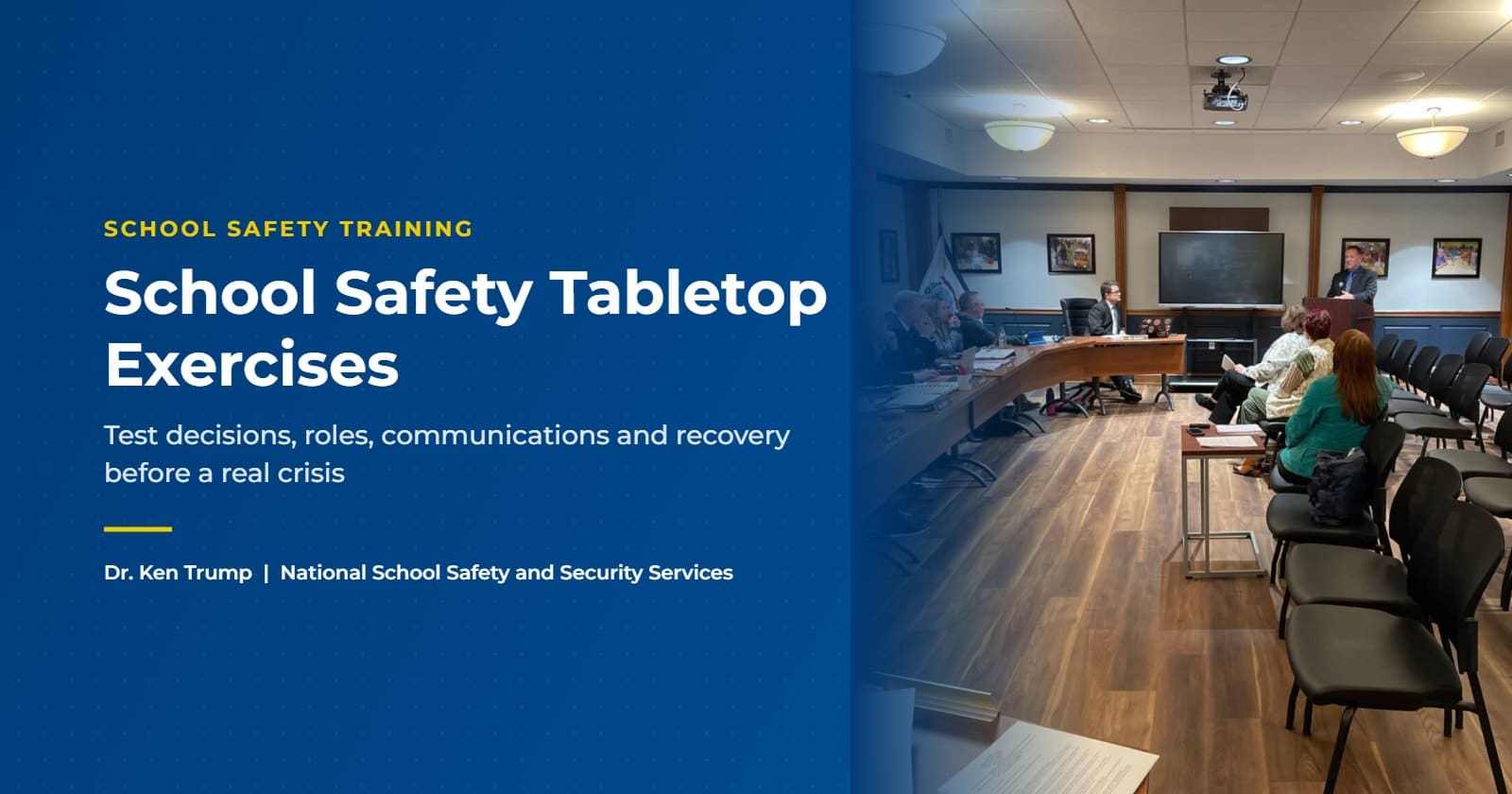
National School Safety and Security Services provides facilitated school tabletop exercises that help district and school crisis teams examine how their emergency operations plans, leadership structures, communications, and response procedures may function during a real emergency.
Tabletop exercises provide a structured, discussion-based way to test plans, clarify roles, identify gaps, and strengthen decision-making without exposing participants to the physical and psychological risks that can accompany poorly designed high-intensity drills.
Programs can be customized for individual schools, district leadership teams, regional school safety collaboratives, or groups that include law enforcement, fire, emergency management, mental health, transportation, communications, and other school-community partners.
REQUEST TRAINING
Request a School Tabletop Exercise
Call (216) 251-3067 or email ken@schoolsecurity.org.
Talk with KenA school tabletop exercise is a discussion-based emergency preparedness exercise in which participants work through a hypothetical crisis scenario and explain how they would respond based on their existing plans, responsibilities, resources, and relationships.
A facilitator introduces the scenario and then presents new information, changing conditions, and operational challenges as the exercise develops.
Participants may be asked:
The purpose is not to “win” the exercise. The purpose is to identify what works, what does not, and what needs to change before an actual emergency occurs.
Tabletop exercises help schools move beyond written plans and examine the operational realities behind them.
They can help school leaders:
A well-designed tabletop exercise can expose weaknesses in plans at far lower cost and disruption than discovering those problems for the first time during a real emergency.
A facilitated tabletop exercise typically begins with a realistic scenario selected around the district’s concerns, plans, and objectives.
Participants receive information in stages rather than all at once. As circumstances change, the facilitator asks questions and introduces new challenges designed to test assumptions, roles, coordination, and decision-making.
The discussion may examine:
The exercise concludes with a facilitated discussion of strengths, gaps, questions, and recommended follow-up actions.
The goal is not simply to conduct an exercise. It is to use what the team learns to improve plans, training, relationships, and preparedness.
The most productive school tabletop exercises bring together people who would actually have responsibilities during an emergency.
Depending on the scenario and exercise objectives, participants may include:
The value comes from bringing together perspectives that may operate separately during normal school operations but must function as one system during a crisis.
Tabletop exercises can be built around a wide range of school emergency scenarios and operational challenges.
Examples include:
The scenario is simply the vehicle. The real focus is often on leadership, decision-making, communications, coordination, logistics, and adaptability.
Years of facilitated school tabletop exercises repeatedly reveal similar preparedness gaps.
School teams sometimes assume that large numbers of police officers, firefighters, or emergency personnel will immediately be available. Actual staffing levels, competing calls, geography, and response times may tell a different story.
Teams may move quickly toward lockdown because it is familiar, even when evacuation, sheltering, or another protective action may be more appropriate to the specific circumstances.
Managing frightened parents, news media, social media, misinformation, transportation, reunification, and community expectations may continue long after the immediate threat has ended.
Plans often identify primary decision-makers without adequately addressing who assumes responsibility when those individuals are unavailable.
A reunification location written into a plan does not automatically mean the site will work under real-world conditions. Transportation, accessibility, traffic, weather, student accountability, communications, and family verification all require attention.
Internal communications, parent notifications, social media, media staging, joint-agency messaging, and coordination among school and public safety public information officers frequently need refinement.
These types of lessons are precisely why tabletop exercises are valuable. They allow teams to discover gaps while there is still time to fix them.
Tabletop exercises, drills, functional exercises, and full-scale exercises serve different purposes.
A tabletop exercise is discussion-based. Participants talk through how they would manage a developing situation.
A drill generally practices a specific action or procedure, such as evacuation or lockdown.
A functional exercise tests particular systems, teams, or operational capabilities in a more realistic but still controlled environment.
A full-scale exercise may involve extensive field activity, multiple agencies, equipment, responders, and simulated victims or operational conditions.
All can have value when properly designed.
Tabletop exercises are particularly useful because they can test complicated decisions, relationships, communications, logistics, and plans without the time, expense, disruption, and potential physical or psychological consequences associated with more intensive exercises.
They are also well suited for professional development and recurring preparedness activities.
There should be no generic “one-size-fits-all” school emergency exercise.
Each school district has different facilities, personnel, community partners, emergency operations plans, transportation systems, communications practices, resources, and local hazards.
Our tabletop exercises can be customized around:
Exercises may be conducted as full-day or half-day professional development programs, leadership exercises, crisis-team sessions, or multi-agency regional exercises.
Most school tabletop exercises can be structured as a half-day or full-day session, depending on the number of participants, complexity of the scenario, and desired depth of discussion.
Shorter leadership-focused sessions may also be appropriate for a specific issue or operational question.
Whenever practical, yes.
Police, fire, EMS, emergency management, and other community partners can help identify unrealistic assumptions, clarify capabilities and limitations, and strengthen relationships before an emergency.
Their participation should complement, not replace, school leadership responsibilities.
No.
Tabletop exercises and drills serve different purposes.
Drills allow staff and students to practice specific actions. Tabletop exercises allow leaders and response partners to examine broader decision-making, coordination, communications, logistics, and emergency-plan implementation.
A comprehensive preparedness program may use both.
They can be.
A tabletop exercise can examine leadership, communications, protective-action decisions, law enforcement coordination, student accountability, reunification, crisis communications, and recovery issues associated with a violent incident without exposing students or staff to highly dramatic simulations.
Yes.
Reunification is particularly well suited to tabletop exercises because it requires coordination among leadership, transportation, facilities, communications, law enforcement, student services, and other functions.
The exercise can reveal problems with site selection, traffic, student accountability, accessibility, parent verification, communications, staffing, and backup locations before a real evacuation occurs.
It depends on the purpose and design of the exercise.
Leadership and operational tabletop exercises typically focus on adults responsible for crisis decision-making and response. Student involvement may be appropriate in selected preparedness or planning activities, but age, developmental considerations, psychological impact, and the specific exercise objectives should guide that decision.
The most important work begins after the discussion ends.
Participants should identify lessons learned, assign follow-up responsibilities, revise plans where necessary, address training gaps, strengthen relationships, and determine what additional drills or exercises may be needed.
An exercise that produces no follow-up is simply a conversation.
A written emergency plan is only the starting point.
Tabletop exercises help school leaders determine whether their plans, people, communications, and partnerships will work when circumstances become uncertain and decisions have to be made quickly.
National School Safety and Security Services provides independent, vendor-free school emergency preparedness training and facilitated tabletop exercises for school districts, independent and faith-based schools, regional collaboratives, and education organizations.
REQUEST TRAINING
Request information about a school tabletop exercise
Call (216) 251-3067
Talk with KenEmail ken@schoolsecurity.org