
School Arrival and Dismissal Safety: Why Backup Supervision Plans Matter
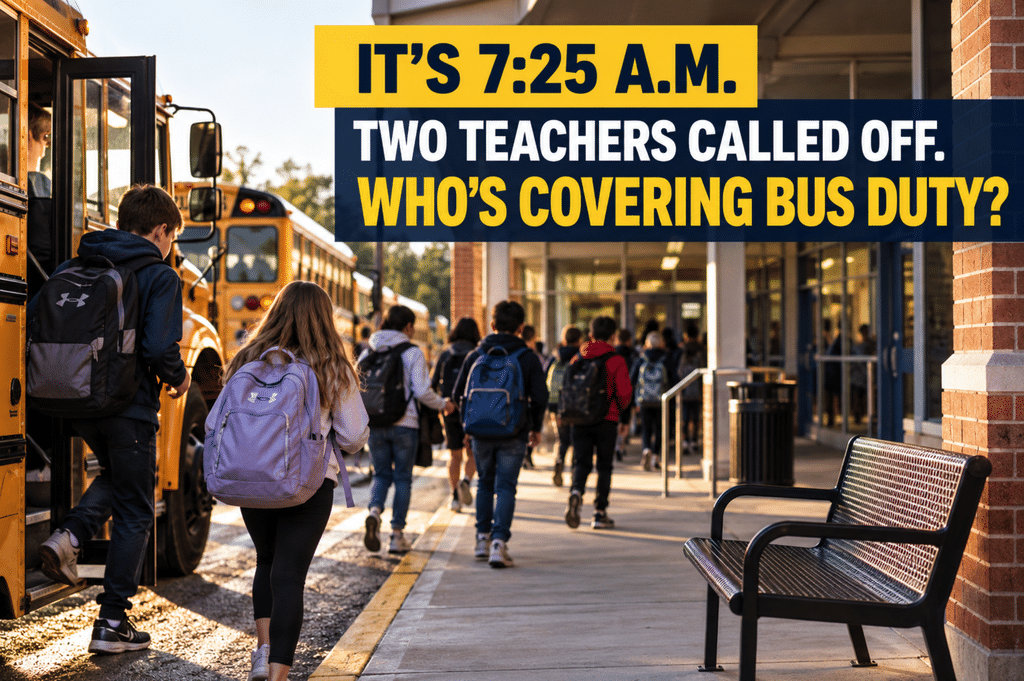
It’s 7:25 a.m.
Two teachers assigned to morning bus duty have called off sick. The assistant principal is handling a student behavior incident. The principal is meeting with an upset parent. Buses are arriving, and students are unloading.
Who’s covering bus duty?
Does anyone know the assigned teachers are absent? Have replacement staff been notified? Has someone verified they’re actually at their assigned posts?
Or is everyone assuming someone else has it covered?
This is the kind of routine staffing disruption that can expose weaknesses in school arrival and dismissal safety.
A school supervision plan is only as effective as its implementation, especially when the adults assigned to carry it out aren’t there.
What Happens When School Bus Duty Staff Are Absent?
When employees assigned to bus duty or other student supervision responsibilities are absent, school administrators need a process to identify uncovered posts, assign qualified backup personnel, communicate changes, and verify that coverage is in place.
Without that process, staffing disruptions can leave students inadequately supervised during some of the busiest periods of the school day.
The challenge isn’t necessarily a lack of written procedures. It’s the failure to anticipate what happens when routine operations don’t go according to plan.

Assigned Supervision Isn’t Actual Supervision
During school safety training, as well as our school safety and security assessments, I distinguish between supervision responsibilities documented on paper and supervision actually occurring in schools.
A schedule might show three adults assigned to a bus-loading area, hallway, cafeteria, or school entrance. But are those adults present, attentive, properly positioned, and actively supervising? And what happens when they’re unavailable?
School administrators should be able to answer several practical questions:
- Who identifies staff absences affecting supervision?
- Who immediately reassigns uncovered duties?
- How are replacement staff notified?
- Who verifies that replacement personnel reported?
- What happens when the designated backup is also unavailable?
- Who monitors coverage as conditions change throughout the day?
These aren’t glamorous school security questions. They won’t sell another security product.
But they are fundamental to school safety.
The Five-Minute Supervision Gap
School leaders can underestimate how quickly an ordinary staffing disruption creates a supervision vulnerability. An uncovered post for even five minutes may mean students entering without adequate adult observation, conflicts developing without intervention, or an unfamiliar individual moving through an area unnoticed.
Not every gap results in an incident. And the reality is, by the nature of schools being schools, there are going to be those situations where people do get pulled away, even if only briefly. Should an incident occur, the question in hindsight will be whether that brief break in supervision was reasonable based upon the facts at hand.
But schools shouldn’t always depend on luck to maintain basic supervision. And the problem extends beyond morning bus duty.
A teacher assigned to hallway supervision is pulled into a parent conference. A cafeteria monitor responds to a student issue. A recess supervisor assists an injured child. An administrator responsible for dismissal is called away to handle a transportation problem.
Who fills the gap, and who recognizes that it exists? Are there others in the immediate area who could logically step in?

Six Steps to Strengthen School Arrival and Dismissal Supervision
Schools don’t necessarily need another lengthy procedure. They need a reliable operational system.
- Identify critical supervision posts. Determine which entrances, bus-loading areas, hallways, cafeterias, playgrounds, and student gathering locations require consistent adult coverage.
- Assign backup personnel in advance. Identify primary and secondary backups for critical supervision posts. Don’t wait until students arrive to figure out who is available.
- Connect staff absence reporting to supervision assignments. When employees call off, administrators should identify their supervision responsibilities along with their classroom or instructional assignments.
- Communicate changes directly. Notify replacement personnel through established communication procedures rather than relying on assumptions or informal arrangements.
- Verify coverage. Assign responsibility for confirming that replacement personnel are actually at their designated locations. A reassignment communicated is not necessarily a reassignment completed.
- Practice adapting to disruptions. Include unexpected absences, competing administrative demands, and staffing shortages in operational discussions and exercises.
The goal isn’t more paperwork. It’s dependable coverage when staffing plans change.
Active Supervision Requires More Than Physical Presence
Even when backup personnel arrive, effective supervision requires more than an adult standing at an assigned location.
Staff members need to be visible, attentive, appropriately positioned, scanning their surroundings, engaging students, and recognizing developing problems. An employee looking down at a cell phone while students move through a busy hallway may be physically present but not actively supervising.
Likewise, a substitute assigned to an unfamiliar location may need direction about student movement patterns, known trouble spots, and supervision expectations.
This is why active supervision in schools must be treated as an ongoing operational practice rather than simply a staffing schedule.

Who Is Accountable When Supervision Coverage Breaks Down?
Employees are responsible for reporting to assigned posts, communicating absences, and actively supervising students. Administrators are responsible for establishing expectations, arranging backup coverage, communicating changes, and monitoring implementation. Both responsibilities matter.
School leaders should also avoid routinely solving one staffing problem by pulling employees away from equally important assignments. Moving a supervision gap from one location to another doesn’t eliminate the problem.
A workable backup plan anticipates predictable disruptions rather than assuming every employee will always be available.
The School Safety Question to Ask Before Tomorrow Morning
School leaders don’t need to wait for an incident or a formal security assessment to examine their supervision coverage. Look at tomorrow’s arrival and dismissal assignments.
Then ask: If two employees assigned to critical supervision posts call off at the last minute, who knows, who responds, and who verifies that students are still being supervised?
If the answer depends on someone noticing an uncovered area or assuming another adult will step in, the backup system needs attention.
After more than four decades working in school safety and security, I continue to emphasize that effective school security isn’t simply about equipment, facilities, and written plans alone.
It’s about people, leadership, implementation, and what happens when ordinary operations don’t go according to plan.
It’s 7:25 a.m. The buses are arriving. Two teachers called off. Who’s covering bus duty?

Dr. Kenneth S. Trump
President, National School Safety and Security Services
Dr. Kenneth S. Trump is President of National School Safety and Security Services, an independent, non-product-affiliated school safety consulting firm. With more than 40 years of experience in PreK–12 school safety, security, and emergency preparedness, he provides independent analysis and strategic guidance to school leaders nationwide.