

High school football season is getting underway, and school athletic event security is already back in the headlines.
A 17-year-old was fatally shot during a high school football game Friday night in Bakersfield, California. The shooting occurred inside the stadium gates following an altercation. It is another reminder that large school athletic events present security challenges very different from those of the regular school day.
The timing underscores why we have just completed a major update of our free School Athletic Event Security resource for superintendents, principals, athletic directors, school safety officials, SROs, law enforcement, and others responsible for planning and managing school sporting events.
The resource is not a product guide. There is nothing to buy. It is practical guidance focused on the fundamentals school leaders can control: planning, people, supervision, communications, coordination, and emergency preparedness.
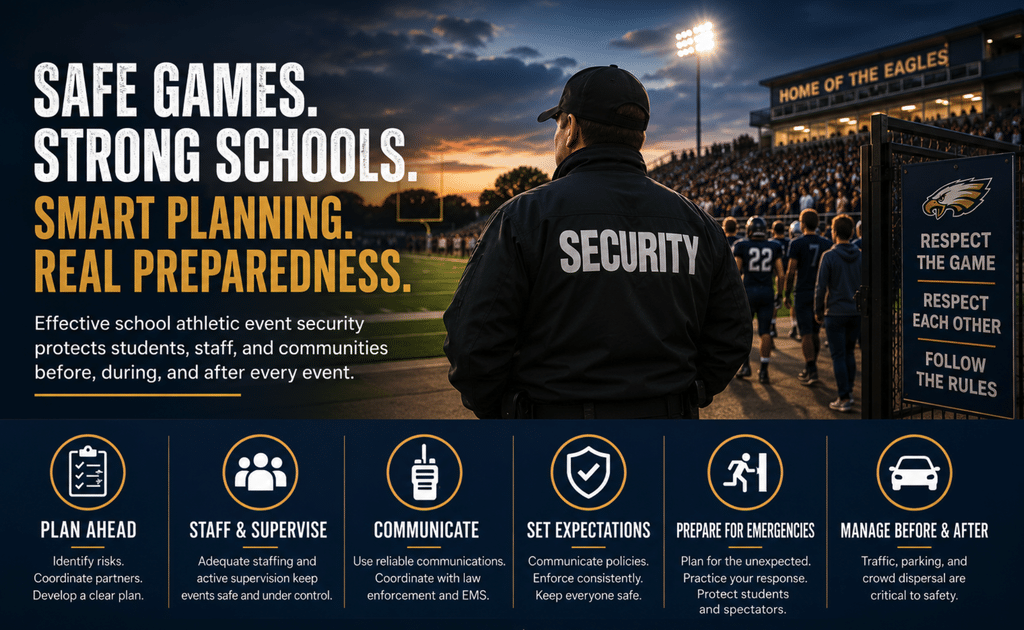
School Athletic Event Security Requires More Than Security at the Gate
Education Week reported this week that gunfire has wounded or killed someone at 43 high school football games since 2018, resulting in 17 deaths and 71 injuries under the publication’s tracking criteria.
Those numbers do not capture every shooting or violent incident associated with a football game. Education Week’s tracker excludes, for example, shootings occurring nearby but off school property and incidents in which shots are fired but no one is wounded. Dr. David Riedman leads the K-12 School Shooting Database, another leading resource, and has tracked school athletic (and other) violence events for years.
I told Education Week during an extensive interview for their story that we typically do not see random mass shootings at athletic events. More often, problems involve interpersonal disputes, fights that escalate, and conflicts that spill into areas where people congregate.
That has significant implications for how schools plan security: The security perimeter does not end at the stadium gate, and the security operation does not end with the final whistle.
Parking lots, restrooms, concession areas, admission lines, student sections, pickup areas, surrounding grounds, and post-game crowd dispersal all deserve attention.

The Fundamentals Still Matter
For decades, I have emphasized three fundamentals for school athletic event security: Plan ahead. Provide adequate staffing and active supervision. Prepare for emergencies. Those principles remain sound.
The updated resource expands upon them with practical considerations involving:
- Advance planning and intelligence sharing
- Adequate staffing and active supervision
- Admissions, reentry, and spectator policies
- Parking lots, perimeters, and surrounding areas
- Separation of rival groups when appropriate
- Two-way radio and emergency communications
- Coordination with police, fire, EMS, and visiting schools
- Emergency public address announcements
- Evacuation, shelter, and other protective actions
- Parent-student reunification
- Post-incident communications and recovery
- Tabletop exercises to test plans before they are needed
One question every event security team should be asking is deceptively simple: Are our people watching the crowd, or are they watching the game?
A colleague has long referred to the opposite as “cop clump” or “teacher talk”, when multiple officers, administrators, or security staff stand together talking while significant areas of an event go inadequately supervised. I discussed that problem again with Education Week in its new examination of football game security.
It is important to remember: Just like the regular school day, adults need to practice active supervision.
The number of people working an event matters. Where they are positioned and what they are doing matters just as much.
Technology Can Help, But It Is Not the Plan
Weapons detection systems, cameras, access control, and other technologies can have a legitimate place in athletic event security strategy. But technology should support good security practices, not substitute for them.
I cautioned Education Week about the potential for schools to lower the sensitivity of weapons screening systems simply to move crowds through entrances faster. Screening can also create another security consideration by concentrating hundreds of people outside a secured perimeter while they wait to enter.
A sophisticated screening system at the gate does little about an inadequately supervised parking lot after the game. Use tech tools based upon a comprehensive assessment, not in a manner that creates security theater.
That is why school athletic event security needs to be approached as an operational and leadership responsibility, not primarily a technology purchase.

What Happens When Something Goes Wrong?
Prevention is one important part of the equation. Schools also need to ask what happens if gunfire, a large fight, severe weather, a medical emergency, or another crisis occurs while hundreds or thousands of people are gathered.
Who makes the decisions? Who communicates with spectators? Where do people go? How do police and fire personnel get in while crowds are trying to get out? What happens to students who arrived without their parents? How will families be reunited?
And also very importantly: What if the threat is outside the stadium?
Automatically evacuating a stadium could potentially send spectators directly toward a threat. Depending upon the circumstances, keeping people temporarily inside may be safer while officials determine what is occurring and where. Education Week also highlighted this issue in its new report.
These are decisions that should be discussed and exercised before an emergency, not improvised in the middle of one.
Free School Athletic Event Security Resources for School Leaders
Our newly updated School Athletic Event Security page brings these issues together in one comprehensive resource. It also connects school leaders with additional free resources on active supervision, two-way radio communications, school emergency planning, and tabletop crisis exercises. Use it to guide your planning discussions.
There are no cookie-cutter security plans that fit every football stadium, gymnasium, school district, or community. A lightly attended middle school athletic event is not the same security environment as a sold-out rivalry or homecoming football game.
The objective is not to turn Friday night football into a fortress. It is to understand the risks, put the right people in the right places, communicate effectively, and have the right plan before something goes wrong.
Friday night should be about the game. Good school athletic event security planning helps keep it that way.
Read the newly updated free resource: School Athletic Event Security: Best Practices for Safer School Sporting Events
Related coverage: Education Week: When Gunfire Interrupts High School Football: What Schools Should Do
Dr. Kenneth S. Trump is President of National School Safety and Security Services
National School Safety and Security Services
Experts You Can Trust!
Connect with Dr. Ken on Linkedin: www.linkedin.com/in/kentrump/
Follow Dr. Ken on X(Twitter) @safeschools