
School safety is often discussed in terms of cameras, access control, emergency plans, threat assessment and school resource officers.
But one of the most overlooked school safety tools is much less technical: how people are treated when they interact with a school.
A new 2026 national survey from the National School Public Relations Association (NSPRA) and Qualtrics examines what it calls the K-12 customer experience, or CX. The report defines customer experience as the quality, clarity and consistency of interactions families and community members have across schools, staff, systems and communication channels. Customer service is one part of that larger experience.
The report is not a school safety study. It does not measure violence, threats or security incidents.
But its findings reinforce an important school safety leadership principle: Good customer service can help build the relationships and trust that support safer schools.
School Safety Depends on Trust Before the Crisis
The report identifies customer experience as fundamentally a trust issue. Districts reporting more consistent, positive interactions were much more likely to view those experiences as strengthening trust.
That matters for school safety. Parents, students and community members need to believe that when they raise a concern, someone will listen, take it seriously and follow through. Those relationships should not begin during an emergency.
Everyday interactions with secretaries, principals, teachers and other school employees help determine whether people view the school as responsive, competent and trustworthy. That same trust becomes even more important when school leaders communicate with parents about safety and security.
If You Want People to “Say Something,” Listen When They Do
The NSPRA report describes getting a problem solved, a question answered or a concern heard as hallmarks of a positive customer experience. People want to know what happens next, who owns the next step and whether their concern has been resolved.
There is an important school safety connection. We routinely tell students, parents and staff: If you see something, say something. But there is another half to that equation: If people say something, what happens next?
As I have written previously, schools need to move from “See Something, Say Something” to knowing how to do something. A reporting system is only as strong as people’s confidence that someone will listen, respond appropriately and follow through.
Good customer service reduces friction between people who have information and the people who need to receive it.

The Main Office Is Part of Your Safety Infrastructure
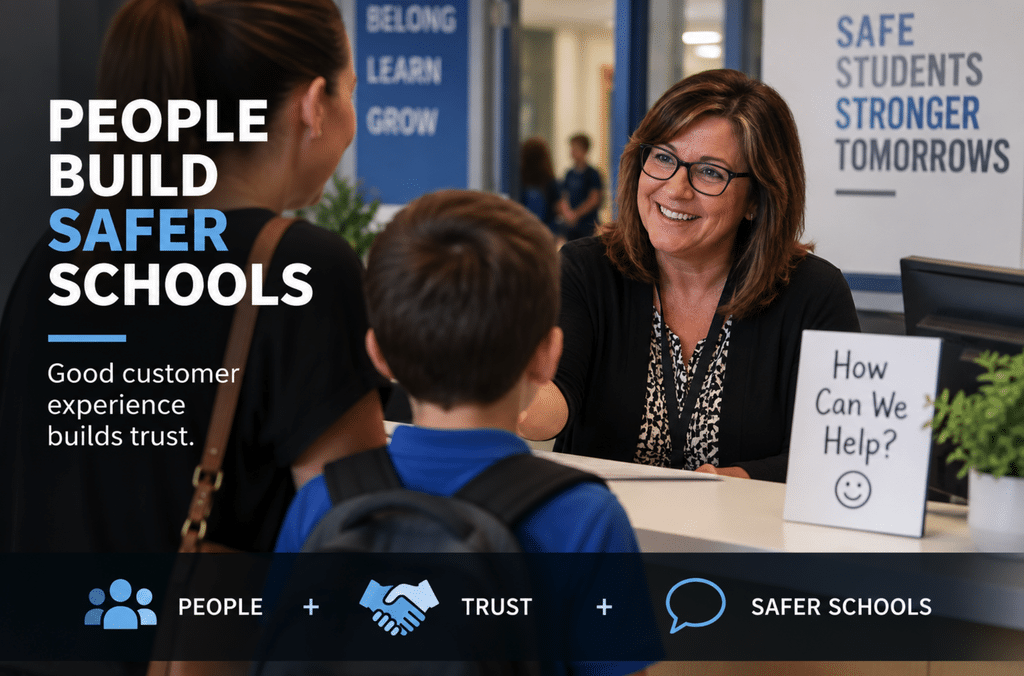
The survey points toward one of the most important human intersections in school safety: the main office.
Among the areas where respondents reported customer experience problems were differences in how schools handle interactions (51%), clarity and tone of staff communications (38%), district processes (33%) and main office or front desk interactions (29%).
This reinforces why school security leadership starts in the main office with school secretaries. Visitor management, access control, parent concerns, student issues, information sharing and relationships intersect there every day.
A secretary who looks up, engages a visitor and says, “Hello, may I help you?” is providing good customer service. That same interaction is also situational awareness.
The Biggest Problems Are Human and Organizational
Perhaps the strongest connection to school safety is that many customer experience problems are operational and human. The report identifies unclear responsibilities, inconsistent handoffs, limited training, inconsistent expectations and processes that vary across schools and departments.
There is a familiar parallel with school safety. Districts can purchase sophisticated security technology, but they still depend on people knowing what is expected, recognizing problems, communicating clearly and following through.
That is also why active supervision is a foundational school safety and security practice: engaged adults can observe, interact, build relationships and identify concerns that technology alone cannot.
Consider this gap: 63% of respondents said their district places a high or very high priority on creating positive external experiences, yet only 38% rated their district very or extremely effective at consistently providing them. Knowing something is important is not the same as consistently doing it.

Customer Experience Is “Trust Infrastructure”
NSPRA uses a particularly useful phrase: customer experience is part of a district’s “trust infrastructure.”
Every phone call, office visit, email and concern-resolution process affects whether families experience a district as clear, responsive, reliable and caring. Failed handoffs, confusing processes and inconsistent answers weaken that trust.
School leaders should think about trust infrastructure as part of safety infrastructure. Not because good customer service prevents every crisis. But strong relationships can make people more willing to communicate, ask questions, raise concerns and seek help. Poor experiences can create frustration, disengagement and distrust.
Good Customer Service Is a School Safety Tool
School safety is about more than securing places. It is also about strengthening people, relationships, communication and organizational practices.
School leaders should ask:
- When someone brings us a concern, do we make it easy or difficult to be heard?
- Do front office staff know how to receive, route and escalate concerns?
- Do parents receive consistent answers across schools and departments?
- Does someone clearly own the next step and follow through?
- Do we train and reinforce these expectations, or simply assume employees know what to do?
The NSPRA research does not prove that customer service prevents school safety incidents. We should not stretch the findings that far.
But it reinforces something school safety leaders should understand: Trust is built long before an emergency. Everyday interactions are opportunities to strengthen it.
That makes good customer service more than a communications or public relations strategy. It also makes good customer service a school safety tool.
Dr. Kenneth S. Trump is President of National School Safety and Security Services
National School Safety and Security Services
Experts You Can Trust!
Connect with Dr. Ken on Linkedin: www.linkedin.com/in/kentrump/
Follow Dr. Ken on X(Twitter) @safeschools
Visit and “Like” Our Facebook School Safety News Channel at: www.facebook.com/schoolsafety