
School safety discussions frequently begin with cameras, access control systems, weapons detectors, panic buttons, security personnel, and other highly visible protective measures. While these resources may have legitimate roles in comprehensive school safety programs, even the most sophisticated security systems ultimately depend on people who are attentive, appropriately trained, and prepared to act.
Schools are dynamic environments. Hundreds or thousands of students, employees, parents, visitors, contractors, and community members move through buildings and campuses every day. Activities shift from classrooms to hallways, cafeterias, playgrounds, parking lots, buses, and athletic facilities. Routines change, people become distracted, and unexpected situations arise. No security device, written policy, or emergency operations plan can anticipate or manage every circumstance educators encounter.
This is why active supervision, situational awareness, pattern recognition, decision-making, and other human factors should be treated as foundational elements of school safety and security, not secondary considerations or optional enhancements.
An engaged teacher may recognize tension between students before a fight occurs. A secretary may notice an unfamiliar visitor entering a restricted area. A bus driver may recognize an unusual change in a student’s behavior. A custodian may identify an unsecured exterior door. A principal may recognize that a seemingly minor change in student movement signals a developing problem.
These are not extraordinary security operations. They are examples of everyday school professionals applying observation, experience, relationships, and judgment. They illustrate a fundamental school safety principle: The first line of school safety is often an attentive adult who recognizes something is wrong and knows what to do about it.
The challenge for school leaders is helping employees recognize, develop, and consistently apply these skills in daily school operations.
Active supervision, situational awareness, pattern recognition, and decision-making are closely related but distinct elements of school safety.
Together, these elements provide an important foundation for prevention, early intervention, emergency preparedness, and effective school safety operations.
IN THIS GUIDE
Active supervision is the intentional, ongoing practice through which school employees observe, monitor, engage with, and respond to students and their surroundings to maintain safe, orderly, and supportive learning environments.
It involves more than assigning an adult to stand in a hallway, cafeteria, playground, or other location. Effective supervision requires adults to be mentally engaged, appropriately positioned, attentive to changing circumstances, and prepared to intervene when necessary.
Educational research and professional guidance commonly describe three core components of active supervision:
These components are described in Vanderbilt University’s IRIS Center guidance on active supervision.
From a broader school safety and security perspective, active supervision also involves anticipating developing problems, recognizing abnormalities, communicating concerns, and taking appropriate action.
There is an important difference between an employee who is physically present and one who is actively supervising.
Passive supervision may involve standing in a designated location while looking at a phone, engaging in extended conversations with other adults, or waiting until a disruption requires intervention. Active supervision involves purposeful positioning, ongoing observation, student engagement, and early recognition of developing concerns.
Consider a cafeteria monitor who remains seated throughout lunch. Although the employee may technically be covering an assigned supervision post, that presence alone does not establish effective supervision. An actively engaged monitor is appropriately positioned, scans the room, interacts with students, and recognizes when a disagreement or unusual gathering may be developing into a problem.
Active supervision does not require employees to remain in constant motion. Some assignments require fixed positions, such as controlling a building entrance or monitoring student movement through a particular location.
The important question is whether employees are actively observing, thinking, engaging, and carrying out their assigned safety responsibilities, rather than merely occupying a designated post.
Active supervision has traditionally been presented as a classroom management and student behavior intervention. That is an important application, but that perspective alone is too narrow when viewed through the broader lens of school safety and security.
Effective supervision supports several overlapping safety objectives.
Student conflicts frequently develop through behaviors, interactions, and social dynamics that attentive adults may recognize before an incident becomes serious. A teacher may notice a growing verbal disagreement, a cafeteria monitor may observe students gathering around a confrontation, or an assistant principal may recognize repeated intimidation of a particular student.
These observations provide opportunities for early intervention. Active supervision may also reduce opportunities for bullying, harassment, and other misconduct in locations where adult monitoring is weak or inconsistent.
School employees who know their buildings, routines, and students may recognize conditions inconsistent with established safety procedures. Examples include an unfamiliar adult in a student hallway, a propped-open exterior door, an unexpected delivery vehicle, or a visitor attempting to bypass established entry procedures.
Effective supervision creates opportunities to observe, verify, and appropriately address such concerns rather than assuming that security equipment or another employee will identify them.
Teachers and other employees develop knowledge of students through daily relationships and interactions. An observant educator may notice unusual patterns of withdrawal, distress, avoidance, escalating anger, or significant changes in a student’s behavior.
Such changes do not automatically indicate a security threat. They may reflect bullying, emotional distress, family circumstances, health concerns, or other needs. Recognizing these changes and connecting students with appropriate support can be an important component of prevention and early intervention.
Students frequently possess information about conflicts, bullying, threats, weapons, and other safety concerns that adults may not otherwise know. They may be more willing to share concerns when they have positive relationships with adults who are visible, approachable, attentive, and responsive.
Active supervision therefore involves more than watching students. It also involves developing relationships that encourage communication with trusted adults.
An important measure of school safety culture is not simply whether students are told to report concerns, but whether they believe adults will listen and respond appropriately.
Employees who routinely maintain awareness of student locations, movement patterns, entrances, exits, and surrounding conditions may be better prepared to recognize changes during emergencies.
Active supervision does not replace emergency preparedness planning or training. It strengthens the everyday familiarity and awareness that can support effective emergency decision-making.
Active supervision has been studied as a strategy for reducing problem behavior, improving student engagement, and strengthening classroom and non-classroom management.
A research review and meta-analysis by Gage and colleagues, published in Behavioral Disorders in 2020, examined 12 studies evaluating active supervision in schools. Four studies provided sufficient information for estimating standardized mean differences, and their results suggested substantial reductions in problem behavior.
However, the researchers also identified limitations in the quality and consistency of the evidence. Only four studies met What Works Clearinghouse design standards, and their findings were mixed. Active supervision is therefore a research-supported practice with promising behavioral outcomes, but the strength of the evidence should not be overstated.
Research: Gage et al., An Evidence-Based Review and Meta-Analysis of Active Supervision
Additional research-informed guidance is available from the Vanderbilt University IRIS Center and the federal Head Start program’s active supervision resources. The Head Start framework emphasizes environmental setup, staff positioning, scanning and counting, listening, anticipating behavior, and engaging and redirecting. Although developed for early childhood settings, several of these principles have practical applications across K–12 schools when appropriately adapted to student ages and operational conditions.
Much of the direct research on active supervision focuses on student behavior and classroom management rather than security-specific outcomes, such as detecting unauthorized individuals, recognizing potential threats, or preventing serious violence. Evidence that active supervision reduces disruptive behavior does not, by itself, establish that it prevents school shootings or other targeted attacks.
Nevertheless, the underlying practices of intentional observation, student engagement, early recognition of concerns, communication, and appropriate intervention have clear practical relevance to broader school safety and security operations. These practices may help employees identify developing problems, recognize unsafe conditions, and respond before situations escalate.
Active supervision should therefore be viewed as both an educational practice and a foundational component of comprehensive school safety and security. Its value extends beyond classroom management, while its application and effectiveness must be evaluated in the context of actual school operations, employee responsibilities, training, and available evidence.
Situational awareness is the ability to perceive what is happening in an environment, understand the significance of that information, and anticipate how circumstances may develop.
In practical school terms, it means being mentally present, attentive, and conscious of students, activities, surroundings, and changing conditions.
Some educators may recognize related concepts through the language of mindfulness, attentiveness, being present in the moment, or what teachers sometimes describe as having eyes in the back of their heads. Although mindfulness and situational awareness overlap in their emphasis on attention, they are not identical.
Mindfulness generally emphasizes conscious attention to present experience. Situational awareness extends beyond attentiveness to include interpreting information and anticipating what may happen next.
Situational awareness is not simply seeing what is happening. It is understanding what it means and recognizing when action may be necessary.
Researcher Mica Endsley’s widely recognized model identifies three levels of situational awareness:
Consider a school administrator supervising a cafeteria. The administrator notices students gathering around two individuals who appear increasingly agitated. That is perception.
The administrator recognizes that the gathering may be developing into a confrontation rather than an ordinary social interaction. That is comprehension.
Finally, the administrator anticipates that the situation could escalate into a fight, draw additional students into the conflict, or create other safety concerns. That is projection.
Situational awareness helps the administrator recognize the developing problem early enough to take appropriate action.
Research: Endsley, M. R. (1995), Toward a Theory of Situation Awareness in Dynamic Systems
Situational awareness should not be confused with constant suspicion, fear, or hypervigilance. The objective is not to turn teachers into police officers or encourage employees to treat every unfamiliar person or unusual behavior as a threat.
Instead, effective situational awareness involves maintaining an appropriate level of attention, recognizing meaningful changes, interpreting circumstances in context, and responding proportionately.
Active supervision and situational awareness are closely related and mutually reinforcing. Active supervision provides the ongoing behaviors through which employees observe and engage with students and their environments. Situational awareness is the cognitive process through which employees interpret those observations, understand their significance, and anticipate developments.
An employee may be physically present and scanning a hallway without recognizing the significance of what is occurring. Conversely, an employee may understand the importance of situational awareness but fail to apply it because of distractions, ineffective positioning, or inadequate supervision practices.
The two concepts are strengthened by pattern recognition, professional judgment, and communication. An employee notices a change in routine, considers its potential significance, and determines whether observation, verification, reporting, or intervention is necessary.
These processes interact continuously. Effective school safety depends not simply on employees seeing what happens, but on their ability to recognize meaningful information and respond appropriately.
One of the most important and frequently underappreciated strengths of experienced educators is their ability to recognize patterns.
Teachers, principals, secretaries, custodians, bus drivers, cafeteria employees, and other staff members develop detailed knowledge of their schools through daily interactions and experience. They know when students normally arrive and leave, recognize familiar faces, understand typical traffic patterns, and know how people generally move throughout a campus.
They also develop an understanding of individual student behaviors, routines, and relationships. This knowledge creates an important foundation for recognizing abnormalities.
Pattern recognition is the process of identifying familiar behaviors, routines, relationships, and environmental conditions, and noticing when something differs significantly from what is normally expected.
An abnormality may involve an unfamiliar person, an unexpected activity, an unusual change in student behavior, or a condition inconsistent with established school operations.
Recognizing an abnormality does not mean a threat exists. It means something may warrant additional attention, verification, or appropriate follow-up.
These examples illustrate how employees’ familiarity with ordinary school operations can help them identify situations requiring attention.
An unfamiliar vehicle may belong to an authorized caregiver, a visitor may simply be lost, and a student’s behavioral change may reflect a need for support rather than a security concern. The safety practice is to recognize that something differs from an established pattern and determine whether verification or follow-up is appropriate.
School employees possess something that outside security personnel and technology systems may not have: deep contextual knowledge of their students, school communities, and daily routines.
A veteran teacher may recognize an unusual change in a student’s behavior. An experienced secretary may realize that a visitor’s request is inconsistent with normal school operations. A bus driver may notice a significant change in a student’s demeanor, while a custodian may recognize building conditions that others overlook.
This contextual knowledge is an important school safety asset. School leaders should help employees recognize that many observational skills they already possess have meaningful safety and security applications.
Pattern recognition must not become a justification for profiling students, families, or visitors based on race, ethnicity, disability, appearance, socioeconomic status, or other personal characteristics.
Effective recognition should focus on observable behaviors, authorized access, established routines, credible information, and context. Schools must also avoid automatically interpreting atypical behavior, emotional distress, or disability-related differences as indicators of dangerousness.
The appropriate response may be a friendly inquiry, verification of authorization, a supportive conversation, notification to an administrator, or referral to a school behavioral threat assessment team.
The objective is informed awareness, not indiscriminate suspicion.
Recognizing a problem is only the beginning. Once employees observe a potentially concerning situation, they must determine what it means and what, if anything, they should do.
These decisions may appear straightforward during a professional development workshop. They become more complicated when circumstances change rapidly, information is incomplete, students need immediate attention, and employees experience stress or uncertainty.
A principal may receive conflicting reports about a possible weapon. A teacher may hear an unusual sound but not know whether it represents an emergency. A secretary may be confronted by an increasingly aggressive parent. A bus driver may need to respond to a student conflict while maintaining control of the vehicle.
Each employee must interpret available information, consider potential consequences, and determine an appropriate course of action, sometimes with only seconds or minutes available.
Naturalistic decision-making (NDM) is a field of research examining how people make decisions in complex, real-world environments involving time pressure, uncertainty, incomplete information, competing priorities, and changing conditions.
Researchers have studied decision-making among firefighters, emergency responders, military personnel, healthcare practitioners, and others working in demanding environments.
Cognitive psychologist Gary Klein is one of the leading researchers associated with naturalistic decision-making. His work helps explain how experienced professionals may recognize familiar patterns and identify plausible responses without systematically comparing numerous alternatives.
Klein’s Recognition-Primed Decision model emphasizes the role of experience, recognizing meaningful cues, and mentally evaluating how a possible action might unfold. It also underscores the importance of recognizing when circumstances do not match expectations.
Research: Gary Klein (2008), Naturalistic Decision Making
Educators routinely make decisions in environments where information is incomplete and circumstances can change quickly. Experience and familiarity may help them recognize developing problems, anticipate consequences, and respond appropriately.
However, experience alone does not guarantee sound judgment. Employees may also develop inaccurate assumptions, reinforce ineffective habits, or misinterpret information.
The practical lesson is that school safety training should do more than teach procedures. It should help employees recognize meaningful cues, understand the situation, consider appropriate actions, and adapt when new information changes the circumstances.
The foundational research on naturalistic decision-making comes largely from fields outside K–12 education. Its relevance to school staff training is a useful professional application, but not alone is it proof that any particular training method prevents school violence.
Human factors influence whether employees recognize problems, interpret information accurately, communicate effectively, and carry out their responsibilities.
Several are particularly relevant to school safety.
Under pressure, people may become narrowly focused on one part of a situation while overlooking other important information. A principal responding to a student fight may concentrate on the students involved without recognizing additional students approaching or another problem developing nearby.
Distractions, fatigue, and competing responsibilities can also undermine attention during routine supervision. Effective training and staffing practices should account for these limitations rather than assuming employees can continuously monitor everything around them.
People have limited capacity to process information and manage competing tasks. During an emergency, employees may receive radio calls, telephone messages, student questions, parent demands, and instructions from multiple sources.
Too much information, particularly when fragmented or contradictory, can complicate decisions. School leaders should establish clear communication responsibilities, prioritize critical information, and avoid unnecessarily overwhelming employees.
People may give greater weight to information supporting their initial interpretation of a situation. An administrator who assumes an alarm is a malfunction may discount evidence suggesting a real emergency. An employee who believes a student report is exaggerated may overlook information supporting the concern.
Training should encourage employees to distinguish observations from assumptions and remain willing to revise conclusions when new evidence emerges.
Experience can improve judgment, but routine familiarity can also create complacency. Employees may become accustomed to bypassing visitor procedures, overlooking unsecured doors, or dismissing repeated alarms.
The absence of previous incidents does not necessarily establish that current practices are safe. School leaders should periodically challenge assumptions and evaluate actual operations.
Uncertainty can cause employees to hesitate because they fear making the wrong decision. They may seek repeated confirmation, wait for someone with greater authority, or continue gathering information when protective action is warranted.
The opposite problem also occurs. Employees may act prematurely without adequately assessing available information or considering unintended consequences.
Effective preparation involves helping employees understand when immediate action is necessary, when additional assessment is appropriate, and when established procedures require reporting or escalation.
One of the most difficult school safety leadership challenges is determining when to gather additional information and when immediate protective action is required.
Not every concerning situation warrants an emergency response, and not every incident allows time for an extended assessment.
The principle of assess and then react, not react and then assess is particularly important when responding to ambiguous threats, rumors, and potentially false reports. However, assessment must occur within the available time and must never become an excuse to delay necessary protective action when credible information indicates imminent danger.
Consider a school receiving a telephone report alleging an immediate threat of violence. Administrators may initially be uncertain whether the threat is credible, fabricated, or part of a swatting incident. Appropriate protective measures may be necessary while the threat is investigated.
At the same time, automatically evacuating hundreds or thousands of students may not be the safest response. Premature evacuation can reduce student accountability, disrupt supervision, and expose students to outdoor conditions or threats that school officials have not evaluated.
Situational awareness, established emergency procedures, communication with responding authorities, and informed judgment are essential.
Our School Swatting Threats: Assessment, Response, and Communications resource examines these challenges in greater detail.
Effective school safety decision-making requires balancing the risks of premature action with the risks of delayed action.
Traditional school safety training frequently emphasizes policies, presentations, checklists, and reviews of emergency operations plans. These activities have value, but knowing what a written procedure says is not the same as recognizing when and how to apply it during an unfolding situation.
An employee may correctly describe visitor management procedures during a training session but fail to recognize a concerning interaction during the school day. A teacher may understand reporting requirements but overlook a meaningful behavioral pattern. A principal may know the school’s emergency response options but struggle when information is incomplete or contradictory.
Effective training should therefore move beyond memorization and develop the practical skills necessary to recognize, interpret, anticipate, communicate, and respond.
Rather than simply telling staff members to monitor hallways, training should present realistic examples of student conflicts, unusual visitor behavior, unexpected changes in routines, and developing concerns.
Participants should identify what they notice, what information is missing, what the observations might mean, and what actions are appropriate.
A secretary may need to recognize escalating visitor behavior and request assistance. A custodian may need to identify and report a building vulnerability. A cafeteria employee may need to recognize emerging student conflicts, while a bus driver may have to make decisions about student behavior while safely operating a vehicle.
Teachers, paraprofessionals, coaches, substitutes, and administrators also encounter different circumstances. Training should reflect their actual responsibilities rather than relying exclusively on generic emergency scenarios.
Training scenarios should not always begin with complete information or follow predictable scripts.
A disagreement that initially appears minor may become more aggressive. A visitor who initially seems cooperative may refuse to follow procedures. An emergency initially believed to be contained may affect additional parts of a building.
Introducing changing information during scenario discussions helps employees practice reassessment rather than assuming their initial interpretation will remain correct.
School safety decisions frequently involve multiple employees and responding agencies. Teachers, administrators, counselors, security personnel, support staff, and first responders may each have different information about the same developing incident.
A shared mental model is a common understanding of the situation, objectives, responsibilities, and expected actions.
When employees share this understanding, they are better positioned to coordinate responses and anticipate one another’s needs. Training and planning should therefore help employees distinguish confirmed information from assumptions, communicate changing circumstances, and understand how their actions affect others.
This is one reason the greatest value of an emergency operations plan is often the planning process itself. Meaningful planning helps people understand different perspectives, identify conflicting assumptions, clarify responsibilities, and develop shared expectations before a crisis occurs.
Our Strategic School Safety Communications resource provides additional guidance.
Effective school safety training does not have to begin with expensive simulations or elaborate exercises.
School leaders can use brief, structured scenarios during professional development, staff meetings, tabletop exercises, and other training opportunities.
A practical framework involves five questions:
These questions reinforce the connection among active supervision, situational awareness, pattern recognition, and decision-making.
A teacher supervising a class change notices an unfamiliar adult moving through a student hallway without an obvious visitor credential. The individual appears to be looking into classrooms.
Participants should discuss what they actually observe, what explanations may be plausible, and what visitor management procedures require. They should then consider how the appropriate response would change if the individual provides a reasonable explanation, refuses to follow procedures, or exhibits threatening behavior.
The exercise develops observation, pattern recognition, professional judgment, communication, and appropriate intervention without encouraging unsupported assumptions.
A student quietly tells a teacher that another student may have brought a weapon to school. The student is uncertain but says classmates have been discussing the concern.
Participants should consider applicable reporting requirements, immediate notification procedures, appropriate protective measures, and the importance of treating reports seriously without assuming every detail is verified.
Additional information can be introduced as the scenario progresses, requiring participants to reassess the situation while maintaining appropriate safeguards.
Other scenarios can address aggressive parent encounters, escalating student conflicts, unfamiliar vehicles in pickup areas, unsecured building entrances, and changing emergency conditions.
Preparing school employees to make decisions under stress does not require deliberately frightening or overwhelming them.
The National Academies of Sciences, Engineering, and Medicine’s 2025 report, School Active Shooter Drills: Mitigating Risks to Mental, Emotional, and Behavioral Health examines potential harms associated with school active shooter drills and recommends avoiding high-intensity, highly realistic, and deceptive drill practices.
Discussion-based exercises, tabletop scenarios, walkthroughs, and carefully designed practice can challenge employees to think and apply procedures without unnecessarily creating fear or distress.
The objective is to strengthen competence, confidence, communication, and judgment, not simply produce anxiety or demonstrate that employees can endure a stressful exercise.
Active supervision and situational awareness are influenced not only by individual skills but also by organizational culture.
An attentive employee may recognize a security concern but hesitate to report it because previous concerns were dismissed. A teacher may avoid questioning an established practice for fear of criticism. A secretary may stop raising visitor management problems when administrators repeatedly minimize the issue.
Likewise, students may become reluctant to report threats or safety concerns if they believe adults will not respond appropriately.
School leaders must create environments in which employees feel comfortable communicating legitimate concerns, questioning assumptions, requesting assistance, and reporting mistakes without unnecessary fear of retaliation.
This does not eliminate accountability. Employees must still fulfill supervision responsibilities, follow established procedures, and respond appropriately to safety concerns.
A healthy school safety culture combines clear expectations with openness, communication, learning, and follow-through.
An employee who recognizes a problem but remains silent cannot contribute effectively to prevention and early intervention.
School safety responsibilities extend well beyond principals, police officers, and security personnel.
Teachers, secretaries, custodians, cafeteria employees, transportation personnel, coaches, paraprofessionals, substitutes, and other employees contribute to school safety through their observations, relationships, and responsibilities.
Their roles differ, but each may recognize circumstances others do not.
A comprehensive school safety program should clarify these employees’ responsibilities, provide job-specific training, and establish appropriate reporting expectations.
The objective is not to turn every employee into a security specialist. It is to help employees recognize that their everyday professional knowledge, observations, and relationships contribute to school safety.
Security technology can support supervision, detection, communication, and emergency response, but its effectiveness frequently depends on the people operating it.
Cameras may provide useful information, but they depend on appropriate monitoring, review, interpretation, and response. Access control systems may regulate entry, but employees must consistently follow procedures and recognize potential breaches.
Weapons detection systems depend on equipment capabilities, sensitivity settings, staffing, screening protocols, and appropriate responses to alerts.
Technology may also create an exaggerated sense of security when employees assume equipment will automatically identify every problem or compensate for weak supervision and inconsistent practices.
School leaders should ask a fundamental question when evaluating security products:
What human action ultimately determines whether this system succeeds or fails?
Our Independent Guide to School Security Products and Technology examines the importance of evaluating security equipment in the context of actual school operations, human factors, and demonstrated performance.
One of the most persistent school safety leadership challenges is the gap between what schools have on paper and what happens in practice.
A district may have detailed hallway supervision assignments, visitor management procedures, student reporting systems, and emergency operations plans. Administrators may believe employees consistently follow these procedures, yet actual school operations may reveal otherwise.
Employees may arrive late to supervision assignments, become distracted, allow visitors to bypass established procedures, or assume someone else will respond to concerns.
This is a problem of fidelity of implementation, meaning the extent to which established practices are actually carried out as intended.
School leaders should examine three realities:
Gaps among these three realities may reveal significant weaknesses.
Training is not effective simply because employees attended a workshop. A supervision plan is not effective simply because staff members have been assigned locations. A security procedure does not protect students if employees routinely bypass it.
These issues require direct observation, coaching, accountability, and continual evaluation.
This approach is central to our Strategic School Safety Leadership framework and independent School Safety and Security Assessments.
Assess the school, not just the building.
While active supervision, situational awareness, and sound professional judgment are important school safety principles, their application must be evaluated within the context of actual circumstances.
In school safety assessments, professional evaluations, and litigation, the reasonableness of an individual’s actions or decisions cannot be determined by isolated observations, generalized recommendations, or hindsight alone. Such evaluations require consideration of the unique facts of each situation, such as what was known or reasonably knowable at the time, the individual’s responsibilities and training, applicable policies and standards, available resources, and the operational conditions under which decisions were made. The presence or absence of any single practice does not, by itself, establish whether an individual’s actions were reasonable.
School leaders can improve these practices without purchasing additional security equipment or creating another lengthy policy manual.
The key is establishing expectations, providing practical training, observing actual performance, and fostering an organizational culture that values awareness, professional judgment, and early intervention.
One practical way school leaders can strengthen situational awareness is to reserve approximately five minutes during regular faculty, department, or administrative meetings for a focused school safety discussion.
Leaders might ask what an employee should do upon noticing an unfamiliar adult in a student hallway, what early indicators suggest a student conflict may escalate, or how a developing concern should be reported.
They might also discuss how employees should respond when new information contradicts their initial understanding of a situation.
These conversations do not replace formal training or exercises. They help staff apply safety concepts to everyday circumstances, reinforce expectations, and identify misunderstandings before an incident occurs.
Most importantly, they make safety awareness an ongoing leadership responsibility rather than an occasional professional development topic.
School boards, superintendents, principals, and safety teams should periodically examine whether their organizations are effectively addressing the human side of school safety.
These questions should lead to meaningful discussions, observations, and improvements rather than becoming another compliance checklist.
Active supervision is the intentional practice of observing, monitoring, engaging with, and responding to students and their surroundings. It commonly involves strategic movement, scanning, positive interactions, and early intervention to support safe and orderly school environments.
Active supervision can help employees recognize student conflicts, unsafe conditions, unauthorized individuals, bullying, behavioral concerns, and other developing problems. It also supports positive student relationships and reporting, which can contribute to prevention and early intervention.
Situational awareness is the ability to perceive what is happening, understand its significance, and anticipate how circumstances may develop. It helps school employees recognize changing conditions and determine when action may be necessary.
Active supervision describes the observable practices employees use to monitor and engage with students and school environments. Situational awareness describes the cognitive process of interpreting observations, understanding their significance, and anticipating developments.
Pattern recognition involves identifying familiar behaviors, routines, relationships, and environmental conditions, then noticing meaningful changes or abnormalities. Employees can use this knowledge to recognize circumstances that warrant additional attention, verification, or follow-up.
Naturalistic decision-making examines how people make decisions in complex, real-world situations involving uncertainty, time pressure, and changing conditions. Its research offers useful insights for training school employees to recognize important information, apply judgment, and respond appropriately when circumstances change.
Schools can use practical training, realistic scenario discussions, tabletop exercises, coaching, and ongoing feedback to help employees practice observation, pattern recognition, interpretation, communication, and judgment. Training should be tailored to employee responsibilities and evaluated for effectiveness.
No. Technology can support monitoring, detection, communication, and emergency response, but it cannot replace employee awareness, judgment, relationships, and appropriate intervention. Effective use of security equipment also depends on training, procedures, maintenance, and human follow-through.
School security is frequently described through the language of target hardening: stronger doors, controlled entrances, cameras, screening systems, and other physical protective measures.
These measures may have legitimate roles in comprehensive school safety programs, but meaningful safety also requires strengthening the knowledge, awareness, judgment, and capabilities of the people responsible for students.
A school can have extensive security technology and still experience serious failures when adults are distracted, warning signs are dismissed, supervision is inadequate, or established procedures are not followed. Conversely, attentive and engaged employees can recognize concerns early, strengthen relationships, identify unsafe conditions, and help prevent problems from escalating.
The answer is not to abandon policies, plans, or procedures. It is to strengthen the human capabilities necessary to apply those procedures effectively in the real world.
Effective school safety is not defined by a single procedure or practice, but by how people, policies, training, resources, and operational circumstances come together in a particular situation.
Train employees to recognize, not simply react. Train them to think, not simply memorize. And train them to make informed decisions, not simply follow scripts.
Active supervision creates the foundation for awareness. Situational awareness helps employees interpret changing conditions, while pattern recognition helps them identify meaningful abnormalities. Training, experience, and professional judgment support appropriate decisions, and effective communication helps turn individual observations into coordinated responses.
The objective is not to turn educators into security officers. It is to help them recognize that observation, relationships, anticipation, communication, and professional judgment are essential educational skills that also serve critical school safety functions.
The most important school safety resource is not necessarily something administrators purchase. It may be the attentive, engaged, and well-trained adult who recognizes a developing problem before it becomes a crisis.
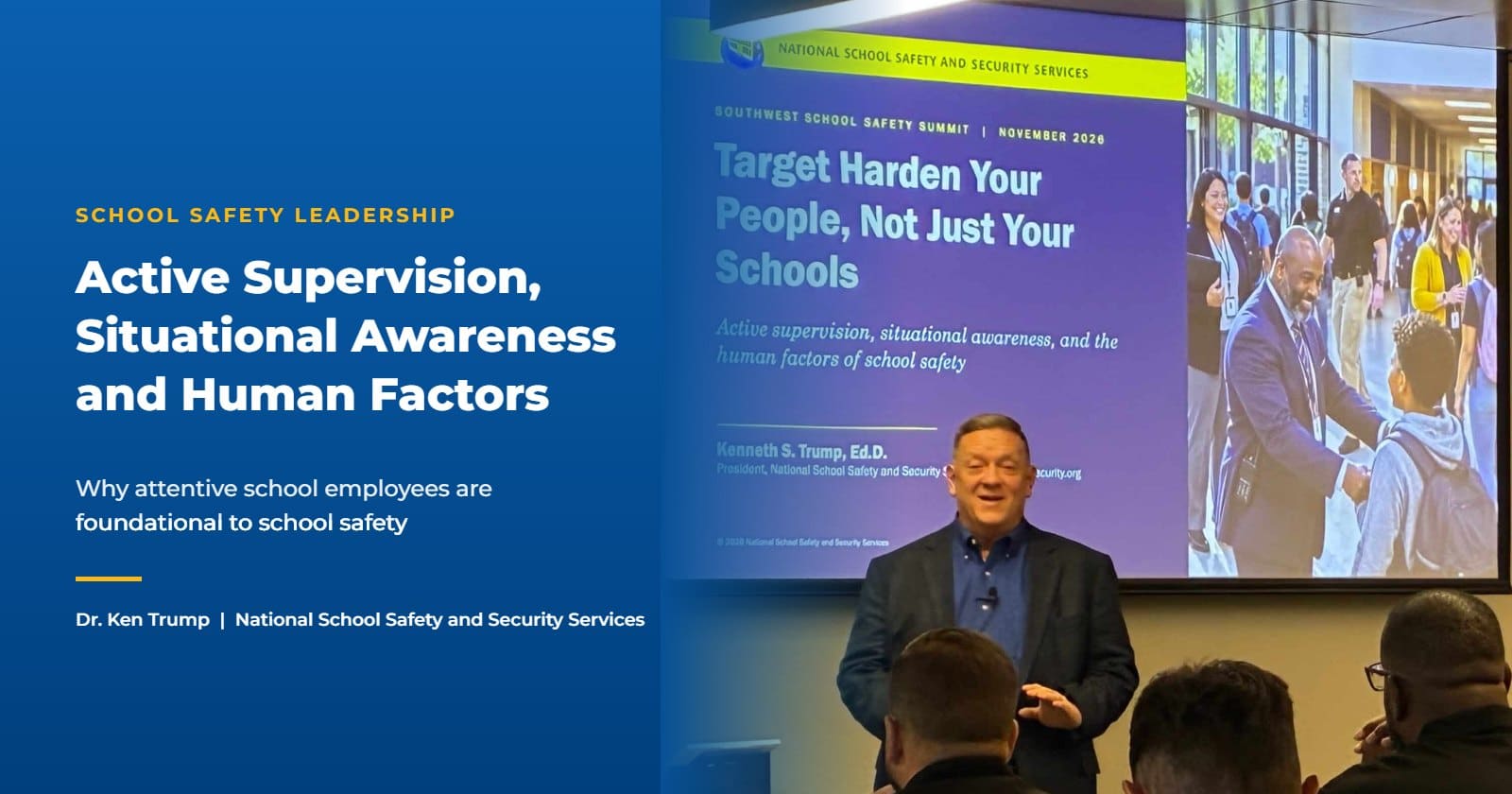
School leaders should target harden their people, not just their schools.
The following research and professional resources provide additional background on active supervision, situational awareness, human factors, decision-making, and school safety training.
National School Safety and Security Services provides independent school safety consulting, assessments, leadership consultations, and professional development to help schools strengthen the human and operational foundations of safety.
Our work emphasizes leadership, active supervision, situational awareness, emergency preparedness, communications, and fidelity of implementation, not simply physical security products or written compliance documents.
Explore our additional resources:
ASSESSMENTS AND TRAINING
Strengthen the human side of school safety. Our independent school safety assessments, leadership consultations, and training programs help school and district leaders evaluate actual practices, strengthen employee awareness, and improve preparedness beyond written plans and security equipment.
Learn More About Our School Safety AssessmentsExplore Our School Safety Training ProgramsKenneth S. Trump, Ed.D., is President and CEO of National School Safety and Security Services, an independent national PreK–12 school safety, security, and emergency preparedness consulting, training, and expert witness firm. He has more than four decades of experience in school safety and earned his doctorate in education from Johns Hopkins University, where his research focused on strategic school safety leadership and communications in environments of ambiguity and uncertainty. National School Safety and Security Services does not sell security products or accept security vendor sponsorships or sales commissions.

President, National School Safety and Security Services
Dr. Kenneth S. Trump is President of National School Safety and Security Services, an independent, non-product-affiliated school safety consulting firm. With more than 40 years of experience in PreK–12 school safety, security, and emergency preparedness, he provides independent analysis and strategic guidance to school leaders nationwide.