
States Should Let School Districts Decide School Safety Needs
In recent years, states have increasingly passed Alyssa’s Law and similar legislation requiring schools to implement panic button systems. The laws are typically promoted as a way to improve emergency response during school shootings and other catastrophic incidents.
The rationale is understandable. Alyssa’s Law is named after the victim of the Parkland school shooting. Few school safety issues evoke stronger emotions than protecting students and staff from active shooters.
But as more data become available, a critical question deserves attention:
Why are states mandating panic buttons based largely on fears of school shootings when the available data show they are overwhelmingly used for routine student behavior and operational incidents instead?
Panic Button Data Show Different Real-World Usage
The latest data come from one of the nation’s largest panic button companies.
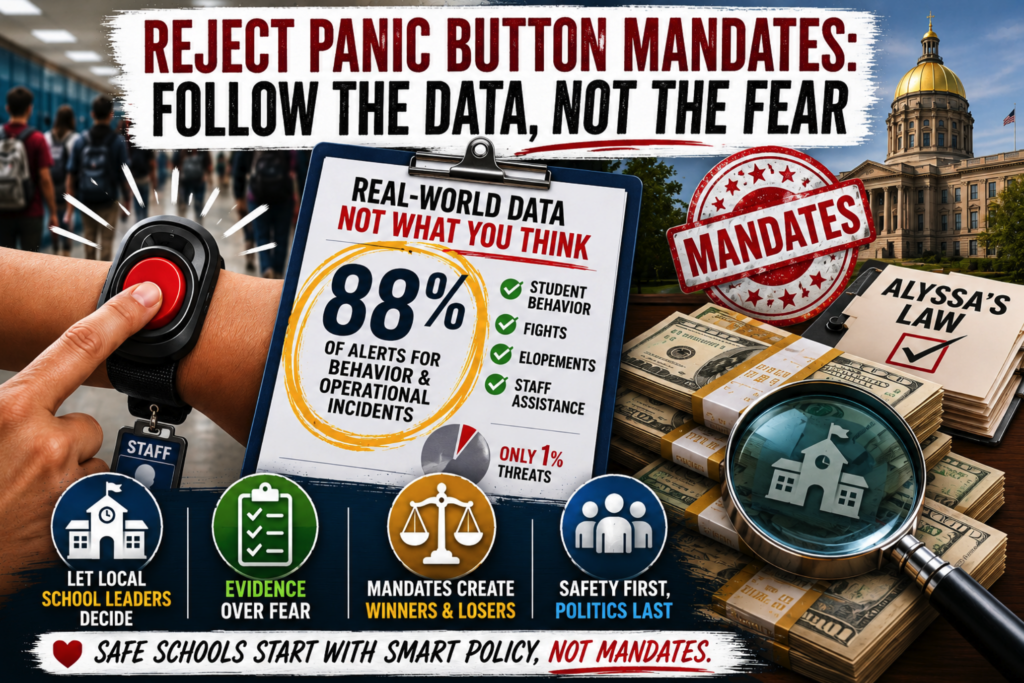
According to a post by Centegix, their own analysis of more than 346,000 wearable panic button activations during the 2025-2026 school year found that:
- 88% involved behavior-related incidents
- Many alerts were related to student fights and physical altercations
- Student elopements were a significant category
- Staff frequently used the system to request immediate assistance
Notably, the company’s reported data do not indicate widespread use for school shootings, armed intruders, or other high-profile critical incidents.
These findings closely mirror data previously reported from Florida.
According to publicly reported Florida data involving approximately 54,000 panic button activations:
- 44% involved student behavior
- 23% involved drills
- 13% involved testing
- 1% involved campus threats
- 1% involved suspicious activity
The pattern is clear. Panic buttons appear to be used primarily for day-to-day school operations rather than the rare catastrophic events often highlighted in legislative debates.

School Districts Should Have the Option to Buy Panic Buttons, But Not Be Forced to Buy Them
This is not an argument against panic buttons.
Some districts may find them valuable. Schools facing frequent behavioral incidents, large campuses, staffing challenges, or communication concerns may decide the systems improve coordination and response times.
That is a local decision. If school leaders determine panic buttons support their operational needs, they certainly can have the choice to purchase them.
But the issue is not whether schools can buy panic buttons.
The issue is whether state governments should force every school to buy them.
Why Statewide School Safety Technology Mandates Are Problematic
School districts vary enormously in size, risk factors, staffing levels, budgets, and safety priorities. A rural district may have very different needs than a large urban district.
When states mandate specific technologies, they remove local discretion and create guaranteed markets for vendors.
That raises important policy questions:
- What independent research supports the mandate?
- What alternatives were considered?
- What are the long-term costs?
- What school safety priorities are displaced?
- Who benefits financially from the requirement?
These are reasonable questions whenever governments require schools to purchase specific products.
Georgia Highlights the Risks of Mandated School Safety Products
Recent controversy in Georgia illustrates why transparency matters.
Georgia lawmakers have called for an investigation into reported relationships involving its Governor, a childhood friend who founded a major panic button company, and the founder’s brother, a now-former U.S. Senate candidate. The governor has dismissed the allegations as unfounded and politically motivated.
Whether those claims have merit is for investigators, journalists, and voters to determine. But the controversy underscores a broader concern.
Public reporting indicates one panic button company received approximately $27 million in Georgia school contracts. The state is one that enacted a statewide panic button requirement.
This does not prove wrongdoing. It does demonstrate why policymakers and taxpayers should carefully examine lobbying, political influence, and financial interests whenever states mandate school safety technologies.

School Safety Policy Should Follow Evidence, Not Fear
The available data increasingly show that panic buttons are primarily being used for student behavior incidents, fights, elopements, and routine operational needs.
School safety decisions should be guided by evidence, independent research, local risk assessments, and transparent policymaking.
Not fear. Not emotions. Not lobbying. Not politics.
And not the financial interests of those who stand to profit from the mandate.
Dr. Kenneth S. Trump is President of National School Safety and Security Services
National School Safety and Security Services
Experts You Can Trust!
Connect with Dr. Ken on Linkedin: www.linkedin.com/in/kentrump/
Follow Dr. Ken on X(Twitter) @safeschools
Visit and “Like” Our Facebook School Safety News Channel at: www.facebook.com/schoolsafety