
When Parents Threaten or Attack School Employees: Prevention, De-escalation and Response
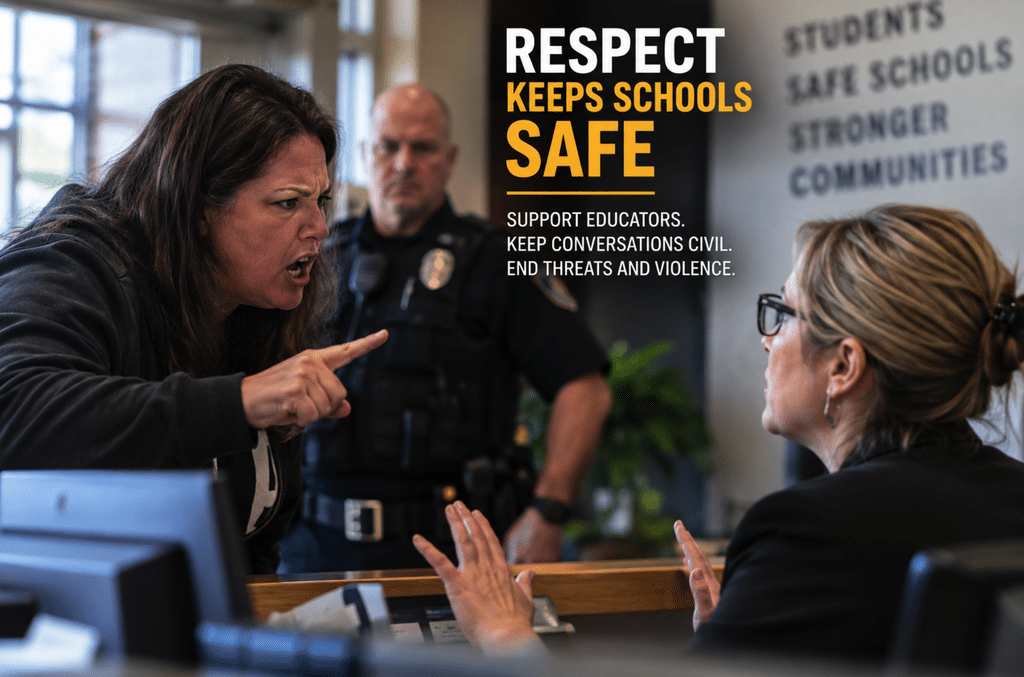
Disruptive, threatening and sometimes violent parents and other adults are creating serious safety challenges for teachers, principals, front office staff, school security personnel and school resource officers.
Angry parents are not new. School leaders have dealt with heated meetings, complaints and confrontations for decades. What deserves greater attention today is the intensity, frequency and escalation potential of some encounters, including threats, intimidation, harassment, social media attacks, attempts to bypass school security procedures and physical assaults.
This is not simply a customer service problem. Once behavior crosses from disagreement into intimidation, threats or violence, it becomes a school safety and workplace violence issue.
Parent Threats Against School Administrators: What Does the Research Tell Us?
This is more than anecdotal.
The American Psychological Association’s Task Force on Violence Against Educators and School Personnel conducted three national surveys involving more than 35,000 teachers, administrators, school psychologists, social workers, counselors and other school staff from all 50 states and Puerto Rico.
The research found high rates of verbal, threatening and physical aggression against school personnel from students, parents and others. Importantly, administrators reported the highest rates of violence from parents.
Research reported by The Ohio State University in July 2026 provides an even sharper picture. After COVID-era restrictions were lifted, 77% of school administrators surveyed reported verbal or threatening aggression from parents, nearly 3.5 times the rate reported by teachers. Even during COVID restrictions, when many schools were operating remotely, 42% of administrators reported verbal or threatening aggression from parents.
A national study published in American Psychologist, Violence and Aggression Against Educators and School Personnel, Retention, Stress, and Training Needs, similarly found that aggression declined during pandemic restrictions but returned to pre-pandemic levels or higher once in-person schooling resumed.
The message for school leaders is straightforward: Threats and aggression toward school employees should neither be considered rare anomalies nor accepted as simply part of working in education.
What Has Changed With Aggressive and Threatening Parents?
Schools have always had upset parents. But the environment in which those conflicts occur has changed.
Conflict can escalate faster
A parent who once had to call the school, schedule a meeting or physically come to the office can now send emails, texts and social media posts instantly. Anger can intensify before school administrators even have an opportunity to understand or address the underlying concern.
School employees are increasingly accessible
Email, messaging platforms, cell phones and social media have blurred traditional boundaries between school employees and the public. Some parents expect immediate access and immediate answers, even when administrators need time to investigate facts.
Online outrage can become an in-person confrontation
Social media can amplify incomplete information, rumors and accusations. A controversy involving one student or employee can quickly generate calls, messages and visits from people who have little or no firsthand knowledge of what actually occurred.
Expectations about acceptable behavior have shifted
School leaders increasingly describe encounters in which individuals believe frustration with a school decision gives them license to insult, intimidate or threaten employees. It does not.
Schools can listen to criticism, acknowledge frustration and work through legitimate disagreements while simultaneously establishing boundaries for unacceptable conduct.
An Angry Parent Is Not Necessarily a Threatening Parent
School leaders should avoid treating every frustrated or emotional parent as a security threat.
Parents have every right to question decisions, advocate for their children, disagree with administrators and expect school officials to listen to legitimate concerns. The distinction is behavior.
A difficult conversation may include anger or strong disagreement. A potential safety problem can include behaviors such as:
- Direct or implied threats of physical harm
- Statements about returning with a weapon or “taking care of” an employee
- Repeated threatening calls, emails, texts or social media messages
- Attempts to force entry into secured areas
- Refusing to leave school property when directed
- Stalking or following employees
- Destroying property
- Physically intimidating or cornering employees
- Bringing additional people to a school to confront an employee
- Fighting with staff, security officers or police
- Assaulting or attempting to assault an employee
Context matters. School administrators and safety officials should evaluate the behavior, circumstances, credibility, escalation and potential capability of the individual, rather than relying solely on whether someone used a particular threatening phrase.

Preventing Parent Confrontations Starts Before Someone Enters the School
The best time to develop procedures for aggressive visitors is not when someone is screaming in the school office.
1. Establish Expectations for Parent and Visitor Behavior
District and school policies should clearly state that respectful disagreement is welcome but threats, intimidation, harassment and violence are not.
Consider communicating expectations through visitor policies, parent handbooks, district websites, meeting notices and other routine communications.
The purpose is not to discourage parent engagement. It is to establish reasonable boundaries for that engagement.
2. Control School Visitor Access
Exterior doors should be secured and visitors should enter through designated locations. Reception staff should know:
- How visitors are admitted
- Where meetings should occur
- When administrators should be notified
- When school security or an SRO should be called
- When an individual should not be allowed beyond the main office
- How to summon immediate assistance if an encounter escalates
School access control and visitor management technology can support this process, but technology does not replace attentive staff, sound judgment and clearly understood procedures.
One of the simplest layers of security remains an alert employee willing to acknowledge an unfamiliar or concerning visitor with a professional “Hello. May I help you?” (The federal Cybersecurity and Infrastructure Security Agency similarly promotes its Power of Hello approach to encourage employees to recognize concerning behavior and engage people appropriately.)
3. Avoid Putting Employees in Unnecessarily Vulnerable Situations
If a parent has previously been threatening or volatile, do not automatically schedule the next meeting as though nothing happened.
Depending upon the circumstances, consider:
- Having two administrators present
- Meeting near an exit
- Using a conference room rather than an isolated private office
- Alerting security personnel or the SRO in advance
- Establishing a beginning and ending time
- Clearly identifying expectations for conduct
- Conducting a virtual meeting when appropriate
- Moving meetings to a district office or other controlled setting when necessary
These are simple administrative precautions that can reduce opportunities for escalation.
4. Train Front Office Staff
School secretaries and reception personnel are often the first employees to encounter an angry visitor. They should not be expected to improvise.
Front office employees should know who to contact, what language to use, where they can retreat if necessary and how to summon assistance quickly. They also need administrative support when they enforce visitor procedures.
A locked door means little if an intimidated employee is pressured into opening it.
5. Watch for Escalating Patterns
Many serious incidents do not begin with an assault. They may begin with increasingly hostile emails, repeated unannounced visits, fixation on an employee, threatening language, online attacks or refusal to follow normal communication channels.
Individual incidents that appear relatively minor when viewed separately may look very different when examined together. Documentation and communication among administrators, security personnel, school police or SROs, human resources, legal counsel and other appropriate officials can help identify an escalating pattern.
A comprehensive school safety and security assessment should examine these human and operational issues along with physical security, access control, visitor management, supervision and emergency preparedness.

How Should School Staff De-escalate an Angry Parent?
School employees who regularly interact with parents and visitors should receive practical training for managing confrontational adults. Effective de-escalation can include:
- Maintaining a calm, professional tone
- Listening without immediately arguing every factual point
- Acknowledging the person’s concern without agreeing with inappropriate behavior
- Maintaining physical space
- Avoiding unnecessary physical contact
- Providing clear choices and boundaries
- Moving students and bystanders away from the confrontation
- Recognizing when continued conversation is no longer productive
- Knowing when to call another administrator, security personnel, an SRO or law enforcement
De-escalation does not mean tolerating abuse indefinitely. There is a point at which the objective changes from resolving the parent’s concern to protecting employees and maintaining a safe environment.

When Should a Meeting With an Aggressive Parent End?
Administrators should be willing to end meetings when behavior becomes threatening, abusive or unsafe.
A school leader can calmly advise the individual that the meeting cannot continue while threats or abusive behavior are occurring and that another opportunity to communicate can be established under appropriate conditions. Employees should not feel obligated to remain trapped in a room attempting to “customer service” their way through escalating intimidation.
Good customer service and good school security are not competing goals. Both require respectful boundaries.
When Should Schools Call Law Enforcement?
Not every argument requires police intervention. But threats of violence, assaults, weapons, stalking, forced entry, property destruction and other potentially criminal behavior should not be minimized simply because the aggressor is a parent.
School leaders should have established protocols for contacting school resource officers, school police or local law enforcement. Potential criminal conduct should be treated as potential criminal conduct.
Administrators should also coordinate with district legal counsel regarding issues such as trespass notices, restrictions on building access, protective orders and other legal remedies appropriate to their jurisdiction and circumstances.
When Does a Parent Threat Require Threat Assessment?
A parent’s threat should not be evaluated solely by asking whether school officials believe the person “really meant it.” Threat assessment requires looking at the totality of circumstances.
Depending upon the incident, assessment considerations may include, but not necessarily be limited to, areas such as:
- What exactly was said or done and whether the threat was specific
- Whether a particular employee, student or location was identified
- Whether the person has engaged in similar conduct previously
- Whether the behavior is escalating
- Whether there are indications of planning or preparation
- Whether there is known or reasonably obtainable information concerning access to weapons
- Whether the person appears fixated on a particular employee or grievance
- Whether stalking or surveillance behaviors have occurred
- Whether concerning communications have occurred online or through third parties
- What protective measures may be appropriate while the situation is being evaluated
Schools should involve appropriately trained personnel and law enforcement when circumstances warrant.
Threat assessment should be a structured process rather than an emotional reaction to an alarming statement. Our school threat assessment resources emphasize multidisciplinary assessment, defensible decision-making and consistent protocols rather than ad hoc responses.
Do Not Forget Employee Safety After the Parent Leaves
The incident does not necessarily end when an aggressive parent walks out of the building.
Depending upon the circumstances, administrators should consider whether an employee needs an escort to a vehicle, should avoid leaving alone, is being targeted online, needs temporary changes to work routines or should be notified about subsequent contact from the individual. Employees may also need assistance or other support following a frightening encounter.
Administrators should conduct an after-action review addressing questions such as:
- What happened and were there warning signs before the incident?
- What worked and what failed?
- Did employees know how to summon help?
- Were access control and visitor procedures effective?
- Was information communicated quickly enough?
- Were warning behaviors documented and shared with the people who needed to know?
- What should be changed before another incident occurs?
School security and emergency preparedness planning should address people, policies, procedures, supervision and communications, not simply doors, cameras and security technology.
Every serious incident should make your school and district smarter as you debrief and revise your protocols and training based upon experiences and lessons learned.

Avoid Two Dangerous Extremes
School leaders should avoid both overreaction and underreaction.
Treating every angry parent like a criminal can damage trust and make productive parent engagement more difficult. But normalizing threats because “parents get emotional” can put employees at unnecessary risk.
The goal is proportionate, behavior-based decision-making: listen to concerns, attempt to resolve legitimate problems, de-escalate where possible, set boundaries, document concerning conduct, assess threats when appropriate, and act decisively when behavior crosses the line into intimidation, threats or violence.
School Safety Includes Protecting the Adults Who Protect Children
Teachers, principals, secretaries, counselors, custodians, school security officers and school resource officers should not have to accept threats or assaults as conditions of employment.
Schools devote significant attention to controlling doors, installing cameras and preparing for outside threats. Yet one of the most immediate safety challenges may be an angry individual already standing at the front desk.
Effective school safety requires more than physical security. It requires clear expectations, active supervision, situational awareness, communication, trained employees, strong leadership and the willingness to intervene before disruptive behavior escalates into violence.
That is not about keeping parents out of schools. It is about keeping schools safe while preserving constructive parent engagement.
Frequently Asked Questions About Threatening and Aggressive Parents at Schools
How should schools handle threatening parents?
Schools should distinguish legitimate disagreement from threatening behavior, document concerning incidents, establish clear behavioral boundaries, use de-escalation where appropriate, involve school security or law enforcement when necessary, and evaluate threats or escalating behavior that raise legitimate safety concerns.
Are threats and aggression from parents against school administrators increasing?
National research indicates that aggression against educators and school personnel declined during COVID-related restrictions and returned to pre-pandemic levels or higher once normal in-person schooling resumed. In a 2026 study reported by The Ohio State University, 77% of administrators surveyed reported verbal or threatening aggression from parents after restrictions were lifted.
Can a school remove an aggressive parent from the building?
Schools generally have authority to maintain safe and orderly facilities, but specific legal authority and procedures vary by state and jurisdiction. Administrators should follow district policies and consult legal counsel and law enforcement regarding removal, trespass restrictions, protective orders and future access when appropriate.
Should schools call police when a parent threatens a teacher or principal?
The response should depend on the behavior and circumstances. Credible threats of violence, assaults, weapons, stalking, forced entry and other potentially criminal conduct may warrant prompt law enforcement involvement. Schools should establish protocols before an incident occurs rather than trying to determine responsibilities during a confrontation.
How can schools prevent confrontations with angry parents?
Prevention strategies include controlled visitor access, clearly communicated behavioral expectations, trained front office staff, effective communication, documentation of escalating behavior, advance planning for meetings involving individuals with a history of aggression, and ready access to administrators, security personnel, SROs or law enforcement.
Should school employees receive de-escalation training?
Yes. Staff who regularly interact with parents and visitors should understand practical verbal de-escalation techniques, personal safety, situational awareness, behavioral warning signs, emergency communications and when to disengage and summon assistance.
Should schools document threatening behavior by parents?
Yes. Documentation can help school administrators identify patterns of escalation that may not be apparent when individual incidents are viewed separately. Documentation may also become important for threat assessment, employee protection, administrative decisions, legal consultation or law enforcement investigation.
Does school visitor management technology prevent violent parent incidents?
Visitor management technology can be one layer of school security, but it cannot substitute for alert employees, controlled access, clear procedures, situational awareness and effective supervision. Schools should focus on the interaction between people, policies, procedures and technology rather than expecting a security product to solve a behavioral problem.