
School emergency plans are usually built around the knowns. Strategic school security leadership gets tested by the “unknown unknowns.”
Schools appropriately plan and train for foreseeable emergencies: fires, severe weather, medical emergencies, threats, violence, evacuations, lockdowns, reunification, and other scenarios. But some of the most difficult situations confronting superintendents and school administrators do not fit neatly under any tab in the district’s emergency plan.
A recent situation involving Winston-Salem/Forsyth County Schools in North Carolina is a striking example.
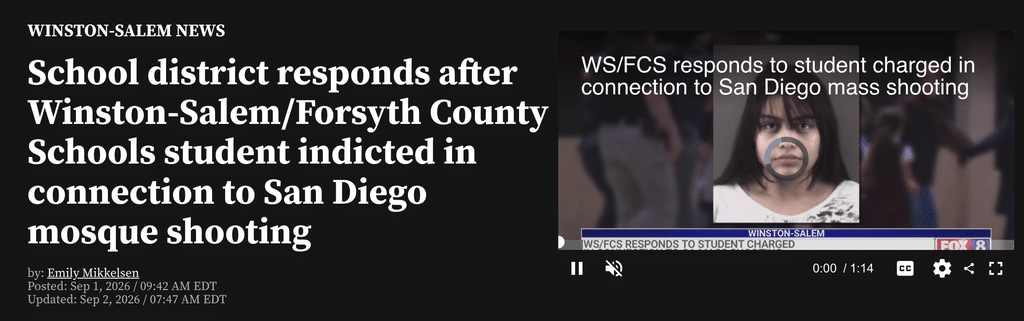
According to FOX8, the district found itself responding after learning that one of its students had been indicted in connection with a mass shooting at an Islamic center in San Diego, California, months earlier and thousands of miles away. Read the FOX8 report
Think about what can suddenly land on a superintendent’s desk in a situation like this: What did the school know? Were other students involved or aware? Are there continuing safety concerns? What can legally be disclosed? What do staff and parents need to know? Who coordinates with law enforcement? Who speaks to the media? What happens when social media speculation gets ahead of verified facts?
There probably isn’t a checklist sitting in the crisis plan labeled “Student indicted months later in connection with an out-of-state mass shooting.”
And that’s precisely the point.

School Crisis Planning Cannot Anticipate Everything
The goal of effective school emergency preparedness should not be to write a separate protocol for every conceivable crisis. That is impossible.
Instead, districts need strategic school safety leadership capable of operating when information is incomplete, circumstances are ambiguous, emotions are high, and the situation does not resemble the tabletop exercise administrators practiced six months ago.
Plans, protocols, and training still matter.But ultimately, people have to make decisions when the plan runs out of pages. And we know that cognitive overload with voluminous plans actually adds to the anxiety of teachers, administrators, and school support staff, leading some people to shut down and fear making any decision at all when a crisis strikes.
Preparing therefore requires leadership teams with clearly defined roles, trusted internal and external relationships, disciplined information verification, established communications processes, and the ability to distinguish what is known from what is assumed or rumored.

Preparing School Leaders for Ambiguity and Uncertainty
The “unknown unknowns” are also why school crisis preparedness must extend beyond traditional emergency operations.
Superintendents, principals, communications professionals, school safety personnel, legal counsel, student services staff, law enforcement partners, and other key leaders need to know how they will work together when the unexpected happens, not simply what their individual emergency-plan responsibilities say.
Strategic school safety leadership asks different questions:
- Who needs to be at the table when an unusual crisis emerges?
- How will facts be verified before leaders act or communicate?
- Who has decision-making authority when circumstances fall outside existing protocols?
- How will operational, legal, student-support, safety, and communications considerations be integrated?
- How will leaders communicate what they know, what they don’t know, and what they are doing next?
Those capabilities are transferable from one crisis to another, including crises no one anticipated.

Frequently Asked Questions About Strategic School Safety Leadership
What is strategic school safety leadership?
Strategic school safety leadership is the ability of school and district leaders to make sound safety decisions, coordinate people and resources, communicate effectively, and adapt when circumstances are uncertain or do not fit existing plans and protocols. It goes beyond emergency procedures to focus on leadership, judgment, relationships, communication, and decision-making.
How can schools prepare for emergencies they cannot predict?
Schools cannot create a written procedure for every possible crisis. They can prepare leadership teams to verify information, establish decision-making authority, coordinate with key partners, communicate under pressure, support students and staff, and adapt existing emergency plans to unexpected circumstances.
What are “unknown unknowns” in school safety?
“Unknown unknowns” are threats, incidents, or circumstances school leaders did not anticipate and therefore may not have specifically addressed in their emergency plans. These situations test whether administrators can apply established safety principles and sound judgment when there is no ready-made checklist for what is happening.
Why aren’t school emergency plans alone enough?
Emergency plans provide essential structure, roles, procedures, and guidance, but no plan can anticipate every situation a school district may face. Effective preparedness therefore requires both strong emergency plans and leaders prepared to make decisions when circumstances fall outside those plans.

The Bottom Line: Prepare People, Not Just Plans
One of the greatest mistakes in school emergency preparedness is assuming that a comprehensive binder, app, template, or collection of protocols equals preparedness. It doesn’t. Emergency plans that are 100+ pages in length may actually be counterproductive in some ways by overwhelming school leaders and their staff.
You cannot predict every crisis that will confront a school district. You can develop leaders who are better prepared to manage whatever comes through the door.
That is the difference between simply having a school emergency plan and developing strategic school safety leadership capable of navigating ambiguity, uncertainty, and the inevitable “unknown unknowns.”
Sometimes the most important question isn’t, “Do we have a plan for this?”
It’s “Are our people prepared to lead when we don’t?”
Dr. Kenneth S. Trump is President of National School Safety and Security Services
National School Safety and Security Services
Experts You Can Trust!
Connect with Dr. Ken on Linkedin: www.linkedin.com/in/kentrump/
Follow Dr. Ken on X(Twitter) @safeschools
Visit and “Like” Our Facebook School Safety News Channel at: www.facebook.com/schoolsafety