
A loaded gun gets through school weapons screening. The district increases detector sensitivity and considers more security equipment. But who decided the original settings were acceptable, and what happened to implementation fidelity?
Following an incident in which a student brought a loaded firearm into Kalamazoo Central High School in Michigan, the Kalamazoo Public Schools superintendent has offered an explanation that deserves closer scrutiny from school boards, parents, and the news media.
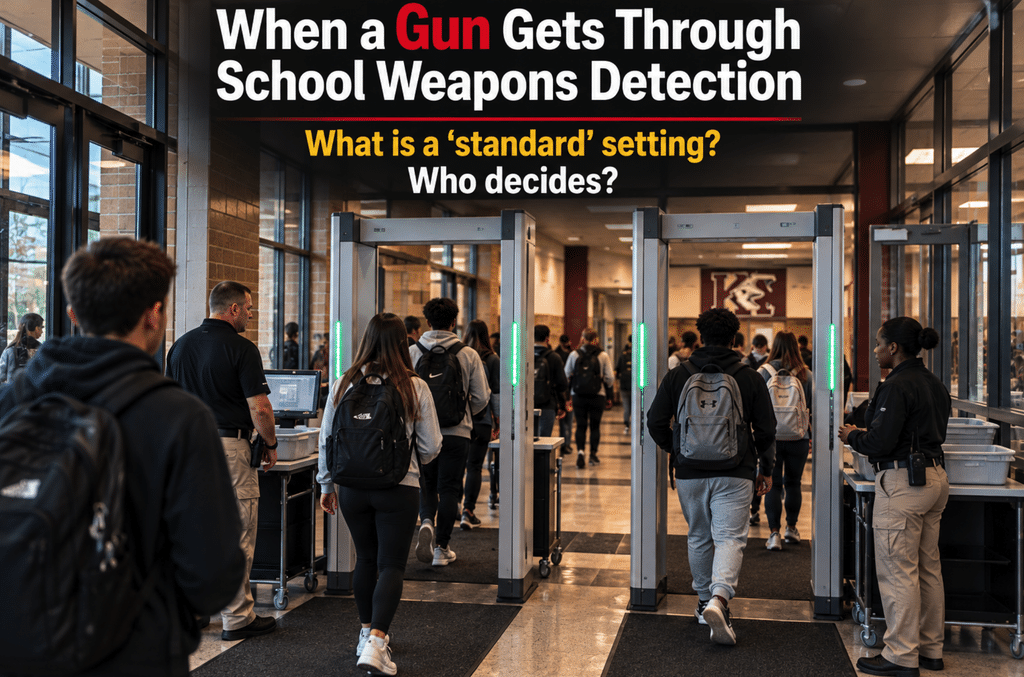
According to WWMT News Channel 3 reporting on October 27, Superintendent Dr. Darrin Slade indicated that the district did not believe its weapons detection equipment malfunctioned. Instead, he explained that the detectors had been operating at a “standard level” of sensitivity and that the district subsequently increased the sensitivity at its middle and high schools.
That explanation should raise more questions than it answers.
What Exactly Is a “Standard Level” of Weapons Detection?
The first question the news media, parents, and school board members should ask is simple: Who determines what constitutes a “standard” sensitivity level?
Is that standard established by the manufacturer? Recommended by a security integrator? Selected by the school district? Jointly determined by the vendor and district officials? And most importantly, what types of weapons and other objects is that supposedly standard setting intended to detect?
The term “standard” sounds reassuring. It suggests an established, appropriate, and perhaps even validated level of protection. But without a clear explanation of what the setting means, what it is designed to detect, and who approved it, the term tells parents very little about the actual security provided.
In fact, earlier WWMT reporting quoted the equipment manufacturer, CEIA, explaining that a properly operated system configured at a sensitivity appropriate for handgun detection will detect a loaded handgun. That makes the district’s explanation even more troubling.
Was the previously designated “standard” setting appropriate for detecting handguns? Who verified that, using what testing protocols, and when? If the setting was appropriate, what explains the failure to detect the firearm? If it was not appropriate, why was the district operating its systems at that level?
If a loaded firearm passed through a detector operating at its designated standard setting without triggering an alarm, school leaders must examine whether that setting was appropriate for the security objectives they believed they were achieving.
Was the equipment operating as designed, but the screening program itself designed or configured below the level of protection parents reasonably expected?
That is a question of implementation fidelity, not simply equipment functionality.

Was Substandard Implementation Built Into the Plan?
Implementation fidelity means that safety measures are consistently carried out as intended, with the staffing, training, equipment configurations, supervision, and operating procedures necessary to achieve their objectives.
A detector can be functioning exactly as configured while the overall security program fails to meet its intended purpose.
If the so-called standard setting did not detect the firearm, and the district subsequently increased sensitivity to detect more objects, what does that tell us about the original operational decisions?
Was the district prioritizing student throughput over detection sensitivity? Was the balance between those competing objectives explicitly evaluated, tested, documented, and approved? Did school leaders understand the limitations and tradeoffs before deploying the system? Were reasonable expectations transparently communicated to parents, staff, students, and the school community?
We cannot conclude from the reported incident alone that the district violated a manufacturer’s specifications or failed to follow its own written procedures. But those are precisely the questions an independent operational review should address.
Implementation fidelity cannot be measured simply by whether equipment is turned on, students walk through it, and staff members are stationed nearby.

Higher Sensitivity Means Longer Lines. So Students Must Adjust?
According to the WWMT report, higher detector sensitivity can trigger additional alarms from everyday objects, potentially slowing students entering the building. The superintendent suggested those delays typically decrease as students become accustomed to the screening procedures.
Think about the implications of that explanation. Are we now expecting students to adjust their daily routines to accommodate screening systems that may not have been configured to achieve the district’s intended detection objectives in the first place?
Certainly, students can be taught appropriate screening procedures. But student compliance and adjustment are not substitutes for sound operational planning.
Increasing sensitivity potentially means more alarms, more secondary screening, more staff intervention, and greater demands on personnel already responsible for supervising students.
The question is not simply how quickly students can learn to move through the equipment. It is whether the district has the personnel, time, training, and procedures necessary to maintain detection effectiveness consistently, even during the busiest arrival periods.
If throughput pressures contributed to the original sensitivity decisions, increasing sensitivity without resolving those operational pressures may simply create a different set of implementation challenges.
More Equipment: Security Improvement or Security Theater?
Now, following the incident, district leaders are reportedly considering additional security measures, including clear backpacks and X-ray machines for screening bags.
Here we go again with the school security industry’s familiar response to security failures: When existing equipment does not deliver the expected protection, consider purchasing and deploying even more equipment.
Clear backpacks create the illusion of increased security but are not inherently reliable weapons detection tools. X-ray screening equipment requires personnel, training, inspection procedures, and time to evaluate the contents of bags. Neither option eliminates the human factors that can undermine effectiveness.
Before adding another layer of hardware, school leaders should be asking whether they have demonstrated the capacity to operate their existing systems with fidelity. Otherwise, districts risk creating security theater: increasingly visible layers of equipment that may reassure observers without delivering the level of protection they assume exists.
Additional equipment might have a legitimate role in a carefully evaluated security strategy. But more hardware should not be the automatic response to unanswered questions about the effectiveness of hardware already installed.

The Staff Time and Student Engagement Tradeoff
Perhaps the most important question is receiving the least attention: How much more limited school staff time, attention, and resources will be devoted to operating security equipment instead of directly engaging with students to prevent weapons incidents in the first place?
Every additional screening station, secondary search, X-ray machine, or bag inspection procedure introduces operational demands. Those demands require people, not just products.
School staff have finite time and attention. Increasing responsibilities for equipment operation can reduce their opportunities for active supervision, building trusting student relationships, recognizing concerning behaviors, identifying conflicts, and intervening before situations escalate.
Ironically, the Kalamazoo superintendent also credited students who reported the presence of a gun to school staff, emphasizing the importance of communication between students and trusted adults.
That deserves more attention. In this incident, human communication provided an important layer of protection where technology apparently did not.
School safety is not an either-or choice between people and equipment. But school boards and superintendents must recognize that every new technological intervention carries staffing, operational, financial, and human-factor consequences.
The strategic school safety leadership question is not how much more equipment we can put between students and their classrooms. It is whether we are investing enough in the people, relationships, supervision, and early intervention needed to keep weapons from reaching schools in the first place.
And until district leaders can clearly explain what “standard” detection means, who determined that standard, and whether it was appropriate for their stated security objectives, purchasing more equipment should not be mistaken for solving the underlying problem.


Dr. Kenneth S. Trump
President, National School Safety and Security Services
Dr. Kenneth S. Trump is President of National School Safety and Security Services, an independent, non-product-affiliated school safety consulting firm. With more than 40 years of experience in PreK–12 school safety, security, and emergency preparedness, he provides independent analysis and strategic guidance to school leaders nationwide.