
A new peer-reviewed study shows public opinion is more nuanced than headlines suggest. The findings reinforce the need for evidence-based, developmentally appropriate school safety policies, transparent communication, and careful evaluation of trade-offs.
When school violence captures national headlines, public pressure often drives calls for more visible school security measures. Active shooter drills, target hardening, and proposals to arm teachers frequently dominate the discussion.
But a newly published peer-reviewed study reminds us that public opinion is far more nuanced than political rhetoric, social media debates, or vendor marketing messages often suggest. [Densley, J. A., Pyrooz, D. C., & Peterson, J. K. (2026). Public Support for Active Shooter Drills, Arming Teachers, and Target Hardening: Evidence from a National Experiment. Journal of School Violence, 1–24. https://doi.org/10.1080/15388220.2026.2704742]
The researchers found varying levels of public support for active shooter drills, target hardening measures, and arming teachers. Just as importantly, they found that support often depends on how these strategies are explained, what trade-offs are presented, and how people understand their potential benefits and risks.
The study found that public support for several school security measures became more cautious once respondents were provided with additional information about their potential benefits, limitations, and trade-offs. Support for active shooter drills and target hardening measures declined when participants were presented with more detailed explanations rather than simple descriptions of the strategies.
Rather than viewing these school security strategies in absolute terms, many respondents weighed competing priorities, including student safety, educational climate, developmental considerations, and implementation concerns.
These findings suggest that initial support for highly visible security measures may be influenced by limited information and that opinions become more measured when people are encouraged to consider developmental impacts, implementation challenges, costs, and potential unintended consequences. This reinforces the value of informed public engagement and evidence-based decision making over emotional reactions or marketing claims
Perhaps the study’s most important takeaway appears in its abstract:
“The findings support evidence-informed, developmentally sensitive policies and candid communication of trade-offs.”
That conclusion should resonate with every superintendent, school board member, principal, and school safety leader.
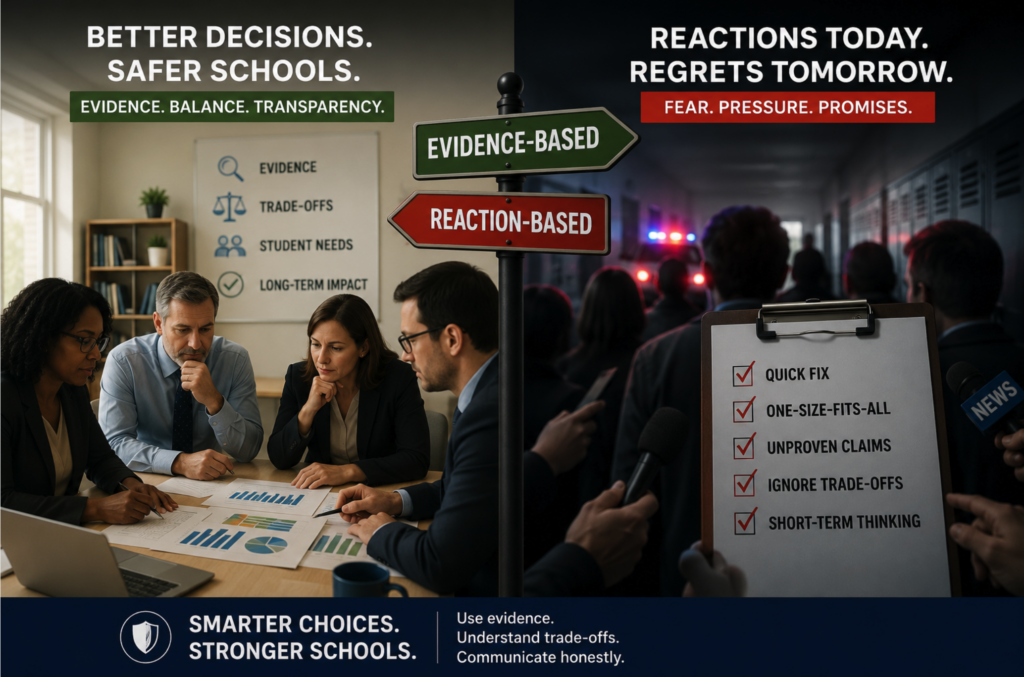
Evidence-Based School Safety Decisions Produce Better Long-Term Outcomes
Too often, school safety decisions are made immediately after a tragedy, when emotions understandably run high. At other times, decisions are influenced by persuasive marketing that promises a particular product, technology, or tactic will prevent the next school shooting.
Neither is a sound basis for school safety decision-making.
Effective school safety leadership requires asking difficult but essential questions:
- What evidence supports this strategy?
- What evidence challenges it?
- What are the intended benefits?
- What are the potential unintended consequences?
- How might this affect students at different developmental stages?
- What trade-offs accompany this decision?
These are governance questions, not marketing questions.
Active Shooter Drills, Target Hardening, and Arming Teachers All Involve Important Trade-Offs
There is no school security strategy that is entirely without cost, limitations, or unintended consequences.
Active shooter drills can improve preparedness, but how they are designed and conducted matters. Developmentally appropriate planning, clear communication, and avoiding unnecessarily traumatic exercises should remain priorities.
Target hardening and security measures such as access control, cameras, panic buttons, and weapons detection technologies require thoughtful deliberations, realistic expectations, ongoing evaluation, and integration into a broader school safety program. No single security measure should be viewed as a stand-alone solution.
Similarly, proposals to arm teachers continue to generate divided public opinion, illustrating that some school safety issues involve competing values rather than simple yes-or-no answers.
The study reinforces an important reality: every school security strategy involves both benefits and trade-offs.
Transparent Communication Helps Build Trust in School Safety Decisions
One of the study’s most valuable contributions is its emphasis on candid communication of trade-offs.
School leaders build credibility when they openly discuss both the strengths and limitations of school security measures rather than overselling their capabilities. Families, staff, students, and school boards deserve honest conversations about evidence, uncertainty, costs, benefits, and implementation challenges.
Confidence should come from transparent leadership, not false assurances.

Key Takeaways for School Leaders and School Boards
This new school safety research reinforces principles that effective school safety leaders have long recognized:
- Base school security decisions on credible evidence rather than fear, politics, or marketing.
- Consider the developmental needs of students when implementing school safety strategies.
- Recognize that every security measure involves benefits, limitations, costs, and trade-offs.
- Communicate openly and honestly with staff, parents, students, and the community.
- Continuously evaluate whether school security strategies are producing their intended outcomes.
The study’s conclusion deserves repeating:
The findings support evidence-informed, developmentally sensitive policies and candid communication of trade-offs.
That is a message school leaders should carry into every discussion about active shooter drills, target hardening, arming teachers, and other school security strategies.
Ultimately, stronger schools are built not through emotional reactions or marketing promises, but through thoughtful, evidence-based leadership, transparent communication, and a commitment to continuous improvement.
The best school security leadership decisions are driven by the strongest independent evidence.
School Security Leadership Quick FAQ Summary
What does the new study say about active shooter drills?
The study found that public support depends on how drills are designed, communicated, and implemented, with particular importance placed on developmentally appropriate practices and honest discussion of benefits and trade-offs.
Does the study support target hardening?
The research shows public support exists but is nuanced. Respondents considered benefits alongside costs, limitations, and potential unintended consequences.
What does the study say about arming teachers?
Public opinion remains divided, demonstrating that arming teachers continues to be one of the most debated school security policies.
What is the study’s most important conclusion?
The authors conclude that the findings support evidence-informed, developmentally sensitive policies and candid communication of trade-offs.
Dr. Kenneth S. Trump is President of National School Safety and Security Services
National School Safety and Security Services
Experts You Can Trust!
Connect with Dr. Ken on Linkedin: www.linkedin.com/in/kentrump/
Follow Dr. Ken on X(Twitter) @safeschools
Visit and “Like” Our Facebook School Safety News Channel at: www.facebook.com/schoolsafety