
New technology. Old emergency codes.
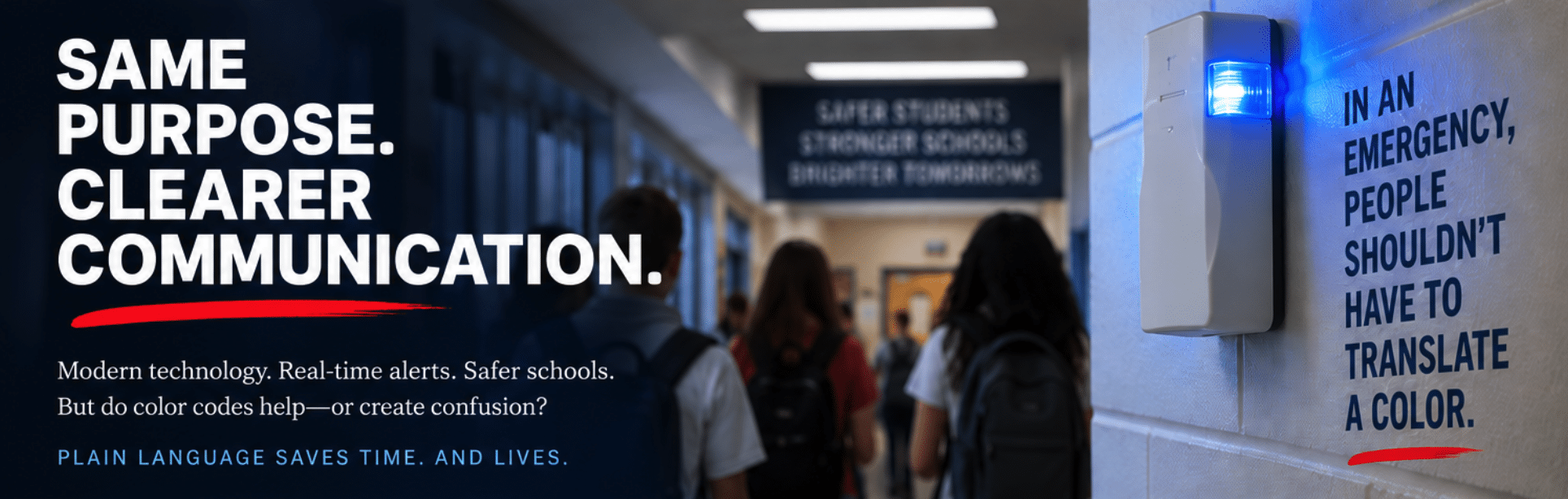
For roughly two decades, federal emergency-management doctrine has pushed emergency communications toward plain language and common terminology. Yet some of today’s newest school safety technologies are being implemented with red, blue, purple, orange and other colors tied to different emergency actions.
Are we using new technology to bring an old communications problem back?
A School Shooting Raises a Bigger Question
The August 12 shooting at Warner Robins High School in Georgia caught my attention for a reason beyond the shooting itself.
Students communicated. School resource officers already on campus responded. A teacher helped the wounded student. School personnel implemented protective procedures. The district also reported that a staff member used a CENTEGIX alert badge to activate lockdown procedures.
But two days before the shooting, the principal had told parents that CENTEGIX CrisisAlert drills would include “Code Yellow, Code Red, and Code Blue safety procedures with visual and audio notifications.” During the actual emergency, the district publicly announced that the school was under a “Code Red.”
The technology is new. The use of emergency codes isn’t.

FEMA and NIMS Have Been Moving the Other Direction
This isn’t simply my preference about terminology.
FEMA’s school emergency guidance says: “Use simple, clear language. Plain language is preferred over codes.”
It also warns: “The use of codes often causes incorrect responses under stress.”
And the 2017 National Incident Management System reinforced the principles that have been in place since after 9/11, describing the use of “plain language and clear text, not codes” in incident management as a matter of public safety.
That guidance has not subsequently been reversed. Yet some implementations of modern school emergency technology, as well as basic school emergency guidelines we are finding in schools without new technology, now assign multiple colors to different actions.
Red might mean lockdown. Purple might mean restricted movement. Blue might mean no entry. Orange might mean severe weather. Green might mean fire. White might mean all clear.
And with strobes and other visuals, at what point does a visual alert become another code people must decode?

Under Stress, Why Add Another Step?
Consider what happens cognitively: Purple → What does purple mean? → Restricted movement → What am I supposed to do?
Now compare that with: RESTRICT MOVEMENT. Remain where you are.
Research on acute stress has found effects on working memory and cognitive flexibility. That does not mean people cannot perform effectively under stress. Training and experience matter greatly.
But why create unnecessary cognitive work?
Visual notification can potentially serve an important purpose in some applications, including reaching people who may not hear an audible announcement.
The question is whether the visual signal reinforces a clear protective-action message or becomes another code that students, teachers, substitutes and visitors must remember.
New Technology Shouldn’t Recreate Old Problems
This is not about declaring that one product or another succeeded or failed based on one incident. Nor is it about assuming schools need wearable panic buttons or similar technologies in the first place.
It is about asking better questions such as: What problem are we trying to solve? Is additional technology necessary to solve it? And if we add technology, does it make the human response simpler or more complicated?
A product can operate exactly as designed and still raise legitimate questions about the procedures built around it. The technology has changed. Human cognitive limitations under stress have not.
I took a deeper look at the FEMA and NIMS history, examples of color-coded school alert systems, cognitive-load research, accessibility considerations and questions school leaders should ask in my new resource:
School Emergency Color Codes vs. Plain Language: What School Leaders Should Know
The bottom line worth thinking about as schools adopt increasingly sophisticated safety technology:
Innovation should not inadvertently reintroduce the communications problems emergency management spent years trying to eliminate.


Dr. Kenneth S. Trump
President, National School Safety and Security Services
Dr. Kenneth S. Trump is President of National School Safety and Security Services, an independent, non-product-affiliated school safety consulting firm. With more than 40 years of experience in PreK–12 school safety, security, and emergency preparedness, he provides independent analysis and strategic guidance to school leaders nationwide.