
Editor’s introduction: School safety leadership is an ongoing responsibility, not a project administrators can complete and check off a list. In this guest article, Dr. Jim Hanna, Superintendent of Rossville Consolidated School District, shares a superintendent’s perspective on leadership, emergency preparedness, relationships with first responders, exercises, accountability, and maintaining school safety as a daily strategic priority.
School Safety Is Leadership: Keeping Safety at the Forefront Every Day
Dr. Jim Hanna – Superintendent, Rossville Consolidated School District
When people hear the words school safety, they often think of locked doors, cameras, school resource officers, emergency drills, or new technology. Those measures have an important place in a comprehensive safety program. But after decades in public education, I have become convinced that the most important component of school safety cannot be purchased or installed.
It is leadership.
For a superintendent, safety cannot become a priority only after a tragedy, a parent concern, or new funding becomes available. It must remain strategically at the forefront every day, including during the long stretches when nothing appears to be wrong.
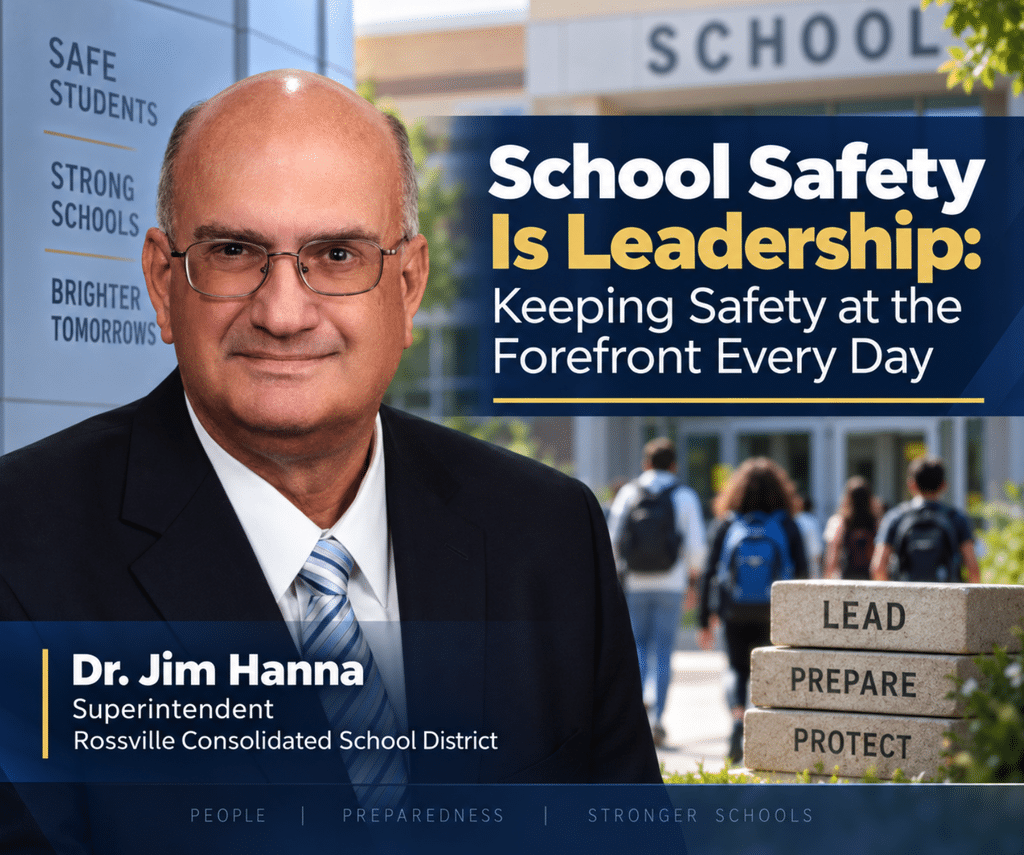
Safety: Leadership Responsibility
Superintendents balance academic achievement, staffing, transportation, facilities, finances, technology, student well-being, and countless other responsibilities. Safety cannot simply become another item on that list. It must be woven through the list.
When considering a facility project, we should ask how it affects emergency response. When transportation routes change, we should consider how we locate and communicate with buses during an emergency. When planning athletic events and concerts, we must remember that our safety responsibilities do not end when the final horn sounds, or the curtain closes.
Federal emergency-planning guidance reinforces this approach by emphasizing collaborative emergency operations plans that are exercised, reviewed, and continually improved (U.S. Department of Education, 2013, 2026).
The superintendent does not personally manage every component of school safety. The superintendent establishes the expectation that the work will continue.
Ask Questions Before an Emergency Asks Them for You
One of leadership’s most important responsibilities is asking questions.
Can everyone hear an emergency announcement? What happens if our normal communication system fails? Do first responders know our building as well as we think they do? How will we account for students? Who makes decisions if key administrators are unavailable?
Perhaps the most important question is: What are we assuming will work that we have never actually tested?
The Cybersecurity and Infrastructure Security Agency (CISA), a federal agency within the U.S. Department of Homeland Security, recommends a systems-based approach to school security that includes vulnerability assessments and layered security rather than reliance on a single measure (Cybersecurity and Infrastructure Security Agency [CISA], 2022).
Purchasing equipment is relatively easy. Building organizational capacity is harder. An emergency plan is only as valuable as people’s ability to execute it, and a communication system is only as effective as its ability to communicate clearly under stressful conditions.
Practice Reveals What Policy Cannot
Written plans cannot fully recreate the confusion, uncertainty, and human decisions that occur during an emergency. That is why training and exercises matter.
At Rossville, we try to move beyond asking whether we completed the required drill. We ask what the drill taught us.
An exercise might begin with our school resource officer entering a classroom and informing students that their teacher has collapsed and is not breathing. Do students know how to summon help? Can someone retrieve an AED? Does the office have the correct location? Does our Emergency Response Team receive the information it needs?
The purpose is not to frighten students or staff. It tests systems, identifies gaps, and builds confidence. Federal guidance similarly emphasizes training and exercises as essential components of preparedness (U.S. Department of Education, 2013, 2026).
After every exercise, leadership should ask: What worked? What did not? What are we going to change?
The final question creates accountability.

Relationships Are Safety Infrastructure
Some of the most valuable school-safety resources do not belong to the school corporation. They belong to law enforcement, fire departments, EMS, emergency management, dispatch centers, mental-health providers, local government, and other community organizations.
Those relationships should not begin in a parking lot during an emergency.
Serving as chairperson of the Clinton County School Safety Commission has reinforced my belief that preparedness improves when the people who will respond together also plan and train together. Federal guidance similarly recommends collaborative planning with first responders and emergency-management personnel (U.S. Department of Education, 2013).
Indiana supports this collaborative approach through its School Safety Specialist Academy, which provides ongoing training and develops specialists who serve as resources and liaisons among schools, county safety commissions, and state agencies (Indiana Department of Homeland Security, 2026a).
Superintendents should first invite responders into schools when there is no emergency. Conduct tabletop exercises together. Include dispatchers, fire, EMS, and law enforcement. Trust built before an emergency becomes an operational advantage during one.
Safety Begins with People
School safety is also more than physical security. Students who feel connected to trusted adults are more likely to communicate concerns. Staff members who know their students may recognize when something changes. A healthy school culture creates opportunities for intervention before a concern becomes a crisis.
At Rossville, relationships among students, employees, parents, and community members are essential to our school community. We also provide a way for students, parents, employees, and community members to submit safety concerns through our district website.
The best safety system is one in which people speak up because they believe someone will listen and respond appropriately.

The Superintendent Sets the Expectation
Superintendents do not need to be police officers, firefighters, paramedics, cybersecurity specialists, architects, or emergency managers. We do need to know when those professionals belong at the table and be willing to listen to their expertise.
We must also create accountability internally. Principals, teachers, transportation personnel, custodians, food-service employees, coaches, administrative assistants, nurses, counselors, and substitutes may all have responsibilities during an emergency.
There is an important difference between saying everyone is responsible for safety and assuming someone else will handle it.
Good leadership eliminates that ambiguity.
Never Become Satisfied
Perhaps the greatest danger in school safety is complacency. A district can have strong policies, dedicated school resource officers, secure entrances, modern technology, trained employees, and excellent relationships with first responders and still have vulnerabilities.
Throughout my career, I have had opportunities to discuss school safety with educators and public-safety professionals in Indiana and beyond. In 2026, I was honored to be selected as the Indiana School Resource Officers Association’s School Safety Leader of the Year, recognizing district-wide safety leadership, preparedness, collaboration, and positive school culture (Jacobs, 2026).
I appreciate that recognition, but school safety is never an individual accomplishment. Our work depends upon educators, school resource officers, first responders, dispatchers, mental-health professionals, board members, parents, students, and community partners working together.
That may be the most important lesson I can share with another superintendent: Do not treat school safety as a project to complete.
Build relationships. Create expectations. Ask difficult questions. Practice. Listen to experts. Learn from mistakes. Communicate. Make improvements. Then start asking questions again.
School safety is not something a district eventually finishes.
It is a leadership responsibility we renew every day.
Dr. Jim Hanna is Superintendent of the Rossville Consolidated School District and Chairperson of the Clinton County School Safety Commission. In 2026, the Indiana School Resource Officers Association recognized him as School Safety Leader of the Year.
References
Cybersecurity and Infrastructure Security Agency. (2022). K-12 school security guide (3rd ed.). U.S. Department of Homeland Security.
Indiana Department of Homeland Security. (2026a). School Safety Specialist Academy.
Jacobs, M. (2026, June 19). Rossville Superintendent Dr. James Hanna named INSROA School Safety Leader of the Year. Carroll County Daily News.
U.S. Department of Education, Office of Elementary and Secondary Education, Office of Safe and Healthy Students. (2013). Guide for developing high-quality school emergency operations plans.
U.S. Department of Education. (2026, March 5). Emergency planning.