
Vendor Influence in School Safety Nonprofits: Who runs the Partner Alliance for Safer Schools? Who Is behind PASS? An analysis of PASS leadership, security industry affiliations, funding relationships and its security product and technology-heavy Seventh Edition school safety guidelines.
Is PASS an independent school safety nonprofit or a security industry organization operating under a nonprofit banner?
School leaders are routinely encouraged to seek trusted, independent guidance when evaluating school safety strategies and security investments.
But what happens when a nonprofit presenting itself as a broad school safety authority is largely led, supported and advised by people connected to security manufacturers, systems integrators, consultants and security industry trade associations?
That question deserves serious scrutiny in the case of the Partner Alliance for Safer Schools (PASS).
PASS is a legally recognized 501(c)(3) nonprofit organization. Its nonprofit status is not in dispute. The more important question is whether PASS should be viewed as an independent, educator-led school safety authority when its leadership structure, committee system, funding partners, founding history and published recommendations are so closely tied to the commercial security industry.
The evidence points to a clear conclusion:
PASS is a security industry-dominated nonprofit that develops and promotes school security guidance while relying heavily on security manufacturers, integrators, consultants and trade associations for its leadership, technical direction and financial support.
PASS may provide useful technical information. But school boards, superintendents, journalists and policymakers should understand who is behind the organization before treating its guidance as an independent or comprehensive school safety framework.
What is the Partner Alliance for Safer Schools?
PASS describes itself as a nonprofit organization providing K-12 safety and security guidelines, checklists, white papers and training resources.
Its website promotes the PASS Guidelines as best practices for securing school facilities and states that its work is developed through collaboration among education, public safety and industry professionals.
The organization began around 2014, with its current nonprofit entity receiving federal tax-exempt status in 2022.
Those facts, however, do not answer the more important questions:
- Who governs PASS?
- Who develops its guidance?
- Who chairs its committees?
- Who financially supports the organization?
- Does its guidance reflect a balanced educational perspective or primarily a security industry perspective?
Those questions paint a far different picture than the organization’s nonprofit branding alone.

Who leads PASS?
PASS says it is led by volunteers representing education, public safety and industry.
A review of its publicly listed Board of Directors, committee chairs and Advisory Council reveals a striking imbalance in who guides the organization. (https://passk12.org/about-pass/leadership/)
The overwhelming majority of the people helping govern, shape and promote PASS are affiliated with the commercial security industry. They represent security manufacturers, systems integrators, security consulting firms, security-focused architectural firms, door and hardware organizations, commercial security providers and national security industry trade associations.
By contrast, only a relatively small portion of PASS’s leadership consists of current employees of schools or school districts.
In practical terms, PASS has several security industry representatives for every current school or district practitioner involved in its leadership structure.
That distinction matters because the people leading an organization naturally influence its priorities, perspective and the types of solutions it emphasizes.
The result is an organization substantially guided by professionals whose careers center on designing, manufacturing, integrating, specifying or consulting on security technologies rather than managing the daily educational, operational and human dimensions of K-12 schools.
The PASS board is not educator-led
PASS’s board includes some individuals with school experience, advocacy backgrounds and public safety expertise.
It also includes leaders affiliated with organizations such as the National Systems Contractors Association, the Security Industry Association, commercial security consulting firms and security industry foundations.
The board is not composed entirely of vendors. Neither, however, is it an educator-led governing body.
There is comparatively limited representation from active superintendents, principals, teachers, counselors, psychologists, transportation leaders, school business officials and other practitioners responsible for managing school safety every day.
The PASS committee structure is even more industry-centered
PASS’s committee structure raises even greater questions.
The committees responsible for education, outreach, resources, compliance and technical guidance are chaired or co-chaired almost entirely by individuals affiliated with security companies, systems integrators, consultants or security industry trade associations.
None of the committee chairs is identified as a current employee of a school or school district.
PASS may characterize this as multidisciplinary collaboration. The more important observation is that the security industry does not merely participate in PASS. It occupies much of the organization’s leadership infrastructure.
Two of the organization’s most active public-facing professionals are very passionate school safety advocates: One a career (now retired) school security director who currently works for a worldwide security access control door company and the other a longtime K-12 sector “evangelist” for a global security vendor specializing in access control, biometric identification, and ID card issuance.
Rather than purchasing exhibit booth space, these and other PASS representatives often present the PASS Guidelines as educational conference workshops and breakout sessions.

Who founded PASS?
PASS’s origins reinforce its current security industry orientation. PASS describes its origins as:
“Led by the National Systems Contractors Association and the Security Industry Association, a partnership was formed among stakeholders united in interest and effort to help ensure that when a school system makes an investment in security, money is spent on the right solutions.” (https://passk12.org/about-pass/)
The organization’s co-founders are Chuck Wilson and Scott Lord.
Neither built his primary career as an educator, superintendent, principal or independent school safety researcher. But both built long careers in the commercial electronic security, life safety and systems integration industries.
Chuck Wilson’s security industry background
Chuck Wilson spent decades leading the National Systems Contractors Association (NSCA), the national trade association representing companies involved in electronic systems integration, communications, life safety and commercial security technologies. (https://passk12.org/training-presentations/chuck-wilson/)
His career has focused on supporting systems integrators, advancing the electronic systems industry and strengthening relationships among technology providers and end users.
Wilson was inducted into the Security Sales & Integration Industry Hall of Fame in 2025, recognizing his decades of leadership within the commercial security industry. (https://www.securitysales.com/news/ssi-industry-hall-of-fame-2025-chuck-wilson-ceo-emeritus-nsca/610815/)
Wilson has also served on a local school board, providing school governance experience. However, his principal professional identity has long been rooted in representing and advancing the electronic security and systems integration industry.
Scott Lord’s systems integration background
Scott Lord also came to PASS through the commercial security industry. (https://passk12.org/training-presentations/scott-lord/)
His career has centered on life safety and electronic systems integration, including work with Electronic Contracting Company, a commercial systems integrator serving schools and other facilities.
Lord currently co-chairs PASS’s Technical Committee.
Like Wilson, his expertise is rooted in designing, integrating and implementing security technologies rather than managing schools or leading educational organizations.
Taken together, PASS’s founders emerged from the commercial security technology sector, not from the broader educational leadership community.

Who funds and partners with PASS?
PASS operates a tiered partnership program supported by numerous security manufacturers, systems integrators, technology companies, communications providers, access control companies, door hardware manufacturers and security industry associations. (https://passk12.org/about-pass/partner-organizations/)
PASS states that these organizations provide financial support and help promote PASS resources and Guidelines.
This creates a noteworthy structural relationship:
- Security companies financially support PASS.
- Security industry representatives help govern PASS.
- Security industry professionals help develop PASS guidance.
- PASS publishes recommendations emphasizing security technologies and facility improvements.
- Industry partners then promote those recommendations to school decision makers.
This does not mean every recommendation is inappropriate.
It does mean PASS guidance should be viewed as industry-influenced school security guidance, rather than automatically accepted as independent research, a government standard or the consensus position of the broader educational community.

What do the PASS Seventh Edition Guidelines recommend?
PASS released the Seventh Edition of its Guidelines in 2025, describing it as its most comprehensive publication to date. (https://passk12.org/guidelines-resources/pass-school-security-guidelines/ or direct download at https://www.hesinnovations.com/content/dam/assa-abloy/americas/ems/hes-innovations-authored-assets/documents/PASS_Safety_and_Security_Guidelines_7th_Edition.pdf)
The Guidelines organize school security into five layers:
- District-wide
- Digital infrastructure
- Campus exterior
- Building perimeter
- Classroom and interior spaces
At first glance, the framework appears balanced. But a closer review tells a different story.
The Seventh Edition is overwhelmingly technology and infrastructure focused
A structured review of the PASS Seventh Edition shows that most of its substantive recommendations focus on physical security, electronic systems, facility hardening, cybersecurity infrastructure and integrated security technologies.
The largest share of the document addresses subjects such as:
- Access control
- Locks and door hardware
- Secure vestibules
- Security glazing
- Cameras and video analytics
- Visitor management technology
- Panic alarms
- Communications systems
- Cybersecurity controls
- Integrated security platforms
Another significant portion discusses the policies, procedures and administrative processes needed to implement and maintain these systems.
Only a comparatively small portion is devoted primarily to people-centered safety strategies where human relationships, professional judgment, active supervision, leadership or student support serve as the principal intervention rather than supporting technology.
The overall impression is unmistakable.
Rather than presenting a balanced framework in which people, organizational culture and physical security receive comparable attention, the Seventh Edition overwhelmingly approaches school safety through the lens of facilities, technology and systems integration.
Readers come away with a roadmap that spends far more time discussing locks, glass, cameras, alarms, communications infrastructure and cybersecurity than the everyday human factors that research consistently shows are fundamental to preventing violence and creating safe schools.
PASS says people are most important. PASS Guidelines tell a different story.
PASS states that vigilant staff and students are the most important part of each security layer. It also acknowledges that technology cannot succeed without policies, procedures and training. Those are important observations.
The problem is that the structure and content of the PASS Seventh Edition do not reflect those priorities proportionately.
The document provides extensive technical guidance on:
- Door specifications
- Locks
- Glazing
- Cameras
- Alarm integration
- Credential technologies
- Communications systems
- Cybersecurity
- Surveillance
- Visitor management
By comparison, considerably less attention is devoted to the operational realities of leadership, human performance, active supervision, trusted relationships, implementation and organizational effectiveness.
Throughout much of the document, staff training is presented primarily as preparing people to operate or respond to technology rather than positioning people themselves as the primary protective strategy.

School safety “systems” or security systems integration?
PASS frequently describes its approach as systems-based. That phrase deserves clarification.
Within the PASS Guidelines, “systems” often refers to integrating cameras, alarms, access control, communications, visitor management and cybersecurity into unified technical platforms.
That is security systems integration.
A broader educational systems approach would place equal emphasis on leadership, supervision, student support, school climate, communications, organizational learning, implementation fidelity and continuous improvement.
Those organizational and human dimensions receive considerably less attention than physical infrastructure and technology throughout the PASS Guidelines.
Does PASS give the security industry nonprofit credibility?
PASS’s nonprofit status may provide an appearance of neutrality that individual manufacturers, trade associations and vendors cannot achieve independently.
That distinction matters. A vendor promoting its own products is obviously advancing commercial interests. The same recommendation may be viewed differently when it is presented through a nonprofit organization perceived as independent.
The concern is not that PASS is an illegitimate nonprofit. Rather, the concern is whether its nonprofit structure provides an aura of independence around guidance that is substantially shaped by the same industry sectors that manufacture, integrate, sell and support many of the technologies emphasized throughout its publications.
The evidence supports a measured conclusion:
PASS gives security industry guidance a nonprofit school safety wrapper. Its legal nonprofit status is not in question. Its independence from the commercial security industry should be.
Are the PASS Guidelines useful?
Yes. There are recommendations reflect accepted facility physical security practices.
School districts should evaluate issues such as:
- Reliable door hardware
- Visitor procedures
- Emergency communications
- Cybersecurity
- Access management
- Maintenance
- Coordination with first responders
- Facility-specific security assessments
The Guidelines can serve as one technical resource. They should be viewed very narrowly as a security industry’s publication offering recommendations for primarily physical security for schools.
They should not, however, be mistaken for:
- Independent academic research
- A government standard
- A legal standard of care
- A balanced school safety framework
- A consensus document developed primarily by educators
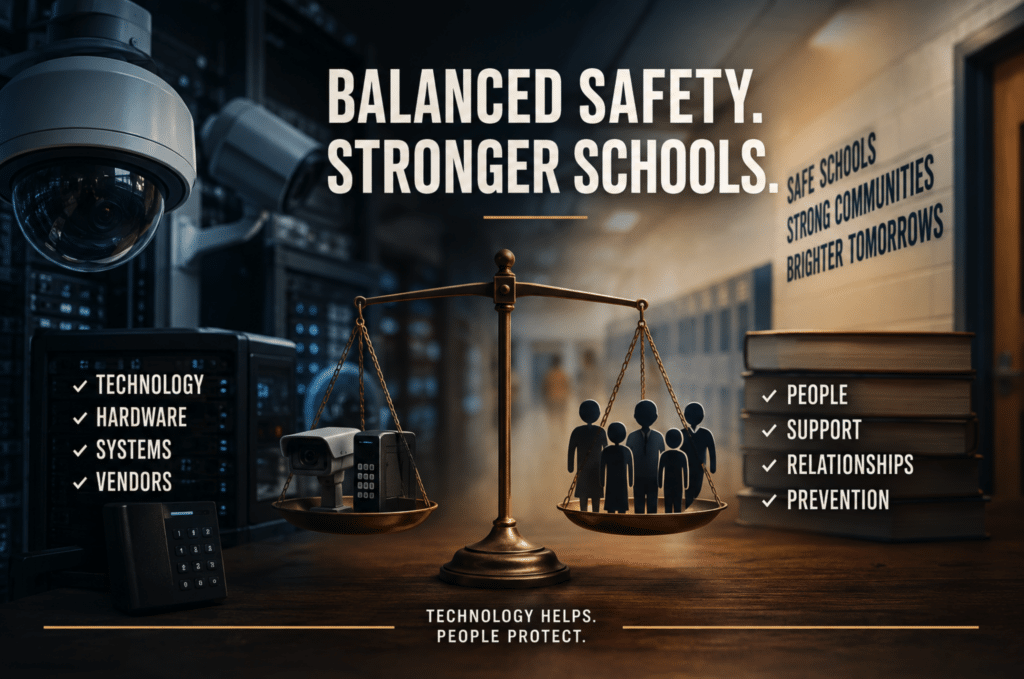
PASS guidance should be evaluated alongside independent assessments, educational research, local operational realities and people-centered school safety practices.
The bottom line: PASS is heavily influenced and led by security vendor business interests
Industry participation in school safety discussions is both appropriate and valuable. The issue is not participation. The issue is dominance.
Across the PASS board, committee leadership and Advisory Council, security industry representatives substantially outnumber current educators and school district practitioners. That imbalance is reflected not only in who leads the organization, but also in the recommendations that receive the greatest attention throughout the PASS Guidelines.
- The organization’s founders came from the commercial security and systems integration industry.
- Its committee leadership is overwhelmingly industry affiliated.
- Its financial partners represent many of the same product categories emphasized throughout its publications.
Its Seventh Edition Guidelines devote the overwhelming majority of their substantive content to physical hardening, security hardware, electronic technology, cybersecurity controls and integrated security systems.
PASS describes people as the most important element of school safety, but its Seventh Edition Guidelines devote the overwhelming majority of their content to physical hardening, security hardware, electronic technology, cybersecurity controls and security systems integration. Staff training and policies are frequently presented as mechanisms for supporting those technologies, while the broader human and organizational dimensions of school safety receive comparatively less attention.
The result is best viewed as an industry-influenced facilities security and technology roadmap, not as a balanced or comprehensive framework for the full spectrum of K-12 school safety.
Or stated more directly:
PASS says people are most important, but its leadership structure, funding relationships and recommendations tell a different story. Locks, glass, cameras, alarms, access control, communications equipment and integrated technology dominate the organization and its flagship Guidelines. People-centered prevention is present, but it remains peripheral.
School leaders should evaluate PASS materials with the same level of due diligence they would apply to recommendations presented directly by a security manufacturer, systems integrator or industry trade association.
A nonprofit label should never substitute for independence, transparency or balanced professional judgment.
Questions school boards should ask before relying on PASS guidelines for school security
School leaders considering PASS guidance should ask questions such as:
- Who developed the specific recommendation?
- What company or industry employs that person?
- Does that employer sell a product or service related to the recommendation?
- What independent research supports the recommendation?
- Was the recommendation reviewed by active school administrators and front-line educators?
- What staffing will be required to operate the system?
- What are the maintenance and replacement costs?
- What false-alert or failure data exist?
- What lower-cost people-centered alternatives were considered?
- What safety need is being addressed, and how will success be measured?
- What unintended consequences could result?
- Is the recommendation a legal requirement, a research-supported practice or an industry preference?
These questions are not anti-technology.
They are basic due diligence.
Dr. Kenneth S. Trump is President of National School Safety and Security Services
National School Safety and Security Services
Experts You Can Trust!
Connect with Dr. Ken on Linkedin: www.linkedin.com/in/kentrump/
Follow Dr. Ken on X(Twitter) @safeschools
Visit and “Like” Our Facebook School Safety News Channel at: www.facebook.com/schoolsafety
Well stated Dr. Trump. We have been saying this for years aboit PASS and the makeup of their “Advisory Council”, which obviously provides guidance for the organization. As you so accurately pointed out many are from the very industry that they a recommending.