
School security products and technology are big business. Access control systems, classroom locks, weapons detection systems, panic buttons, surveillance cameras, artificial intelligence, drones, and other emerging technologies are increasingly promoted as solutions to complex K-12 school safety and security challenges.
But school leaders do not need another sales pitch. They need independent school security analysis that helps them evaluate evidence, identify limitations and unintended consequences, ask better questions, and make better decisions.
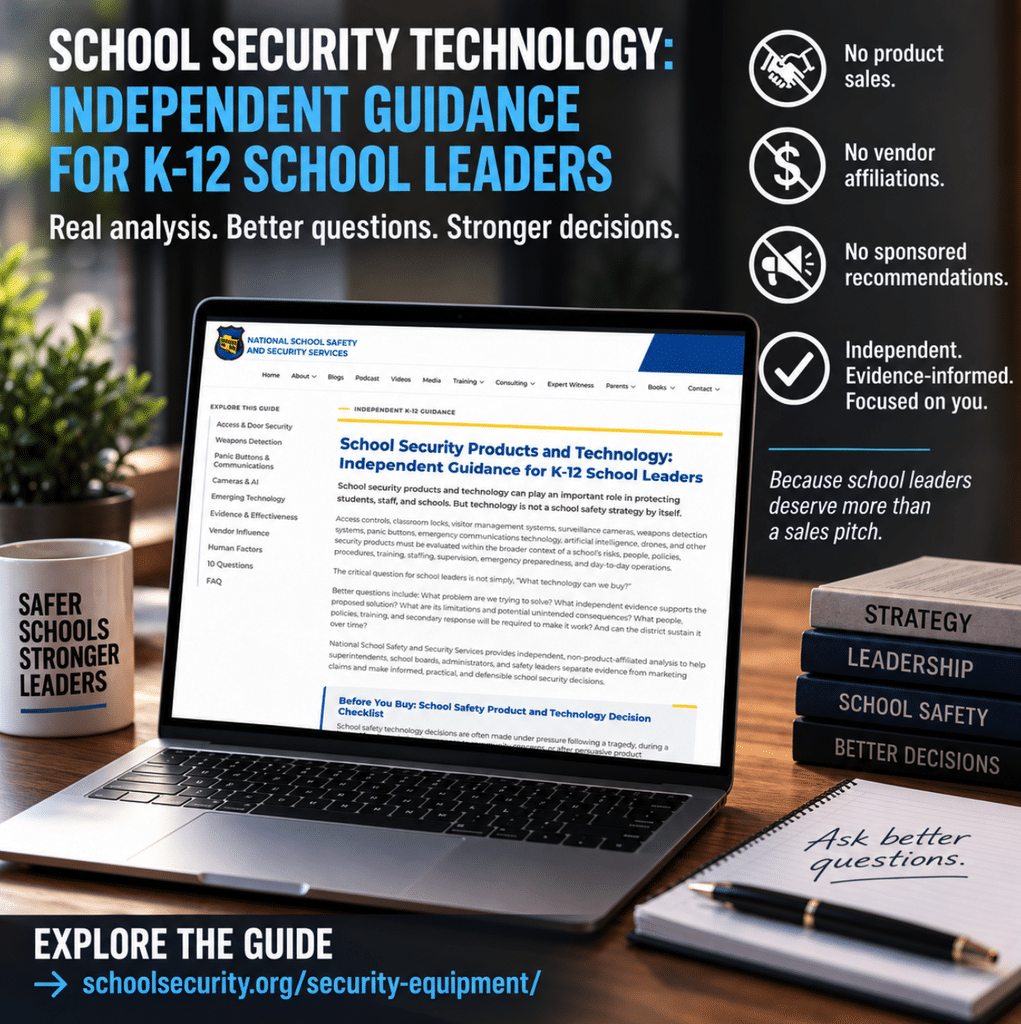
That is why we created our new School Security Products and Technology: Independent Guidance for K-12 School Leaders resource site.
Why independent school security technology guidance matters
The school security marketplace can be difficult to navigate. Vendors understandably promote their products. Industry organizations advocate for their self-created “standards” and guidelines. Consultants may develop relationships with manufacturers, attend vendor-sponsored events, participate in industry marketing, or recommend products and services with which they have relationships.
We choose a different path. National School Safety and Security Services does not sell school security products or technology. We have no financial affiliations with security manufacturers or vendors. Our recommendations are not sponsored.
While some consultants spend their time glad-handing and schmoozing with vendors and industry interests, we focus on helping school leaders critically evaluate what works, what the evidence actually shows, what can go wrong, and what questions should be asked before money is spent or mandates are adopted. That independence matters.
How should school leaders evaluate security products and technology?
The critical question should not simply be, “What technology can we buy?”
School leaders should first ask:
What school safety or security problem are we trying to solve?
What independent evidence supports the proposed solution?
What are its limitations and potential unintended consequences?
What people, policies, procedures, training, and secondary response will be required to make it work?
Can the district realistically implement and sustain it over time?
Our new guide examines these questions across school access and door security, weapons detection, panic buttons and emergency communications, surveillance cameras and AI, emerging school security technologies, security standards, vendor influence, evidence of effectiveness, and human factors.
It also provides a practical 10-question framework for evaluating school security technology and connects school leaders to deeper independent analyses of individual products, technologies, research, mandates, vendor claims, and industry trends.
Does school security technology make schools safer?
Technology can support school safety and security, but technology is not a school safety strategy by itself.
A security product may perform exactly as designed and still fail to solve the problem a school thought it was buying it to solve. Effectiveness depends not only on the technology, but also on how it operates within the realities of a school.
That means evaluating technology alongside people, active supervision, policies, procedures, training, staffing, communications, emergency preparedness, leadership, and day-to-day operations.
Our approach is not anti-technology. It is pro-due diligence. Pro-evidence. Pro-critical thinking. Pro-school leadership.
School leaders deserve credible, independent information that helps them separate evidence from marketing claims and make informed, practical, and defensible school safety decisions. No product sales, vendor affiliations, or sponsored recommendations.
Explore our new independent K-12 School Security Products and Technology Guide resource site.
Stop checking boxes. Start asking better questions.


Dr. Kenneth S. Trump
President, National School Safety and Security Services
Dr. Kenneth S. Trump is President of National School Safety and Security Services, an independent, non-product-affiliated school safety consulting firm. With more than 40 years of experience in PreK–12 school safety, security, and emergency preparedness, he provides independent analysis and strategic guidance to school leaders nationwide.