
School resource officers in Omaha, Nebraska, are carrying a new use-of-force tool: gloves that deliver an electrical stimulus through direct skin contact to produce pain compliance or interfere with coordinated movement. (Omaha Police Department Use-of-Force Policy)
School safety researcher David Riedman highlighted the Omaha school deployment in his Riedman Report, drawing attention to the fact that the Omaha Police Department had already purchased these devices specifically for school resource officers while national attention was focused on plans by ICE to acquire the same technology. (Riedman Report) (Associated Press)
His reporting raised a question school leaders nationwide should be asking: Do electric shock gloves belong in K-12 schools?
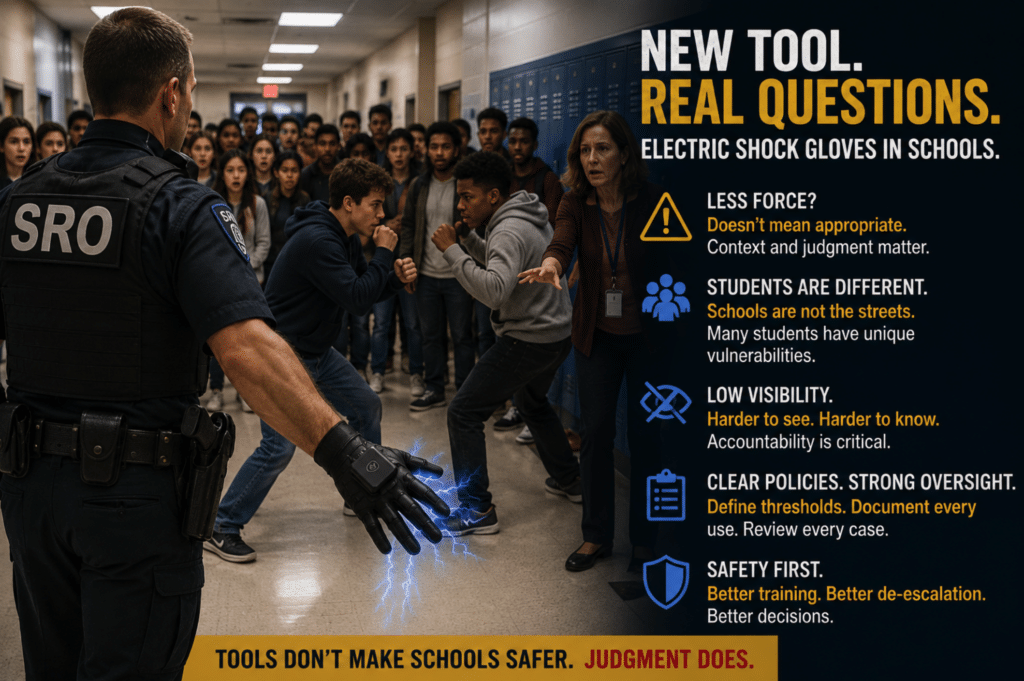
Omaha requested 40 pairs of the gloves for just under $66,000 in 2025, specifically describing them to the City Council as another use-of-force option for school resource officers intended to help de-escalate and prevent higher-force situations. (Nebraska Public Media)
Twenty-nine of Omaha’s 34 SROs have been trained to use the gloves, which are currently used only by SROs assigned to middle and high schools. (Nebraska Public Media)
The devices were used twice by Omaha SROs during the 2025-2026 school year, and OPD says both incidents were reviewed and determined to be justified and within department policy. (WOWT / Omaha Police Department statement)
The rationale sounds reasonable: Give officers another less-lethal option that might help prevent injuries or avoid escalation to a TASER, pepper spray, or greater physical force. OPD specifically says it selected the G.L.O.V.E. for SROs because it wanted an option involving a lower level of force than a TASER or pepper spray. (WOWT / Omaha Police Department statement)
But less force does not automatically mean appropriate force, especially in the eyes of parents, school staff, and students. This is particularly the case when the people on the receiving end are children and adolescents in the custody of educators acting in the place of parents.
My assessment is caution, leaning strongly toward no for routine deployment of these devices in K-12 schools.
What Are Electric Shock Gloves?
The G.L.O.V.E., or Generated Low Output Voltage Emitter, is manufactured by Kentucky-based Compliant Technologies. (Nebraska Public Media)
When deactivated, the device functions as a normal glove; when activated and placed in direct contact with skin, Omaha’s policy says it produces pain compliance or “neural peripheral interference” that makes coordinated movement more difficult. (Omaha Police Department Use-of-Force Policy)
The manufacturer promotes the technology for law enforcement, corrections, security agencies, EMS and military applications. (Compliant Technologies) Unlike a TASER deployed from a distance, the electrical function of the glove requires direct contact with the person’s skin. (Associated Press)
That raises a basic school safety question: Does a technology developed for broader law enforcement, corrections and security applications appropriately translate into K-12 schools?
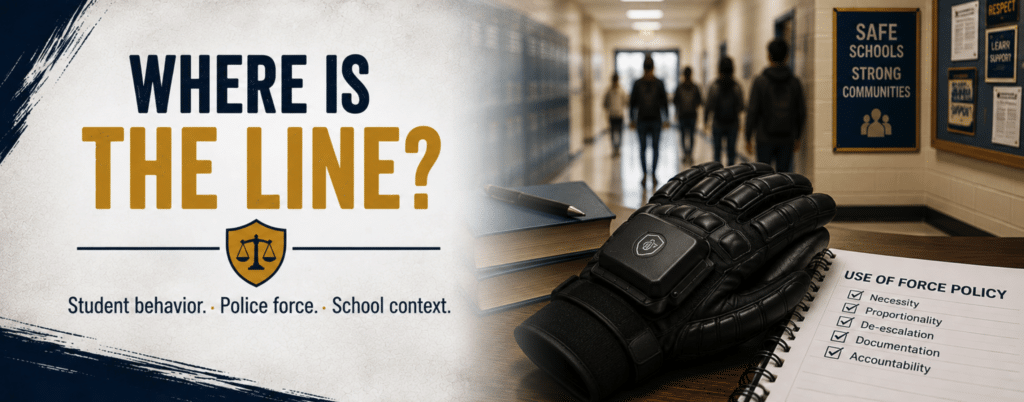
The Omaha Experience Raises Questions
This is no longer a hypothetical debate. Omaha SROs have already used the gloves twice on students. In one case at a high school, Omaha’s use-of-force trainer said an officer used the glove on a student for “noncompliance.” (Nebraska Public Media)
In the other, police said the device was used on a student who was attempting to enter a school when the student was not supposed to be there; commands were given to leave, the individual refused, and the officer used what police described as a quick touch with the glove before securing the individual. (Nebraska Public Media) Police reported no injuries or need for medical intervention in either incident. (WOWT)
But “noncompliance” can be a particularly troubling word in a school environment. Students refuse directions, argue, pull away, become emotionally dysregulated, challenge authority and make poor decisions. Those behaviors may warrant intervention and consequences, but they do not automatically warrant police use of force.
And Omaha’s written policy makes this issue even more significant. The OPD policy categorizes a person who fails to follow a lawful order but offers no physical resistance as a “Passively Resistive Subject.” (Omaha Police Department Use-of-Force Policy)
The Electronic Compliance G.L.O.V.E. is listed among the officer responses permitted for passively resistant subjects. When an officer uses the glove against a passively resistant person, OPD policy requires the officer to explain in the Chief’s Report why a lesser response would have been ineffective. (Omaha Police Department Use-of-Force Policy)
That threshold deserves serious scrutiny when applied to adolescents in schools. School discipline cannot gradually migrate into police use of force simply because a police officer is standing nearby.
What the Manufacturer’s Guidance Says
The manufacturer’s cautions should also get the attention of school leaders. The Associated Press reports that Compliant Technologies warns that the device should not be used as punishment or against individuals merely displaying “verbal defiance or belligerence.” (Associated Press)
AP also reports that the manufacturer cautions against use on high-risk populations that include children, pregnant women, elderly people and people with disabilities. (Associated Press) Omaha’s own policy specifically prohibits applying the G.L.O.V.E. to small children, elderly people and visibly pregnant individuals and restricts contact with areas including the face, neck, chest and groin. (Nebraska Public Media)
That creates questions that deserve answers. What constitutes a “small child”? What about adolescents with physical, developmental, behavioral or medical vulnerabilities? And how does an officer know about conditions that may not be visible during a rapidly unfolding encounter?
Those are not arguments that every use will result in harm. They are arguments for a much higher level of scrutiny before putting these devices into routine school use.
Less-Lethal Does Not Mean Low-Risk
There is a legitimate law enforcement argument for the gloves. Omaha Police Officer Jason Cvitanov, the department’s use-of-force training instructor, describes the G.L.O.V.E. as a lesser use If an officer is physically struggling with an aggressive individual and a brief application prevents a prolonged fight, injuries or escalation to greater force, that argument deserves consideration.
But the glove also presents a different accountability issue. The device functions as a normal patrol glove until an officer activates its electrical mode, and the electrical stimulus is administered through direct skin contact. (Associated Press)
That means an electrical use of force during a hands-on encounter may be less visually obvious to nearby students, staff or someone later reviewing video than the deployment of a traditional weapon. The concern about the discreet nature of the device has also been raised nationally by civil-liberties advocates interviewed by the Associated Press. (Associated Press)
That does not mean officers will misuse the technology. It means low visibility makes clear policy, documentation and accountability even more important.

Schools Are Different
One recurring problem in school safety is taking equipment and tactics developed for other environments and assuming they automatically translate into schools. Schools are not correctional facilities, military environments or city streets. They are educational environments populated primarily by children and adolescents, many having varying types of special needs.
Good school policing requires officers who understand adolescent behavior and recognize the distinction between misconduct, emotional escalation, resistance and an actual threat to safety. Fortunately many, if not most, SROs have specialized training and understanding of these challenges and unique considerations when schools are compared to other law enforcement settings.
Judgment, relationships, communication, de-escalation and knowledge of students can be more valuable than another piece of equipment.
More Tools Are Not Always Better
School safety increasingly operates under an assumption that another technology, device, alert or tactical option inherently improves safety. Sometimes it does. Sometimes it simply adds another decision that must be made under stress.
Experienced SROs already have multiple response options. More importantly, effective SROs develop relationships with students, understand adolescent behavior, recognize escalation and know when to slow an encounter rather than accelerate it.
An electrical glove should never become a shortcut for those skills. Nor should school leaders confuse the availability of a lower-level force option with evidence that the option needs to be used.
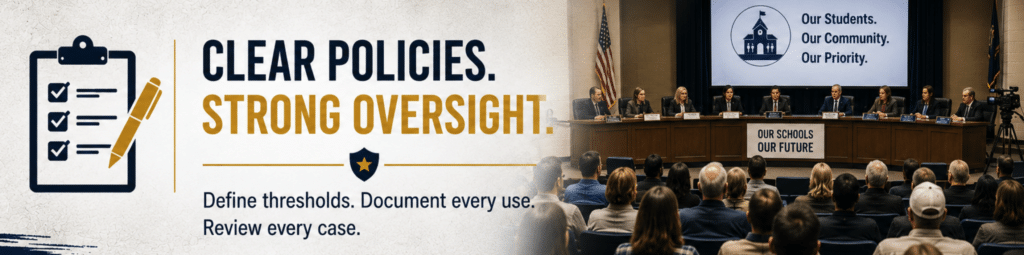
Questions School Leaders Should Ask
Before allowing electric shock gloves in schools, superintendents, school boards, police chiefs and SRO supervisors should ask:
- What specific school safety problem are we trying to solve?
- What independent research, rather than manufacturer claims, supports using this technology with adolescents?
- At what level of resistance may an SRO activate the glove?
- Should electrical pain compliance ever be used for passive resistance or refusal to comply?
- How is “noncompliance” defined in a PreK-12 school setting?
- How will we prevent disciplinary matters from escalating into police use-of-force incidents?
- What restrictions apply to younger students, students with disabilities, medical vulnerabilities or other special needs?
- What data does the device retain about each activation, and will those records be preserved?
- Can body-worn camera footage clearly establish when the electrical function was activated?
- What medical assessment follows its use?
- How will every student deployment be documented, investigated and reviewed?
- Were school administrators and school boards involved before deployment?
- Were parents informed that SROs would be carrying electric shock devices in their children’s schools?
- What alternatives were considered before adding another use-of-force tool?
- Is this new tool addressed in the school district’s Memorandum of Understanding (MOU) with the law enforcement agency?
- Does this need to be formally addressed in Board of Education policy?
These are not simply police equipment questions. They are school governance, leadership, student safety and liability questions.
My Take: Caution, Leaning Toward No
I strongly support well-selected, properly trained school resource officers. Officers confronting genuine violence need reasonable options to protect students, staff, themselves and even the individual creating the threat.
But supporting SROs does not require automatically supporting every new technology marketed to law enforcement. The standard should be higher in schools.
Before putting an electrical pain-compliance device into the SROs tool belt while working primarily around children and adolescents, school and police leaders should be able to demonstrate a clearly defined need, independent evidence supporting its use, strict thresholds, school-specific training, safeguards for vulnerable students and meaningful accountability.
The Omaha experience gives school leaders nationwide an opportunity to examine these questions before electric shock gloves become the next school safety trend. At this point in time, there does not appear to be extensive history and data for school-based applications of this new law enforcement tool.
The most important question is not whether an electric glove represents less force than a TASER. The better question is why electrical force is necessary in that particular encounter with that particular student in the first place.
Until there is a convincing answer, and most importantly documented evidence of a thorough working through the questions and issues above, my position is one of caution.
And for routine deployment in K-12 schools, at this time I lean toward no.
Dr. Kenneth S. Trump is President of National School Safety and Security Services
National School Safety and Security Services
Experts You Can Trust!
Connect with Dr. Ken on Linkedin: www.linkedin.com/in/kentrump/
Follow Dr. Ken on X(Twitter) @safeschools