
School leaders routinely apply evidence-based decision making in education. The same analytical thinking should guide decisions about panic buttons, weapons detection, other school security technologies, and school safety programs.
Can School Security Technology Improve Attendance, School Climate, and Graduation Rates?
School leaders are increasingly encountering school security effectiveness claims about school security technology.
Some claims are stated directly. Others are implied through marketing materials, conference presentations, customer success stories, case studies, promotional reports, and polished sales presentations.
The messages may sound something like this:
- “After implementing our panic button system, suspensions declined, attendance improved, and graduation rates increased.”
- “Our weapons detection system helped staff build stronger relationships with students.”
- “Since installing our weapons detection technology, no firearms have been found in our schools.”
- “Our platform has transformed school climate and culture.”
These school security effectiveness claims are compelling. They also raise an important question:
Where is the independent evidence demonstrating that the technology actually caused these outcomes?
That distinction matters because correlation is not the same as causation, a principle every educator has encountered through educational research and evidence-based decision making.
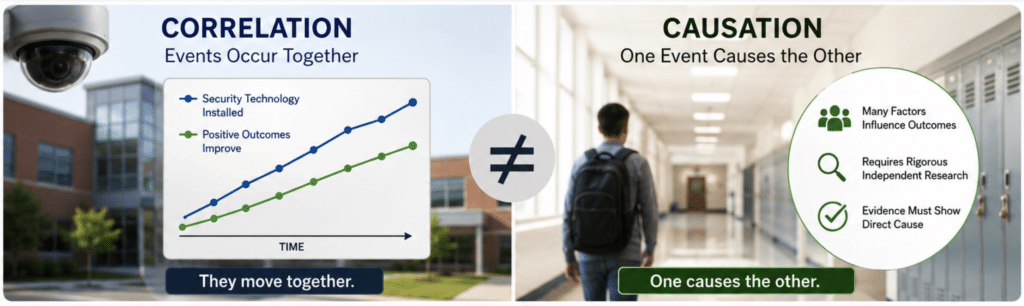
Correlation vs. Causation: Why the Difference Matters When Evaluating School Security Effectiveness Claims
One of the most fundamental principles of research is that correlation does not prove causation.
Simply because two events occur during the same period does not mean one caused the other.
If a school district purchases panic buttons in August and attendance improves during the school year, it does not automatically follow that panic buttons caused higher attendance.
Likewise, if weapons confiscations in a school decline after installing weapons detection, there is no basis to conclude that because of the technology there are no longer guns in the school, without first having rigorous independent research to evaluate the claim.
Educational outcomes are influenced by numerous variables, including:
- Leadership changes
- School climate initiatives
- Student mental health supports
- Threat assessment teams
- Positive behavioral interventions
- Teacher quality and retention
- Student support services
- Improved attendance initiatives
- Community demographics
- Changes in discipline practices
- Normal year-to-year variation
Without controlling for these and other factors, assigning cause and effect to a single product is speculation, not science.
School leaders routinely expect this level of analytical rigor when evaluating instructional programs, educational interventions, curriculum initiatives, and student achievement data. School security effectiveness claims deserve the same disciplined level of scrutiny.
Can School Security Technology Improve School Climate or Student Relationships?
Perhaps some of the most surprising school security effectiveness claims suggest that security technology improves school culture or strengthens relationships between staff and students.
Technology does not build trust. People build trust.
Healthy school climate develops through caring adults, effective leadership, positive relationships, quality instruction, student engagement, active supervision, communication, and consistent expectations.
A weapons detection system may alter the screening process. A panic button may impact school communications.
Neither teaches empathy, develops rapport, improves mentoring, or creates meaningful relationships with students. These are human functions.
Suggesting that technology itself improves relationships or school culture extends well beyond what current independent research has established.
Marketing Reports Are Not the Same as Independent Research
Many of the statistics supporting school security effectiveness claims originate from the companies selling the products. That distinction is critically important.
Company-generated reports can provide useful information about product utilization, operational performance, or how customers are using a technology. They may also offer helpful insights into implementation trends or system activity.
For example, panic button activation reports have provided valuable operational data showing that the overwhelming majority of activations involve everyday school incidents rather than active shooter events.
Those operational statistics can help inform policy discussions.
However, they do not independently validate broader effectiveness claims that a technology improves school climate, reduces suspensions, increases graduation rates, improves attendance, strengthens student relationships, or produces other educational outcomes.
Independent research generally includes safeguards designed to reduce bias, including:
- Independent researchers with no financial interest in the product
- Transparent research methodology
- Appropriate comparison or control groups
- Statistical analyses controlling for multiple variables
- Peer review
- Replication by other researchers
- Publication in respected academic journals
These standards exist to separate objective evidence from promotional narratives.
Until those standards are met, school security effectiveness claims should be viewed cautiously whenever they imply or suggest cause-and-effect relationships.

Questions School Leaders Should Ask When Evaluating School Security Effectiveness Claims
School leaders have both a fiduciary responsibility and a student safety responsibility.
Before accepting broad school security effectiveness claims, decision-makers should ask questions such as:
- What independent, peer-reviewed research demonstrates that your product caused these outcomes?
- Who conducted the research?
- Who funded the study?
- Were the researchers financially independent?
- What variables were controlled?
- Has the research been replicated?
- Is the study published in a peer-reviewed journal?
- What evidence distinguishes correlation from causation?
It is also fair to ask: Has your security product or technology been independently tested with results published by an independent lab with no affiliation to your company?
These are not hostile questions. They are examples of responsible due diligence.
Credible companies should welcome them because objective evidence benefits both schools and the industry.

Evidence-Based School Security Leadership Requires Independent Validation
School security technologies can play important roles within a comprehensive school safety strategy. But the issue is not whether technology has a place in school safety.
The issue is whether school security effectiveness claims presented through marketing materials, customer success stories, conference presentations, or promotional reports extend beyond what independent evidence currently supports.
School leaders make decisions involving millions of taxpayer dollars, student safety, public trust, and significant legal liability.
Those decisions deserve more than persuasive marketing. They deserve independent research, transparent evidence, thoughtful analysis, and realistic expectations.
Until rigorous, independently validated studies demonstrate otherwise, school leaders should distinguish marketing from science, correlation from causation, testimonials from evidence, and promotional narratives from independently validated research.
The strongest purchasing decisions are rarely driven by the strongest marketing campaign.
They are driven by the strongest independent evidence.
Dr. Kenneth S. Trump is President of National School Safety and Security Services
National School Safety and Security Services
Experts You Can Trust!
Connect with Dr. Ken on Linkedin: www.linkedin.com/in/kentrump/
Follow Dr. Ken on X(Twitter) @safeschools
Visit and “Like” Our Facebook School Safety News Channel at: www.facebook.com/schoolsafety