
School safety trends for 2026-2027 will put greater pressure on school boards and superintendents to separate evidence from emotion, scrutinize security vendor influence, strengthen implementation, and demonstrate that their safety decisions are thoughtful, defensible, and effective.
As the 2026-2027 school year begins, K-12 school leaders will again face intense pressure to “do something” about school safety.
High-profile school safety incidents in school districts will generate calls from school communities and legislators for new mandates, technologies, programs, and quick fixes. But the biggest school safety challenges ahead are increasingly about governance, leadership, due diligence, and fidelity of implementation.
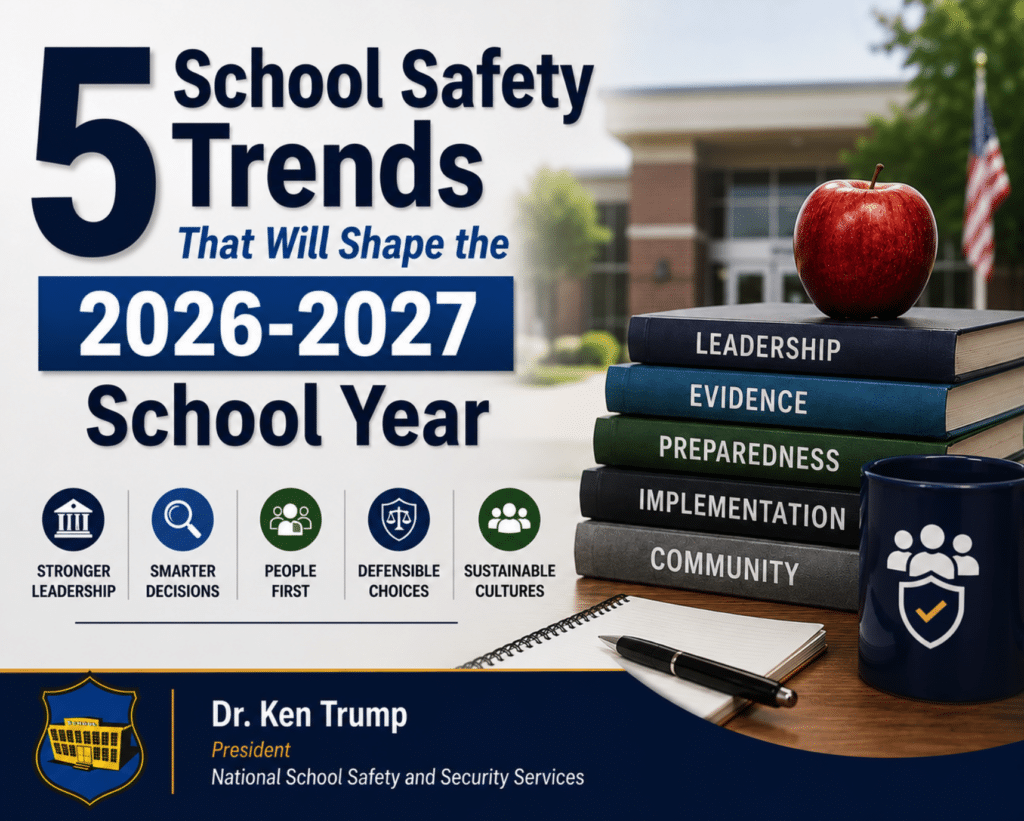
Based on more than four decades of working with school leaders and assessing K-12 school safety, security, and emergency preparedness, here are five school safety trends I expect to shape the 2026-2027 school year.

1. School Safety Will Become a Bigger School Board Governance Issue
School boards and superintendents will face growing pressure from parents, students, employees, the media, and their communities to separate evidence from emotion when making school safety decisions.
School boards, superintendents, and principles will continue to be inundated with calls for new security measures and quick fixes. The districts that perform best will be those whose leaders ask tougher questions, conduct meaningful due diligence, and resist reactionary policymaking.
The conversation will increasingly shift from compliance to fidelity of implementation.
No more of just “checking the box.” It is not enough to say a district has a safety plan, conducted a drill, purchased a security product, or adopted a policy. Leaders need to know whether those measures are actually being implemented consistently and effectively.
School boards and superintendents will face greater expectations to demonstrate how they evaluate risks, oversee safety investments, communicate with stakeholders, and document defensible decisions.
They and their professional associations will also need to push back when state and federal policymakers promote unfunded or underfunded school safety mandates that may sound good politically but do not necessarily fit day-to-day school operations, climate, and culture.
School safety is becoming as much a governance and organizational leadership issue as a security issue.

2. School Leaders Will Need to Separate Independent School Safety Expertise From Security Vendor Marketing
School administrators and board members increasingly tell us they struggle to “cut through the noise” of sales pitches promising solutions to school violence. That challenge is getting harder.
Security vendors are no longer relying only on exhibit booths, advertisements, and product demonstrations. Companies and industry interests are creating or supporting nonprofits, sponsoring research and educational content, underwriting conferences, lobbying legislators, and paying to get access to give keynote and other high-profile speaking opportunities.
These relationships do not automatically invalidate the information presented. But they make transparency, disclosure, and independent evaluation more important.
School leaders need to ask:
- Who funded this research, organization, or recommendation?
- What financial or organizational relationships exist?
- Is the source truly independent?
- Who benefits if our district follows this advice?
The question should not simply be “Is this good advice?” It should also be “Who benefits if we follow it?”
Independent, conflict-free school safety expertise will become more valuable as the line between education and security industry marketing becomes harder to see.

3. People and Leadership Will Continue to Drive the Biggest School Safety Improvements
Artificial intelligence, weapons detection systems, panic buttons, cameras, drones, and other school security technology companies will continue to increase their marketing and lobbying.
Some school leaders will cave under community pressure and buy target hardening items to counter public pressures to “do something” about school safety. Others will buy these items with good intentions believing vendor marketing claims they will prevent or somehow more effectively intervene in violent incidents.
Some physical security measures have legitimate roles when selected through a comprehensive assessment of actual school security and emergency preparedness needs.
But investigations and school security litigation following serious incidents repeatedly bring the focus back to fundamentals:
Were students actively supervised? Were doors properly secured? Did staff recognize and report concerning behavior? Were crisis roles clear? Did employees understand their responsibilities? Were procedures practiced? Did administrators know whether policies were actually being followed?
A district can purchase sophisticated technology and still have serious vulnerabilities when leadership, supervision, training, communication, and implementation are weak.
Technology can support effective school safety. It cannot replace it.
The greatest opportunities for meaningful improvement will continue to come from strengthening people, leadership, preparedness, and fidelity of implementation.

4. School Safety Incidents Will Increasingly Move From the Schoolhouse to the Courthouse
Parents are increasingly taking grievances involving school injuries, violence, and student deaths into state and federal courts via school security lawsuits against school districts, school leaders, and school staff.
School safety decisions will therefore be evaluated not only by educators and parents, but also by attorneys, judges, school security expert witnesses, and juries after something goes wrong.
The questions after a serious incident will not simply be: “What safety measures did you have?”
They will increasingly include:
Why did you choose them? What risks did you identify? How did you train staff? Were procedures actually followed? How did administrators monitor implementation? Can you demonstrate that your decisions were part of a thoughtful, evidence-informed process?
Having a written emergency plan is different from demonstrating that employees were trained, procedures were practiced, deficiencies were corrected, and administrators maintained meaningful oversight.
Due diligence, documentation, and fidelity of implementation will become as important as the safety measures themselves.
School safety decisions increasingly need to be both operationally sound and defensible after the fact.

5. Sustainable School Safety Cultures Will Outperform Symbolic Security Measures
The districts making the greatest long-term progress will move beyond checking compliance boxes and chasing the latest product.
They will build sustainable cultures of preparedness based on leadership, accountability, active supervision, situational awareness, strong relationships, clearly defined crisis roles, meaningful training, student and parent engagement, community participation, and continuous improvement.
These practices may not generate the headlines of a major security technology purchase. But effective school safety is built through thousands of small actions performed correctly every school day.
One question should become increasingly important for superintendents and school boards:
Are we actually doing what we say we are doing?
That is the essence of fidelity of implementation.
Strong school safety cultures and sustainable systems will outperform isolated, highly visible, and symbolic security initiatives.
What Will Define Effective School Safety in 2026-2027?
The schools that make the greatest progress this year will not necessarily be the ones that spend the most money.
They will be the ones that lead better, ask better questions, conduct meaningful due diligence, and make decisions based on evidence rather than emotion, marketing, political pressure, or the latest headline.
Boards and superintendents will increasingly need to demonstrate not simply that they did something, but that they identified the problem, evaluated their options, selected appropriate strategies, implemented them with fidelity, and continuously monitored their effectiveness.
The most important school safety question for 2026-2027 is not: “What can we buy next?”
It is: “What problem are we trying to solve, what does the evidence tell us, and are we doing the fundamentals well every day?”
That is where meaningful school safety begins.
Dr. Kenneth S. Trump is President of National School Safety and Security Services
National School Safety and Security Services
Experts You Can Trust!
Connect with Dr. Ken on Linkedin: www.linkedin.com/in/kentrump/
Follow Dr. Ken on X(Twitter) @safeschools