
With the Rise of Industry-Affiliated “Nonprofits” in School Security, Not Every School Safety Nonprofit Is Independent. Here’s What School Leaders Need to Know.
As the school security industry has grown into a multi-billion-dollar marketplace, a new trend has emerged: for-profit security vendors and industry executives creating or leading nonprofit organizations focused on school safety.
These organizations purport that they provide valuable resources, networking opportunities, advocacy, and professional development related to school safety. Many of them do create forward-facing activities in one or more of these areas.
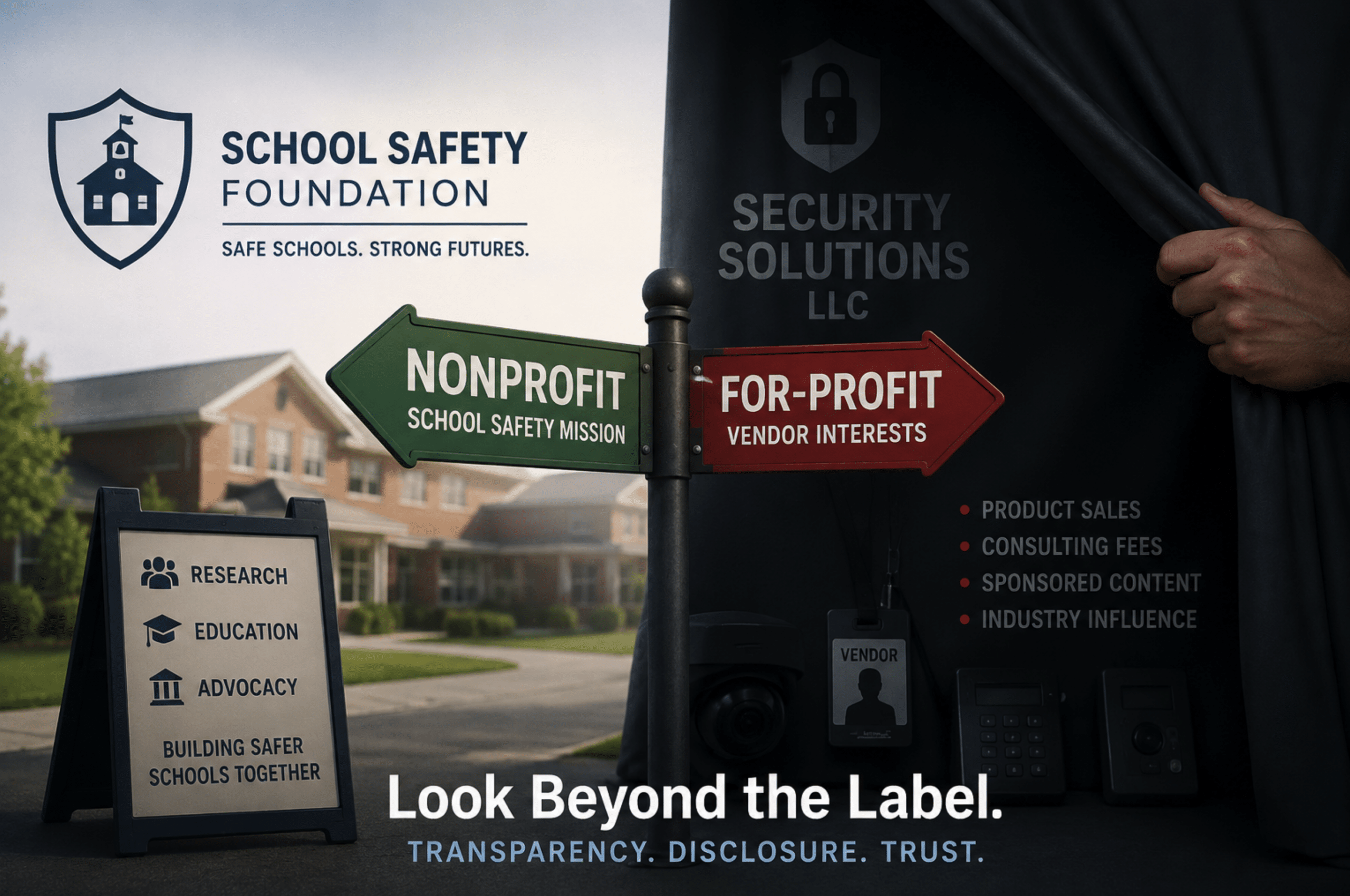
The issue is not just whether an organization is organized as a nonprofit. That’s a classification issue of how the entity is legally formed and structured.
The issue is whether educators, policymakers, journalists, and the public clearly understand who governs the organization, who funds it, and whether commercial interests could influence its work.
In an era when schools are investing millions of taxpayer dollars in security technologies and services, transparency has never been more important.
Does Nonprofit Status Mean an Organization Is Independent?
Many school leaders assume that a nonprofit organization is objective, neutral, or free from commercial influence. But that assumption can be misleading.
A nonprofit designation simply describes an organization’s tax status. It does not automatically mean the organization is independent of industry influence or free from potential conflicts of interest.
School leaders should recognize that nonprofit organizations can vary widely in their governance, funding, leadership, and relationships with private companies.
How School Security Vendors Are Trying to Build Credibility Through Nonprofit Organizations
Industry professionals may possess valuable expertise and deserve a role and voice in the conversation.
However, their expertise is typically in the product or service they are selling, and how to be salespersons. It does not make them subject matter experts in school safety with the education, training, and experience.
And in those increasing situations where school security vendors are hiring school security directors and school administrators to give themselves credibility, the bottom line is that these former education employees are not being paid to be independent school safety experts. They are being paid by these security product and technology vendors to advance the sales and marketing of the companies paying them.
The hidden goal is that nonprofit organizations will serve as powerful credibility builders for individuals and companies operating within the school security product and technology marketplace.
And in some cases, the same individuals with their hands in the formation and/or operation of the non-profits may simultaneously serve as:
- Executive of a security company
- Founder or officer of a nonprofit school safety organization
- Conference presenter
- Author of best practice guidance
- Legislative advisor
- Media commentator
- Member of advisory boards or so-called “standards” committees created by these organizations themselves
None of these roles is inherently inappropriate. But concerns arise when audiences are unaware of how these roles intersect or when potential conflicts are not clearly disclosed.

Why Transparency and Conflict-of-Interest Disclosure Matter in School Safety
School districts routinely ask vendors to disclose costs, product limitations, warranties, performance claims, and references before making purchasing decisions.
Organizations presenting themselves as non-profits and independent sources of guidance should be held to similarly high standards of transparency.
School leaders deserve to know:
- Who founded the non-profit organization?
- Who serves on its board of directors?
- What percentage of board members represent security vendors versus educators, school administrators, or independent practitioners?
- Who funds the organization’s operations?
- Are major sponsors also school security product and technology vendors serving the K-12 market?
- Are financial statements publicly available?
- Does the organization maintain a written conflict-of-interest policy?
- Are educational resources independently tested and reviewed?
These are not accusations. They are basic governance questions that every responsible organization should welcome.
Why Independent School Security Advice Matters
School safety decisions increasingly shape:
- Student safety strategies
- Emergency preparedness planning
- Procurement decisions
- Legislative initiatives
- Public confidence
- Media coverage
- Taxpayer investments
When recommendations originate from organizations with undisclosed commercial relationships, educators may unknowingly receive guidance that aligns more closely with security product and technology industry priorities than independent analysis.
This means decision makers deserve enough transparency to evaluate them appropriately.

How School Leaders and Reporters Can Distinguish Independent School Safety Organizations from Security Industry-Affiliated Groups
Labels alone rarely tell the whole story.
School leaders need to exercise due diligence by exploring the independence and history of the organization and individuals when considering the school safety sources of information they are consuming.
Reporters covering school safety frequently seek expert commentary after incidents involving violence, emergency preparedness, school security technology, or student safety.
Before presenting an organization as an independent authority, school leaders and journalists should consider asking:
- Who funds the organization?
- What professional backgrounds do board members represent?
- Do leaders have financial relationships with companies discussed in the interview?
- Are conflicts of interest publicly disclosed?
- Does the organization advocate for particular products or services?
These questions do not undermine credibility. They strengthen it.
Independent School Safety Expertise Welcomes Transparency
This discussion is not about criticizing nonprofit organizations or questioning the integrity of individuals who volunteer their time to improve school safety. Many nonprofit organizations make important contributions to the profession.
Rather, it is about recognizing that transparency builds trust.
Organizations that truly operate independently should have little hesitation in openly disclosing:
- Governance structure
- Board composition
- Funding sources
- Sponsorship relationships
- Conflict-of-interest policies
- Leadership affiliations
Transparency allows educators to make informed decisions.
School Security Organizations Should Be Evaluated by Governance, Not Branding
Whether an organization is nonprofit or for-profit is only one small part of the picture.
More important questions include:
- Who governs it?
- Who funds it?
- Who benefits from its recommendations?
- Are commercial relationships clearly disclosed?
What you’re seeking to determine is: Are school security product and technology vendor influences dominating governance and operations?
Those questions matter because school leaders increasingly rely on outside organizations to shape policies affecting students, staff, taxpayers, and entire communities.
Independent expertise is measured not by a tax designation or a mission statement, but by transparency, accountability, and a demonstrated commitment to serving schools above security product and technology vendor commercial interests.
Dr. Kenneth S. Trump is President of National School Safety and Security Services
National School Safety and Security Services
Experts You Can Trust!
Connect with Dr. Ken on Linkedin: www.linkedin.com/in/kentrump/
Follow Dr. Ken on X(Twitter) @safeschools
Visit and “Like” Our Facebook School Safety News Channel at: www.facebook.com/schoolsafety
10 Due Diligence Questions Every School Board and School Administrator Should Ask Before Relying on a School Safety Organization
Whether evaluating a nonprofit organization, professional association, advocacy group, or industry coalition, school leaders should perform the same level of due diligence they would expect when evaluating a curriculum or other educational service vendor.
Before relying on an organization’s recommendations, consider asking:
- Who founded the organization, and what were their professional affiliations at the time?
- Who serves on the board of directors, and how many members represent security vendors, consultants, educators, school districts, researchers, or law enforcement?
- Who provides the organization’s funding? Are donors, sponsors, and major contributors publicly disclosed?
- Does the organization maintain a written conflict-of-interest policy? If so, is it publicly available?
- Are educational resources and best practice recommendations developed independently or influenced by sponsors, board members, or commercial partners?
- Are financial statements, IRS Form 990 filings, and annual reports readily available for public review?
- Does the organization encourage diverse viewpoints, or do its publications consistently promote similar products, technologies, or approaches?
- Are leadership roles clearly disclosed when individuals simultaneously represent nonprofit organizations, consulting firms, and commercial companies?
- Does the organization distinguish between evidence-based recommendations, professional opinion, and product marketing?
- Would you reach the same conclusions if the organization’s name and nonprofit status were removed from the discussion?
These questions are not intended to discredit any organization. They are intended to promote transparency, strengthen governance, and help school leaders make informed decisions based on evidence, independence, and the best interests of students and staff.
The nonprofit label should never be the end of a school leader’s due diligence. It should be the beginning.