
New independent guide examines why communicating school safety is not simply a public relations function, but a fundamental responsibility of effective school leadership.
School leaders can make sound safety decisions, follow established emergency procedures, and manage a difficult incident effectively, yet still lose the confidence of parents, employees, and their communities because of poor communications.
The reverse is equally true. A polished public statement, carefully crafted parent letter, or reassuring news media interview cannot compensate for weak school safety leadership or a poorly managed crisis.
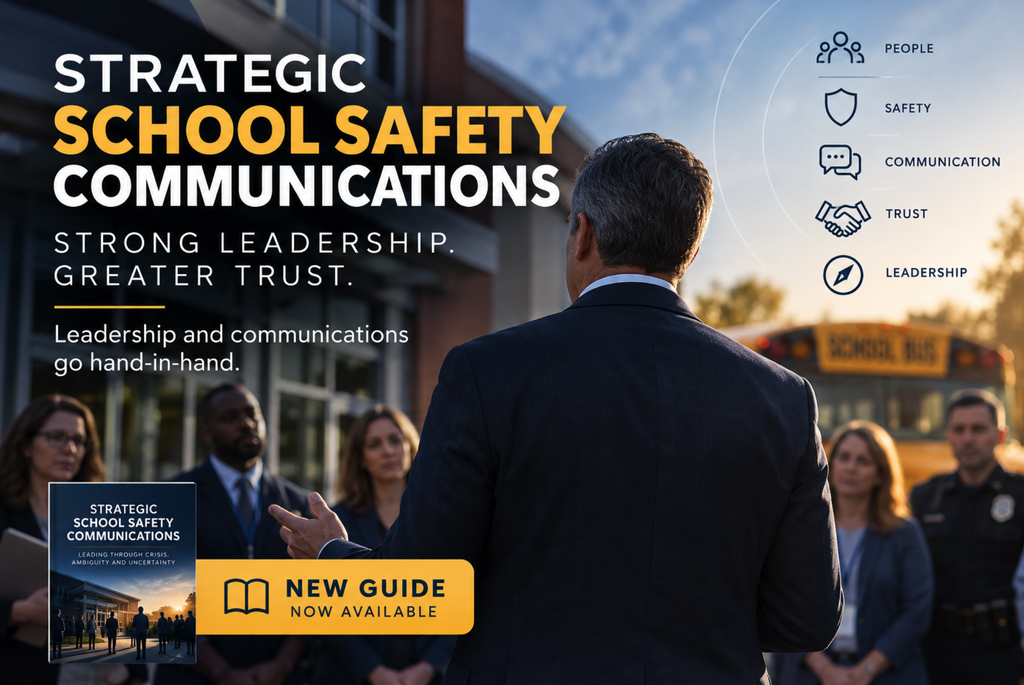
Strategic school safety leadership requires effective communications. And credible school safety communications must reflect strong leadership. The two go hand-in-hand.
That is the central message of our newly released independent guide, Strategic School Safety Communications: Leading Through Crisis, Ambiguity and Uncertainty.
School Safety Communications Is a Leadership Discipline, Not an Afterthought
Too often, school safety communications is treated as something that begins after an incident occurs. An administrator drafts a parent notification, a communications director prepares talking points, and a superintendent responds to questions from reporters or school board members.
But by that point, much of the groundwork for successful communications should already have been established.
Strategic school safety communications begins long before a crisis. It involves building trust, explaining school safety priorities, establishing credible relationships, preparing leadership teams, and developing the judgment needed to communicate when information is incomplete and circumstances are changing.
And in today’s environment of instant social media reporting, heightened parent concerns, competing narratives, and intense public scrutiny, those leadership responsibilities have become increasingly complex.
Communications cannot be separated from school safety decision-making. It must be integrated into how leaders think, plan, act, and evaluate their decisions.
Leading When There Are No Easy Answers
One of the most difficult challenges facing school administrators is communicating during ambiguity and uncertainty.
Parents want immediate answers, employees need direction, and school boards expect explanations. News media and social media demand information, sometimes before school officials can verify the facts.
School leaders may face enormous pressure to promise solutions, announce new security measures, or provide reassurances they cannot realistically guarantee. This is where strategic leadership matters most.
Effective leaders recognize the difference between communicating quickly and communicating responsibly. They understand that acknowledging uncertainty is not necessarily a sign of weakness. They also recognize that silence, defensiveness, and promises unsupported by facts can undermine public confidence.
The challenge is not simply deciding what to say. It is exercising sound judgment about what is known, what remains uncertain, what actions are appropriate, and how to maintain credibility throughout the process.
A New School Safety Communications Resource for School Leaders
Our new guide draws on more than four decades of practical school safety consulting experience, along with my doctoral research at Johns Hopkins University examining strategic school safety leadership and communicating school safety in highly ambiguous and uncertain environments.
It explores the leadership dimensions of school safety communications, including building public trust before a crisis, communicating when facts remain uncertain, coordinating with emergency response partners, managing misinformation, and sustaining credibility during post-incident recovery.
The guide also includes practical questions for superintendents, principals, school board members, communications directors, and school safety leadership teams to evaluate their own preparedness.
It is intentionally independent and non-product-affiliated. The focus is not on selling another communications platform, notification system, or technological solution. It is on strengthening the leadership judgment, organizational capacity, and relationships that make effective communications possible.
Strong Leadership and Credible Communications Are Inseparable
School safety leadership is about much more than managing security equipment, emergency plans, and crisis response procedures. It also involves helping people understand risks, decisions, expectations, and the realities of keeping schools reasonably safe.
School leaders cannot communicate their way out of poor decisions. Nor can they assume that good decisions will speak for themselves. The most effective school safety leaders understand that what they do and how they communicate what they do are inseparable responsibilities.
That is why strategic school safety communications deserves a place alongside prevention, preparedness, response, recovery, and governance in every school district’s leadership strategy.
Read our new independent guide:
Strategic School Safety Communications: Leading Through Crisis, Ambiguity and Uncertainty


Dr. Kenneth S. Trump
President, National School Safety and Security Services
Dr. Kenneth S. Trump is President of National School Safety and Security Services, an independent, non-product-affiliated school safety consulting firm. With more than 40 years of experience in PreK–12 school safety, security, and emergency preparedness, he provides independent analysis and strategic guidance to school leaders nationwide.