
Where School Safety Training Actually Happens: Inside the School
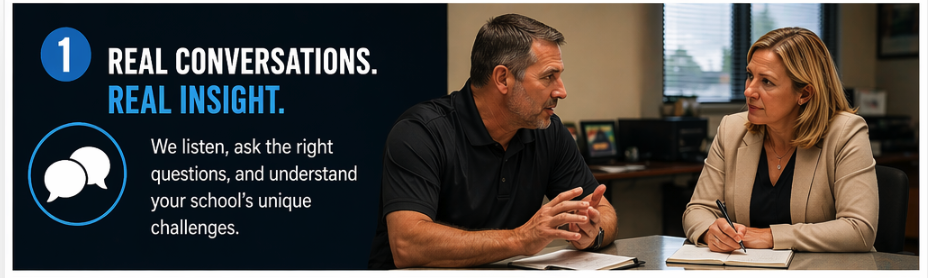
There’s a moment at the end of many school security and emergency preparedness assessments that says everything.
A principal pauses and says:
“This has been really helpful. I’ve learned more than a dozen things I can do just from our conversations today.”
That’s the outcome that matters. And we hear this time-after-time in our assessment work in schools.
Not a checklist.
Not a product recommendation.
Not a report that sits on a shelf.
Actionable change. Immediately.
The Problem with Traditional “School Security Assessments”
Too many school security assessments, especially those driven by vendors, lean heavily in one direction:
- Hardware
- Products
- Technology
- Physical security upgrades
These elements have a place. But they are only part of the picture.
The reality in PreK–12 schools is different:
- Most safety challenges are behavioral, not technological
- Many risks are tied to supervision, communication, and decision-making
- The most effective solutions often require people-focused changes
You don’t solve those issues with a template or checklist.
School Safety Assessment Is a Qualitative Process
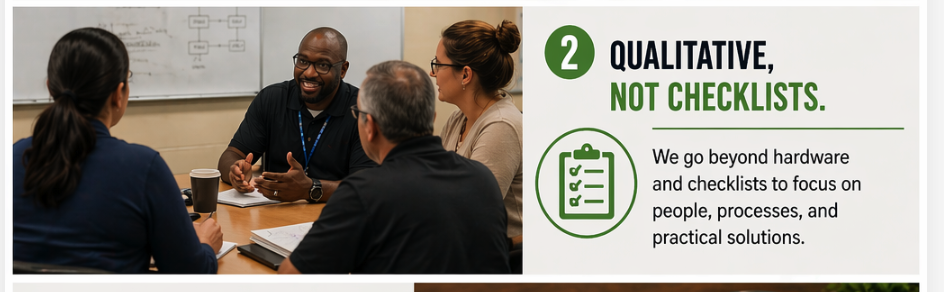
Effective assessments are not mechanical. They are qualitative and interactive.
They focus on:
- Listening to school leaders and staff
- Understanding how the building actually operates day-to-day
- Identifying gaps in practices, not just equipment
- Asking the right questions and answering them in real time
This is not about walking through a building with a clipboard.
It’s about engaging people in meaningful conversations that lead to better decisions.
When School Security and Emergency Preparedness Assessments Become Training
The most impactful assessments don’t feel like inspections.
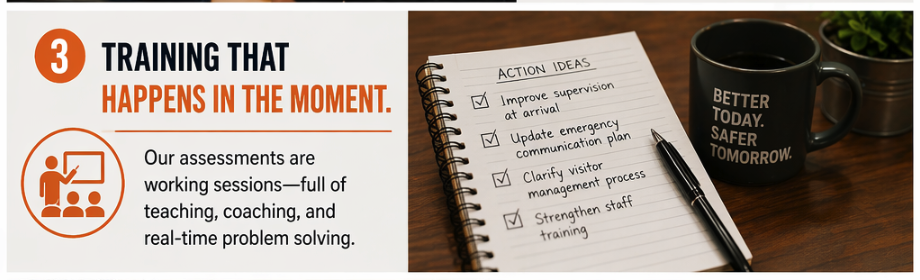
They feel like working sessions.
- Conversations turn into coaching
- Questions turn into teaching moments
- Observations turn into practical solutions
In many ways, these are mini technical assistance sessions happening in real time.
As a result:
- School leaders gain clarity immediately
- Staff understand not just what to do, but why
- Problems are addressed on the spot, not weeks later
By the time the visit ends, schools often have multiple actionable steps they can implement without delays.
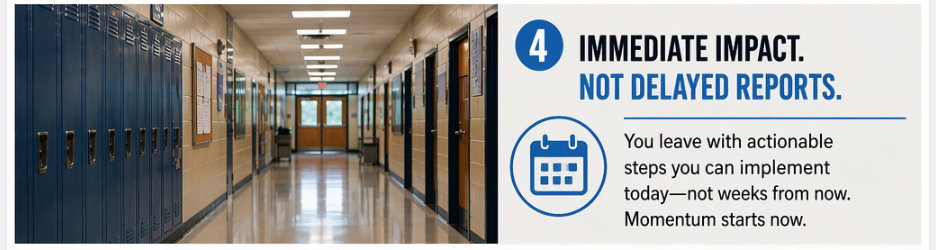
Immediate Impact vs. Delayed Reports
Traditional models often follow a familiar pattern:
- Conduct assessment
- Leave
- Deliver report weeks later
But the delay matters.
Momentum fades.
Questions linger.
Opportunities for immediate improvement are lost.
In contrast, a conversation-driven approach delivers:
- Real-time insight
- Immediate application
- Stronger buy-in from staff
The written report becomes a reinforcement and more detailed tool, but not the starting point.
Why This Can’t Be Replicated at Conferences
This level of impact cannot be achieved in a convention center or hotel ballroom.
Even the best national, state, or regional conferences:
- Are generalized by nature
- Cannot account for each school’s unique context
- Reach individuals, not entire teams
- Focus on exposure more than implementation
Real school safety work is:
- Context-specific
- Relationship-driven
- Grounded in daily operations
It happens in:
- Hallways
- Offices
- Cafeterias
- Front offices
- Conversations with real people facing real challenges
The Bottom Line
The most effective school safety training is not something you attend.
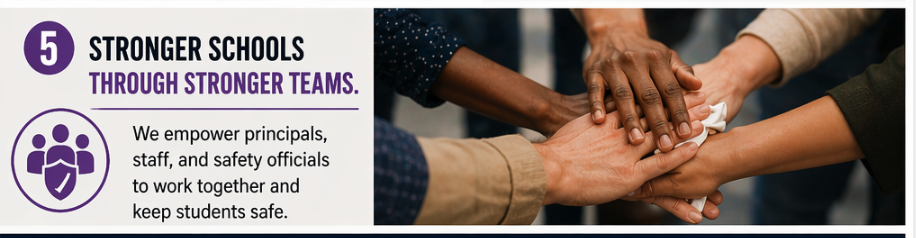
It’s something you experience inside your own school, with your own people, focused on your own challenges.
It’s:
- Practical
- Immediate
- People-centered
- Actionable
And when it’s done right, school leaders don’t leave with a stack of notes.
They leave with a clear sense of what to do next. Without delay. Today.
That’s the difference between checking boxes and actually making schools safer.
Click here for information on our assessment services.

Dr. Kenneth S. Trump is President of National School Safety and Security Services
National School Safety and Security Services
Experts You Can Trust!
Connect with Dr. Ken on Linkedin: www.linkedin.com/in/kentrump/
Follow Dr. Ken on X(Twitter) @safeschools
Visit and “Like” Our Facebook School Safety News Channel at: www.facebook.com/schoolsafety