
The Shift From Specialized School Safety Tools to “All-In-One” Platforms or Companies
In the school safety marketplace, many security product and technology vendors begin with one strong core service. Hypothetically, it may start with a visitor management platform. Or perhaps a panic alert technology. Maybe it is even emergency management software, tip reporting, or threat assessment tools.
At first, the company and product is often highly focused. The product may be relatively clean, responsive, and reliable. Customer support tends to be stronger. Updates are targeted toward improving the core service schools originally purchased.
But then the bundling begins.
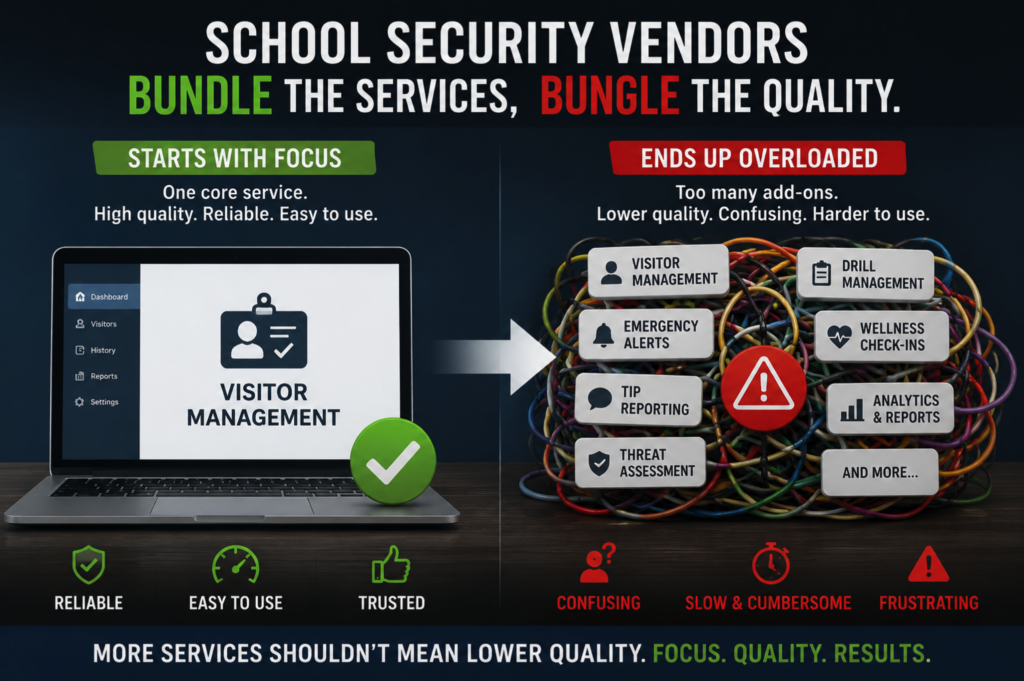
Let’s say visitor management gets bundled with emergency alerts. Emergency alerts get bundled with reunification software and apps. Then we get some behavioral reporting tools and threat assessment modules added. Then drill management is added. Toss in some wellness monitoring. Don’t forget some AI analytics to layer on top. Suddenly, the company attempts to do everything for everybody.
The Business Goal of the School Security Vendor Is Simple
The motivation behind this trend is not complicated: Bundle more services, expand contracts, and increase recurring revenue and profit margins. Sell it all as a “one stop shop” or “integrated systems.” All the while, make your products and services harder for districts to replace you.
From a business perspective, the strategy makes sense. Companies want larger market share, higher valuations, and deeper customer dependence on their platforms.
But schools should recognize that business growth strategies do not automatically translate into better operational outcomes for educators.

When the Core School Safety Products Starts Slipping
Too often, the quality of the original core service begins to diminish as companies expand their products and bundles.
Over the past couple of years, we have increasingly observed this during school security and emergency preparedness assessments in districts nationwide. In particular, some visitor management systems that once functioned reasonably well as standalone tools now appear less reliable and more cumbersome after companies expanded into broader bundled service models.
In one school district, two school security consultants with more than 40 years experience in the profession were unable to both successfully sign in at school and administrative sites using the district’s visitor management system. School secretaries were observably frustrated with the system by the second school the consultants visited.
At one school, we self-entered that we were five days or five months old and the system printed a badge. At another school, I signed in as serial killer Jeffrey Dahmer and used his birthday.
The point was not to play games. But it was to show that the problem was not untrained or inexperienced school office staff using the system, as vendors may try to default to as an explanation. It was two independent school security consultants very well versed in school visitor management systems.
For the record, we did sign-in with our real names and under the supervision of school staff at each site. The point was to try the system, which was an epic failure – not just for us, but for those who had to use it daily. And school leaders reported repeated attempts over the months through multiple vendor service representatives to get help to get things on track in their district.
But rest assured, bundled services were there as an option if the district wanted to purchase those, too.
Some common challenges schools may experience:
- More complicated interfaces
- Increased training demands
- Slower customer support
- Feature overload
- Greater implementation challenges
- More staff confusion over day-to-day usage
Districts can end up with what amounts to a digital “junk drawer” of partially implemented features rather than a high-quality operational tool.

Bigger Bundles Are Not Always Better
School leaders should approach bundled security services and platforms carefully and critically. There certainly are well-intended and credible security vendors, but that doesn’t mean the bottom line isn’t really the bottom line: Bigger sales.
More features do not necessarily equal better outcomes. A larger platform does not automatically create a safer school. And companies claiming to do everything exceptionally well deserve thoughtful scrutiny.
Technology should support school operations, not overwhelm them.

Questions School Leaders Should Ask
Before purchasing or expanding bundled school security services, school leaders should ask practical operational questions:
- Has the quality of the company’s original core service remained strong as expansion occurred?
- Can school leaders independently track down other school leaders who use the services to get feedback without having to rely on vendor-provided “cherry picked” references?
- Are the new bundled features or products fully mature or still evolving?
- What features are schools actually using consistently day to day?
- What challenges and failures have been identified by other school leaders who have used, or are using, the services?
- How much added staff training and management time will the system require?
- Is the district purchasing operational value or simply purchasing more features?
- What’s the service responsiveness with — and after — initial implementation?
- What’s the exit strategy if school leaders need to bail out if things turn out to be a complete flop?

Final Thought: Do Everything for All or One Thing Exceptionally Well?
School security is not a plug-and-play sport. Technology can support people and processes, but it cannot compensate for weak implementation, poor training, or operational overload.
Sometimes the best solution is not the platforms or companies that do everything. It is simply the company and platform that still does one important thing exceptionally well.
Dr. Kenneth S. Trump is President of National School Safety and Security Services
National School Safety and Security Services
Experts You Can Trust!
Connect with Dr. Ken on Linkedin: www.linkedin.com/in/kentrump/
Follow Dr. Ken on X(Twitter) @safeschools
Visit and “Like” Our Facebook School Safety News Channel at: www.facebook.com/schoolsafety