
An angry parent allegedly throws a vase during a heated confrontation in a school office. A school secretary responds by pulling out her personal firearm and placing it on a desk. But perhaps the most disturbing revelation is that the secretary reportedly felt so unsafe at work that she brought a gun to protect herself.
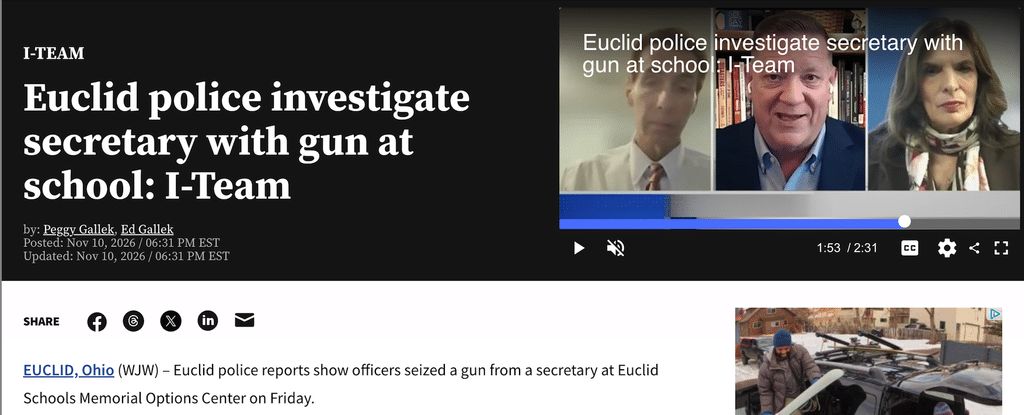
A recent Cleveland FOX 8 I-Team investigation into an incident at a Euclid, Ohio, school, for which I was interviewed as a school safety expert, raises troubling questions about school security, employee fears, and the training we provide to frontline school support staff.
According to the police account cited in the report, the parent and school secretary became involved in a “very heated” argument, with both reportedly swearing at each other “very loudly.” The parent allegedly threw a vase. The secretary then placed a firearm on her desk, identifying it as her own.
Perhaps even more concerning was the police report’s statement that the secretary “has told numerous people that she has not felt safe at this school with the provided security and said that she brings the firearm as protection.”
Two wrongs don’t make a right.
An angry parent throwing objects during a confrontation is unacceptable. A school secretary introducing a firearm into an already volatile school office confrontation creates another serious safety concern.
Both actions deserve scrutiny and appropriate accountability. But beyond the conduct of both individuals, school leaders should be asking a more fundamental question:
What happens when the school employees responsible for helping keep students and others safe do not feel safe themselves?
School Secretaries Are Frontline School Safety Personnel, Whether We Recognize It or Not
School secretaries and front office personnel are often the first employees to encounter an angry parent, an agitated visitor, a threatening telephone call, or someone attempting to enter a school without authorization.
They answer the phones. They manage visitors. They respond to upset parents. They coordinate communications during emergencies. They often serve as the eyes and ears of school administrators, especially when principals and assistant principals are occupied elsewhere in their buildings.
Yet these same employees are frequently overlooked in school security and emergency preparedness training.
Over more than four decades of working in school safety, I have repeatedly encountered school secretaries, custodians, food service workers, and other support personnel who receive little or no meaningful security training specific to their responsibilities.
Our firm has provided specialized school support staff safety and emergency preparedness training for years.
It is not unusual for school secretaries attending our training sessions to tell us that it is the first meaningful security and emergency preparedness training they have received in 20 or even 30 years on the job.
Think about that: We place employees on the front lines of potentially volatile situations, sometimes for decades, without adequately preparing them to recognize, prevent, manage, and respond to those situations.
Then we are surprised when something goes wrong.
When a School Employee Says They Feel Unsafe, Leadership Needs to Listen
One of the most concerning aspects of the Euclid incident is the secretary’s reported statement that she had repeatedly expressed concerns about inadequate security.
We do not know the full circumstances behind her concerns. We do not know what training she received, what security measures were in place, whether she formally reported her concerns, or how administrators may have responded.
Those facts matter and should be examined before reaching conclusions about this school’s security practices or leadership.
But the larger lesson applies to every school district.: When employees repeatedly say they feel unsafe, that is a school safety leadership issue, not simply an employee complaint.
School leaders should take these concerns seriously, evaluate whether they reflect actual vulnerabilities, and communicate with employees about what can reasonably be done to address them.
That does not mean every employee concern requires another security guard, metal detector, panic button, or other expensive security technology. Sometimes the most meaningful improvements are operational rather than technological.
Employees may benefit from clearer procedures, stronger administrative backup, practical verbal de-escalation training, better office layouts, improved visitor management, and greater confidence that help will be available when needed. And sometimes an employee’s concerns may reveal genuine weaknesses that administrators have not recognized.
The starting point is listening, evaluating, and acting rather than dismissing employee fears or automatically purchasing more security equipment.
Could Training and Better Office Design Have Helped?
Consider the reported confrontation between the parent and secretary.
- Would practical training in verbal de-escalation have helped the secretary recognize warning signs, manage the interaction, establish boundaries, or disengage before the confrontation intensified?
- Could different office design features have provided a safer physical separation between the parent and employee?
- Was there a clear procedure for summoning an administrator, school security officer, or police when a visitor became confrontational?
- Did the secretary know when to stop engaging with the parent, move to a safer location, and request immediate assistance?
- Was there another trained employee available to provide backup?
- Had staff practiced responding to an angry or threatening visitor before an actual confrontation occurred?
We cannot conclude that any particular intervention would have prevented this incident. However, these are precisely the kinds of questions school leaders should be exploring before an angry encounter escalates into a crisis.
School office security should involve more than locked entrance doors, visitor identification systems, and surveillance cameras. It should include the human factors associated with how employees interact with visitors, recognize escalating behavior, communicate with colleagues, and obtain assistance.
A thoughtfully designed school office can support these practices by providing appropriate separation, controlled access to interior areas, clear sightlines, accessible communication systems, and safe options for employees to disengage from threatening individuals.
But the physical environment is only part of the solution. Security hardware cannot substitute for employees who know what to do, when to do it, and who will support them when situations deteriorate.
School Support Staff Need Training Specific to Their Jobs
Too often, school safety professional development is built around administrators, teachers, school resource officers, and security personnel. Support staff may receive a generic annual presentation or be asked to review an emergency plan. That is not the same as preparing them for the situations they actually encounter.
Different employee groups have different responsibilities, risks, and operational challenges.
School Secretaries and Front Office Personnel
School secretaries need practical training in managing angry visitors, verbal de-escalation, visitor access control, threatening telephone calls, emergency notifications, administrative backup procedures, and their roles in crisis communications and student-parent reunification.
They should understand when to disengage from a confrontation, how to summon assistance, and what to do when administrators are unavailable.
Custodians and Maintenance Personnel
Custodians need training in building security, suspicious activity recognition, access control, emergency utility procedures, after-hours incidents, and their essential roles in supporting emergency responders.
These employees often know the physical operations of a school better than anyone else in the building. Their knowledge can be invaluable in both preventing and responding to emergencies.
Food Service and Cafeteria Personnel
Food service employees need training related to cafeteria supervision, fights and disturbances, lockdowns and evacuations during meal periods, vendor access, and procedures for maintaining student safety when hundreds of students are gathered in large common areas.
Their responsibilities may change dramatically during an emergency, particularly when school administrators and teachers are not immediately present.
School Bus Drivers and Transportation Personnel
Bus drivers and transportation employees need specialized preparation for student behavior incidents, threatening situations, emergencies on buses, communications, evacuation decisions, and their roles during school-wide emergencies.
Paraprofessionals, clerical employees, substitutes, and other support personnel also need to understand the security and emergency responsibilities associated with their assignments.
One generic school safety presentation for everyone is rarely sufficient. Training should be practical, scenario-based, and aligned with the realities employees face during their workdays.
Five Practical Steps School Leaders Can Take Now
School administrators do not need to wait for an incident involving a thrown vase or a firearm before addressing support staff safety.
1. Ask Support Staff What Makes Them Feel Unsafe
Meet with secretaries, custodians, cafeteria employees, transportation workers, and other support personnel.
Ask about concerning incidents, recurring problems, areas of vulnerability, and situations where they feel unprepared.
Listen without becoming defensive. Assess their concerns, document what you learn, and communicate the actions taken to address identified problems.
2. Provide Role-Specific Security and Emergency Preparedness Training
Focus on situations employees are likely to encounter.
For front office staff, prioritize recognizing escalating behavior, verbal de-escalation, establishing boundaries, summoning assistance, and safely disengaging.
Use realistic scenarios and opportunities for discussion rather than relying solely on lectures or written procedures.
3. Evaluate Front Office Security From the Employee’s Perspective
Assess desk locations, public access, separation from visitors, escape options, communication systems, and response procedures.
Consider what happens when a parent becomes aggressive while the principal is unavailable or the secretary is working alone.
Walk through the office with the people who actually work there every day. Their observations may identify vulnerabilities that are not obvious during a conventional building security inspection.
4. Establish Clear Backup and Intervention Procedures
Employees should know when and how to request help, who responds, when law enforcement should be contacted, and what to do while awaiting assistance.
These procedures should be communicated, practiced, and evaluated for their actual effectiveness.
A procedure that works only when the principal or security officer happens to be nearby is not an adequate backup plan.
5. Include Support Staff in School Safety Planning and Exercises
Invite these employees to contribute to emergency planning, participate in relevant tabletop exercises, and identify operational weaknesses.
Their firsthand experiences can reveal vulnerabilities that administrators, consultants, and security personnel might otherwise overlook.
Most importantly, follow through. Asking employees to identify concerns without addressing them can further undermine their confidence in school leadership.
The Bigger Issue Is School Safety Leadership, Not Just Security Equipment
This incident also raises important questions about organizational culture.
· Do school employees believe their safety concerns are heard?
· Do they trust administrators to intervene when parents become threatening?
· Do they have the authority and confidence to disengage from confrontations rather than continue arguments that are escalating?
· Are there shared expectations for managing aggressive visitors?
· Does the school have a workplace culture in which employees can report security concerns without fear of being dismissed or criticized?
· Does leadership distinguish between genuine security needs and the temptation to respond to fear with more hardware?
These are questions of strategic school safety leadership.
Schools cannot promise employees that every threatening or uncomfortable situation will be prevented. But administrators can provide reasonable safeguards, clear procedures, effective training, and an organizational culture that takes employee safety seriously.
Employees who understand their responsibilities, have practiced responses, and trust that their colleagues and administrators will support them are better positioned to make sound decisions under stressful and uncertain conditions.
This is also why school safety assessments should examine more than physical security equipment and written procedures. They should evaluate how employees actually perform their responsibilities, whether established procedures are consistently implemented, and whether frontline personnel are prepared for the situations they may encounter.
The issue is not simply whether schools have security measures in place. It is whether those measures work in the real world when employees need them most.
Don’t Wait Until Someone Throws a Vase or Pulls a Gun
There should be accountability for inappropriate conduct, whether it involves an angry parent or a school employee introducing a firearm into a volatile confrontation.
But an investigation focused exclusively on individual wrongdoing risks overlooking a potentially significant underlying concern: Why did this school secretary reportedly feel so unsafe that she believed bringing a personal gun to work was necessary?
And what, if anything, could school leaders have done to identify and address those concerns before the confrontation occurred?
These questions do not excuse unsafe conduct. They recognize that meaningful school safety improvement requires examining the circumstances, workplace conditions, and human factors surrounding an incident.
School secretaries, custodians, food service workers, transportation personnel, and other support employees are not peripheral to school safety. They are essential members of the school safety team.
If we expect them to help keep our schools safe, we have a responsibility to help them feel safer, become better prepared, and know they will not be left to handle dangerous situations alone.
That starts with leadership, listening, training, and operational follow-through. Not another box checked on an annual professional development form.
School Support Staff Safety Training and Additional Resources
National School Safety and Security Services provides independent, customized school safety training and consulting focused on practical implementation, human factors, and real-world school operations.
- School Support Staff Safety and Emergency Preparedness Training: Specialized, role-specific training for school secretaries, custodians, maintenance personnel, food service workers, and other school support employees.
- Strategic School Safety Leadership: Strengthening safety leadership, decision-making, accountability, and implementation.
- School Emergency Preparedness, Response, and Recovery: Improving school emergency planning, training, exercises, and operational readiness.
- School Safety and Security Assessments: Independent assessments addressing physical security, operational performance, and human factors affecting school safety.
Related news coverage: Cleveland FOX 8 I-Team: Euclid Police Investigate Secretary With Gun at School. Dr. Kenneth S. Trump, President of National School Safety and Security Services, was interviewed for the station’s investigation.


Dr. Kenneth S. Trump
President, National School Safety and Security Services
Dr. Kenneth S. Trump is President of National School Safety and Security Services, an independent, non-product-affiliated school safety consulting firm. With more than 40 years of experience in PreK–12 school safety, security, and emergency preparedness, he provides independent analysis and strategic guidance to school leaders nationwide.