
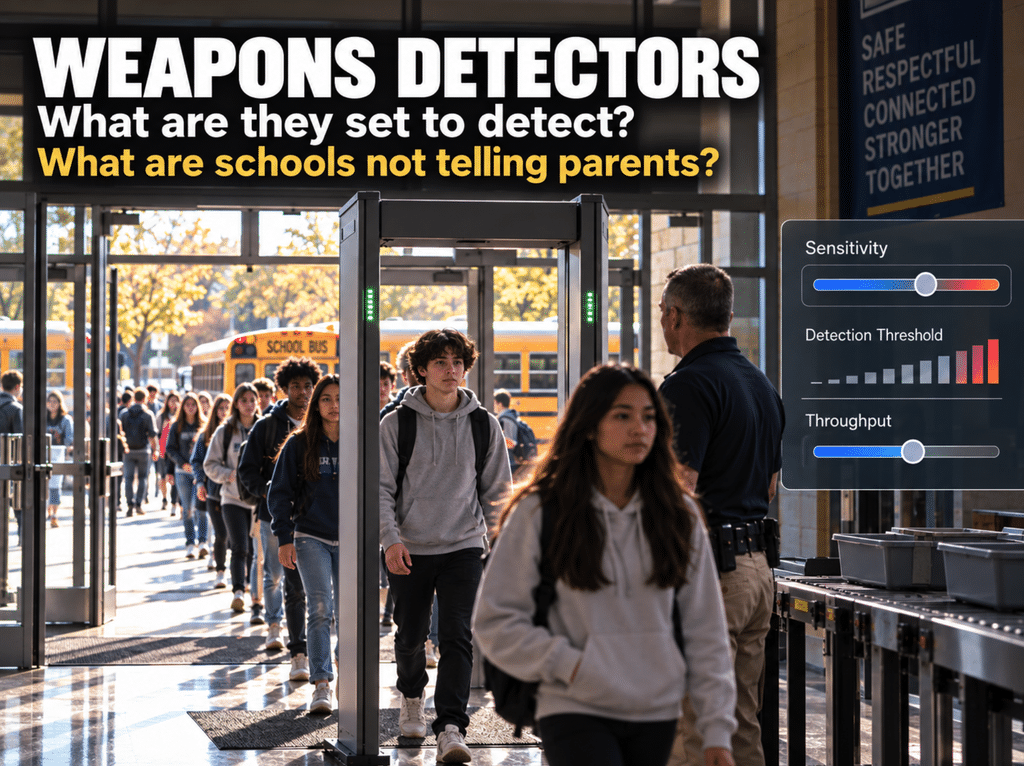
When schools tell parents they have weapons detection systems, are they explaining what those systems are actually configured to detect, and what they may miss?
A loaded handgun brought into Kalamazoo Central High School in Michigan on October 16, 2026, has generated conflicting accounts, public frustration, and questions about the effectiveness of the school’s weapons detection system.
But beyond the immediate controversy lies a broader school safety leadership issue that deserves greater attention nationally: Weapons detection systems have adjustable sensitivity settings, and those settings can influence which threats are detected, how frequently alarms occur, and how quickly students enter school.
The question is not simply whether a school has weapons detection technology. It is whether school leaders understand, accept, and communicate the operational limitations associated with how that technology is configured and used.
Kalamazoo, Michigan: A Loaded Gun, Conflicting Accounts, and Unanswered Questions
According to WWMT News Channel 3’s reporting on the police investigation, a 16-year-old student brought a loaded handgun into Kalamazoo Central High School. The student reportedly told investigators that the weapons detector activated when he entered and that a subsequent search failed to discover the firearm.
Kalamazoo Public Schools disputes that account, stating that surveillance video showed the detector did not alert and that no secondary search occurred upon entry. WMUK also reported on the conflicting accounts and the district’s response.
WWMT further reported that a subsequent test involving the recovered handgun and backpack reportedly activated the detector. However, the backpack did not contain all the materials present during the student’s original entry, leaving questions about whether the test adequately reproduced the original conditions.
The district had previously invested approximately $300,000 in state grant funding for weapons detection systems at its secondary schools. WWMT’s earlier investigation identified the equipment as CEIA OPENGATE systems and examined questions directed to the district, police, and manufacturer.
Additional WOOD-TV coverage addressed changes to screening procedures following the incident.
Determining exactly what happened in Kalamazoo requires a careful review of the available evidence. A missed alarm, an inadequate secondary search, and an equipment malfunction are different operational problems requiring different corrective actions.
However, one question deserves particular scrutiny: What detection sensitivity settings were in place when the student entered the school, and were those settings appropriate for the threats school leaders believed they were screening for?

The Sensitivity Settings Issue School Leaders Need to Understand
Weapons detection systems are not necessarily configured to identify every prohibited weapon or metal object that passes through them.
Many systems allow operators to adjust detection sensitivity to target different types and sizes of metallic objects. These adjustments can influence the equipment’s ability to detect smaller weapons while also affecting the frequency of alarms generated by everyday items.
For example, schools may configure systems primarily around the detection of firearms and larger metallic threats. Depending on the equipment, selected detection parameters, and screening conditions, smaller bladed weapons such as knives, box cutters, and razor blades may be more difficult to detect reliably.
Increasing sensitivity may improve detection of smaller metallic threats, but it can also produce more alarms requiring additional screening.
This is where school safety decisions become leadership decisions, not simply technology decisions.
School administrators must consider how they balance the detection of potentially dangerous items against the operational demands of processing hundreds or thousands of students entering school within a relatively short period.
That balance has a name in the security industry: throughput.

Throughput Versus Detection: Who Is Accepting the Risk?
Manufacturers market weapons detection systems partly on their ability to process large numbers of people efficiently while minimizing unnecessary alarms.
That operational benefit is attractive to school administrators who want to avoid long entrance lines, late arrivals to class, staffing demands, and disruptions to the educational environment.
But sensitivity settings can create important tradeoffs.
A school may choose settings intended to reduce nuisance alarms and secondary searches, accepting limitations in the categories of objects the system will reliably identify. Alternatively, more sensitive configurations may require additional personnel, closer inspection, and longer screening times.
Neither technology nor staffing decisions can eliminate every risk. However, school leaders should recognize that configuration decisions may involve accepting particular detection limitations in exchange for operational efficiency.
Who makes those decisions: A vendor representative? The school security director? Building administrators? The superintendent? The school board?
And perhaps most importantly, do those making the decisions understand their implications?
School leaders cannot responsibly delegate these judgments entirely to equipment vendors or technicians. Vendors can explain product capabilities, recommend configurations, and assist with testing. School officials remain responsible for determining how the equipment fits their actual security objectives, staffing capabilities, and broader safety practices.
Bottom line: Security equipment vendors and school leaders need to collaboratively address and understand what schools wish to detect, what level of risk school leaders are willing to accept by foregoing a higher level setting to achieve a faster desired throughput, and related issues.
What Does the Manufacturer Say?
The manufacturer of the systems used in Kalamazoo, CEIA, acknowledges that its OPENGATE equipment offers adjustable sensitivity and security settings.
In its official OPENGATE product information, CEIA describes the ability to change detection parameters through a mobile application, allowing operators to adjust sensitivity for different security needs. CEIA also promotes high-throughput screening with fewer unnecessary alarms.
More significantly, in its response to WWMT’s questions about the Kalamazoo incident, the manufacturer stated that a properly installed and operated system configured at an appropriate sensitivity setting for handgun detection will identify a loaded handgun and produce an alarm. The qualifying language matters.
The manufacturer did not publicly disclose Kalamazoo’s particular settings, and the available reporting does not establish that sensitivity settings caused the October 16 incident.
Nevertheless, the manufacturer’s statements underscore a fundamental point: Purchasing and installing a weapons detection system does not, by itself alone, establish which threats it is configured to detect or how reliably it will detect them under actual school conditions.

Are Schools Being Fully Transparent With Parents?
When parents hear that their children’s school has weapons detection systems, many understandably expect that guns, knives, and other dangerous weapons will be identified before students enter.
But do those expectations match the actual capabilities and operating configurations of the equipment?
If a school knowingly selects settings that prioritize the detection of larger firearms while accepting reduced detection capabilities for bladed weapons or even smaller guns, should parents be told that the system does not provide equivalent screening for all weapons?
There is a difference between telling parents that a school has weapons detectors and explaining what those detectors are intended to detect.
School officials do not need to disclose specific technical settings or details that could help someone circumvent screening. They should, however, provide accurate, understandable explanations of the system’s intended purpose, general detection limitations, testing practices, and the other safety measures used to address threats the equipment may miss.
Transparency does not require publishing a security playbook. It requires avoiding assurances that create a greater perception of protection than actual operating practices support.
This is especially important when a district publicly emphasizes its investment in weapons detection technology as evidence that schools are safer.

Questions Every School Board and Superintendent Should Be Asking
The Kalamazoo incident offers an opportunity for school leaders nationwide to examine their own weapons detection practices.
- Who determines and approves the sensitivity settings used in our schools?
- What categories of weapons are our systems configured and independently tested to detect?
- What types of smaller weapons or prohibited items might not reliably generate an alarm?
- What detection-versus-throughput tradeoffs have we accepted, and who formally approved them?
- How frequently do we test equipment under realistic daily operating conditions?
- Are staff consistently trained and supervised in secondary screening procedures?
- Do our public statements accurately describe both the capabilities and limitations of our systems?
These questions are not an argument for or against weapons detection technology. That’s another conversation. They are an argument for informed decision-making, operational testing, and accountability when school leaders make a choice to implement school weapons detection systems.
School Security Leadership Requires More Than Purchasing Technology
The controversy in Kalamazoo should not be reduced to whether a particular manufacturer produces an effective weapons detection product.
The more important questions concern how the system was configured, tested, staffed, supervised, and incorporated into the school’s overall security practices. The investigation must establish what actually occurred before responsibility for a particular failure can be determined.
School leaders should also remember that technology is only one layer of prevention and intervention. In Kalamazoo, information from people ultimately led authorities to the student and the firearm, reinforcing the importance of reporting channels, responsive staff, and other human elements of school safety.
As I emphasize in my guidance on school security products and technology and strategic school safety leadership, buying equipment is not the same as demonstrating that it performs as expected in the realities of everyday school operations.
Parents deserve more than reassurance that weapons detectors are installed. They deserve confidence that school leaders understand what their systems can detect, what they may miss, and the risks associated with those decisions.
That is a school safety leadership and transparency issue, not simply a technology issue.


Dr. Kenneth S. Trump
President, National School Safety and Security Services
Dr. Kenneth S. Trump is President of National School Safety and Security Services, an independent, non-product-affiliated school safety consulting firm. With more than 40 years of experience in PreK–12 school safety, security, and emergency preparedness, he provides independent analysis and strategic guidance to school leaders nationwide.