
Omaha’s electric shock glove controversy exposes a bigger school safety leadership problem.
Here’s a question every superintendent and school board member should be asking: Do you really know what’s happening in your schools when it comes to safety, security, policing, and emergency preparedness?
Not every operational detail. But enough to provide meaningful leadership, oversight, and accountability?
The unfolding controversy over electric shock gloves carried and used by school resource officers in Omaha Public Schools provides a troubling case study of what happens when the answer appears to be no.
The Superintendent and Board Didn’t Know
In my recent article, Electric Shock Gloves for School Resource Officers? Why Schools Should Think Twice, I examined Omaha Police Department SROs carrying the G.L.O.V.E., an electric shock device intended as a lower-level use-of-force option.
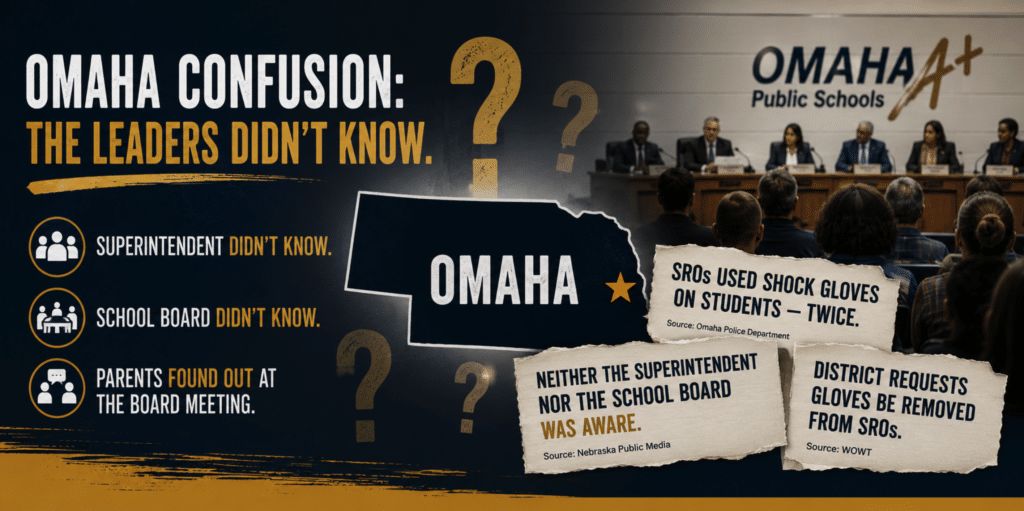
Twenty-nine Omaha police SROs were trained to use the devices, and the gloves had already been used twice on Omaha Public Schools students during the 2025-2026 school year.
Then came the school board meeting. About 30 parents, students, and community members spoke about the gloves before a packed room. But perhaps the most stunning revelation was that members of the Omaha Public Schools Board of Education said they had not known about the gloves. Superintendent Matthew Ray said he hadn’t known about them either. (Nebraska Public Media)
Board Vice President Kimara Snipes questioned how police could introduce a new use-of-force device into schools without a formal conversation with the superintendent or elected board. She said she was “livid” when she learned what had occurred. Board member Gini Magnuson said the gloves had never come before the board for a vote or contract while acknowledging that this did not absolve the board of responsibility. Superintendent Ray took responsibility for the board not knowing, explaining that he himself had not known. (Nebraska Public Media)
Consider what that means: A new police use-of-force technology was introduced into district schools. SROs were trained and equipped with it. It was used twice on students. Yet the superintendent and elected school board say they didn’t know.
That’s not a minor communications glitch. That’s a school safety leadership problem.
Then the District Reversed Course
Following the controversy, Superintendent Ray formally asked local law enforcement agencies to stop authorizing SROs to carry the G.L.O.V.E. on Omaha Public Schools property. Omaha Police Chief Todd Schmaderer agreed. OPD SROs will no longer carry the gloves in OPS schools, although officers will continue carrying their standard-issued equipment. (WOWT)
Omaha Mayor John Ewing said the city’s four public school district superintendents were contacted and given the option to opt out. Omaha Public Schools did so. (WOWT)
So within days, this went from a police department defending the technology as a lower-level force option specifically suited for SROs to the school district saying: We will not have our SROs carrying it.
That sequence should get the attention of superintendents and school boards far beyond Omaha.
These Are Exactly the Questions School Leaders Should Have Been Asking
In my initial article, I listed questions school boards and superintendents should ask before allowing electric shock gloves in schools:
- What specific school safety problem are we trying to solve?
- What independent research supports using the technology with adolescents?
- At what level of resistance may an SRO use it?
- Should electrical pain compliance be permitted for passive resistance?
- What restrictions apply to younger or vulnerable students?
- How will every use be documented and reviewed?
- Were school administrators and the school board involved before deployment?
- Were parents informed?
- What alternatives were considered?
Those last questions look considerably less hypothetical now. The Omaha controversy illustrates precisely why significant school safety decisions cannot operate in organizational silos.
Boards Don’t Need to Know Everything. But They Need to Know Enough.
There is an important distinction here. A superintendent should not be deciding where every security camera is mounted. School board members should not be directing an SRO’s tactics during an arrest. They don’t need to know which radio channel a principal switches to during an evacuation or which administrator grabs which student roster during reunification.
Governance is not micromanagement.
But there is a big difference between staying out of the operational weeds and being disconnected from consequential school safety decisions.
Today’s superintendents and boards need to be more hands-on than they were decades ago. School safety has become increasingly complex, involving emergency plans, security technologies, threat assessment, SRO agreements, communications systems, drills, reunification, surveillance, access control, and relationships with multiple first responder agencies.
Those systems also carry legal, political, financial, educational, and community-relations implications. A superintendent and board cannot responsibly provide oversight if their knowledge stops at, “We have SROs,” “We have an emergency plan,” or “The police handle that.”
Does the Left Hand Know What the Right Hand Is Doing?
This may be the most damaging perception created by the Omaha situation.
Parents now have every reason to wonder: If the superintendent and school board didn’t know SROs were carrying a new electric shock device, what else don’t they know?
Fair or unfair, that’s the question leadership gaps create.
School districts regularly talk about “partnerships” with police, fire, emergency management, mental health agencies, and other community organizations. But a partnership requires communication in both directions.
Law enforcement agencies have legitimate authority over their officers, equipment, policies, and use-of-force decisions. School districts have legitimate authority and responsibility for what happens inside their schools and for the welfare of their students.
Those responsibilities clearly intersect when police assign officers carrying a new use-of-force technology specifically into schools. Someone needed to recognize that intersection.
Someone Should Have Raised the Flag
Even if the superintendent and board were not initially involved, another uncomfortable question remains: Did nobody below them recognize that this issue needed to be elevated?
District safety administrators? Central office administrators? Principals? SRO supervisors? Police command staff? Someone involved in managing the district-police relationship?
A new electric shock device introduced specifically for SRO use is not a routine equipment change equivalent to replacing flashlights or radios. It has obvious student safety, special-needs, parent, policy, liability, media, and community-relations implications.
Good middle managers need the judgment to recognize when something technically within their operational authority has implications well beyond their lane. They need enough political and school-community relations horse sense to say: The superintendent needs to know about this. The board needs to know about this. We need to think through how parents will react before they learn about it from the news.
Somewhere in the Omaha process, that communication failed.
Parents Expect Their Leaders to Know
Parents do not neatly separate the organizational charts of a school district and police department. When something happens to their child in school, they see the school.
Telling parents afterward that the superintendent didn’t know, the board didn’t approve it, or the police made the equipment decision is unlikely to inspire confidence.
The Omaha board meeting demonstrated that reaction. About 30 parents, students, and community members spoke about the gloves, raising concerns about student trust, de-escalation, vulnerable students, and the lack of public involvement before the devices appeared in schools. (Nebraska Public Media)
One educator representative made an important point: When law enforcement equipment is going to be used on students in schools, educators, school leaders, and the public deserve an opportunity to be part of the conversation rather than learning about it from the news. (Nebraska Public Media)
Get Out of the 30,000-Foot View
Superintendents and boards should periodically get below the broad assurances and ask what is actually happening operationally.
What does the current SRO agreement actually say? What circumstances trigger police involvement rather than administrative discipline? What equipment are SROs carrying? What security technologies have been added? What changes have been made to emergency procedures? When were plans last exercised rather than simply reviewed? What recurring problems are building administrators seeing? What assumptions are police making that school administrators may not share?
And perhaps most importantly: What significant school safety decisions are being made several organizational levels below the superintendent that leadership would be uncomfortable explaining at a packed school board meeting tomorrow night?
That’s a useful test.
School Safety Leadership Requires Situational Awareness at the Top
School boards govern. Superintendents lead and manage. Building administrators and safety professionals handle operational details. Police chiefs command their officers. Those roles should remain distinct, but distinct roles cannot become disconnected silos.
The lesson from Omaha isn’t that superintendents and school boards need to approve every operational decision. It is that significant decisions affecting student safety, use of force, parent expectations, liability, and public confidence need a clear pathway to executive and governance-level awareness.
School leaders should know enough to ask intelligent questions, challenge assumptions, recognize emerging risks, and make defensible decisions. And the people working beneath them need enough judgment to know when to raise an issue up the flagpole.
The electric shock gloves are now coming off Omaha Public Schools SROs. (WOWT)
But the bigger question remains, not just for Omaha but for every school district: Does your superintendent and school board really know what’s happening with school safety in your schools?
If leadership only finds out after parents, reporters, or controversy bring it to their attention, the answer came too late.
Dr. Kenneth S. Trump is President of National School Safety and Security Services
National School Safety and Security Services
Experts You Can Trust!
Connect with Dr. Ken on Linkedin: www.linkedin.com/in/kentrump/
Follow Dr. Ken on X(Twitter) @safeschools