
In a number of schools during our security and emergency preparedness assessments, we sometimes hear from school safety and administration teams:
“We use cell phones to text or call for help and a Google Chat group for emergency communication – we’re covered.”
It sounds modern. Efficient. Familiar.
And we hear this in schools that have two-way radios on site and are not piloting any panic buttons or apps.
But in a real emergency, that mindset can quickly fall apart.
The Problem: Confusing Convenience with Capability
Cell phones and messaging platforms like Google Chat can be useful for day-to-day coordination:
- Changes in the day’s schedule and activities
- Routine communication
- Non-urgent updates on student needs
But school safety is not a routine function.
When a situation turns urgent – or life-threatening – these tools often introduce delays, friction, and failure points that staff don’t think about until it’s too late.
Reality Check: What Happens in a Crisis?
Consider real-world scenarios:
- A staff member is grabbed by an irate parent in a hallway
- A teacher collapses from a heart attack
- A fight escalates rapidly in a crowded area
- A suspicious person is moving through the building
Now ask yourself:
👉 What’s faster – and more realistic under stress?
Option A:
- Pull out your phone
- Unlock it
- Try to make a phone call to another staff member -OR-
- Open an app or locate the correct chat group box
- Type a message
- Hit send
- Hope someone sees it immediately
Option B:
- Press a single button on a two-way radio
- Speak instantly
- Be heard immediately by multiple staff
This isn’t theoretical. It’s human factors.
Human Factors Matter More Than Tech Features
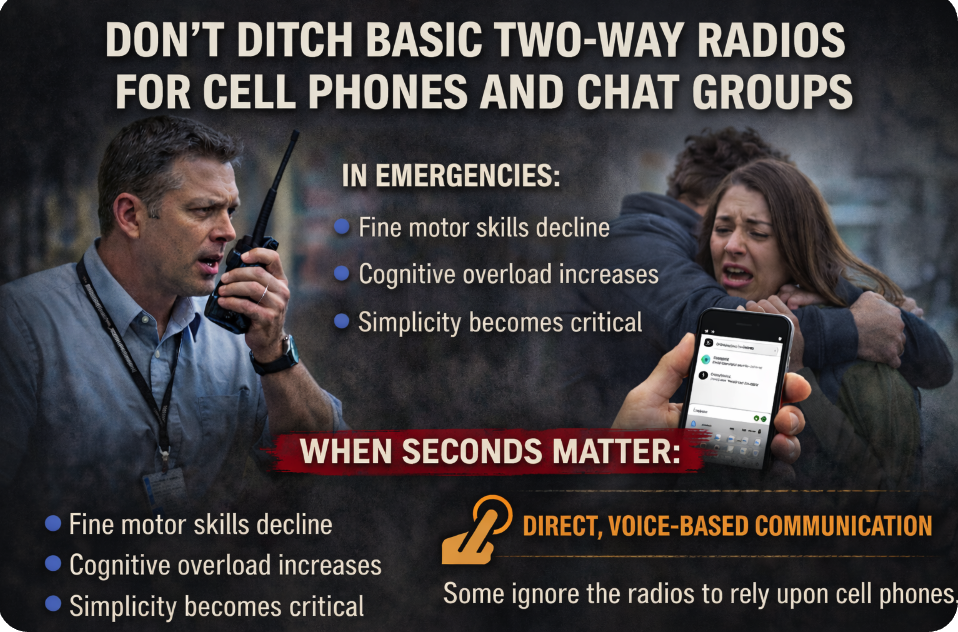
Under stress, people:
- Lose fine motor skills
- Experience cognitive overload
- Default to the simplest available action
That’s why in high-risk professions, two-way radio communication tools are designed for:
- Speed
- Simplicity
- Reliability
Two-way radios can, when working and used properly, check all three boxes. They meet these criteria for immediate, voice-based communication.
Trying to make cell phone calls and typing in chat platforms do not.
A Critical Clarification: This Is Not About Selling or Bashing “More Tech”
This is where the conversation often gets misinterpreted.
👉 The takeaway is not:
- “Replace phones with apps”
- “Buy a new panic button system”
- “Add another layer of software”
In fact, adding more layers can sometimes:
- Increase complexity
- Slow response time
- Create new points of failure
👉 The real issue is fit-for-purpose tools.
Every communication method has a role:
- Two-way radios: Immediate, voice-based, staff-to-staff emergency communication
- Cell phones: External communication (911, parents, district offices)
- Apps and other systems (if you choose to use them and have fidelity of implementation): May supplement — but should not replace — simple, direct two-way radio communication tools you already have
No single tool solves everything.
But not all tools perform equally in the first critical seconds of an incident.
The Illusion of “We’ll Just Use Our Phones”
Relying on cell phones and chat groups creates hidden vulnerabilities:
❌ Time delay – typing and navigating apps takes seconds you may not have
❌ Uncertain delivery – messages can be missed, muted, or delayed
❌ Signal dependency – dead zones and overloaded networks happen
❌ One-to-one communication – not inherently designed for instant group alerting
❌ Can require multiple fine motor skill moves – difficult or impossible in a physical confrontation
Meanwhile, radios provide:
✅ Instant, one-touch communication
✅ Simultaneous group broadcast
✅ No reliance on cellular networks
✅ Ease of use under stress
✅ Audible alerts attract the attention of others using the radios
The Bigger Issue: Tools Already Exist — They’re Just Not Being Used
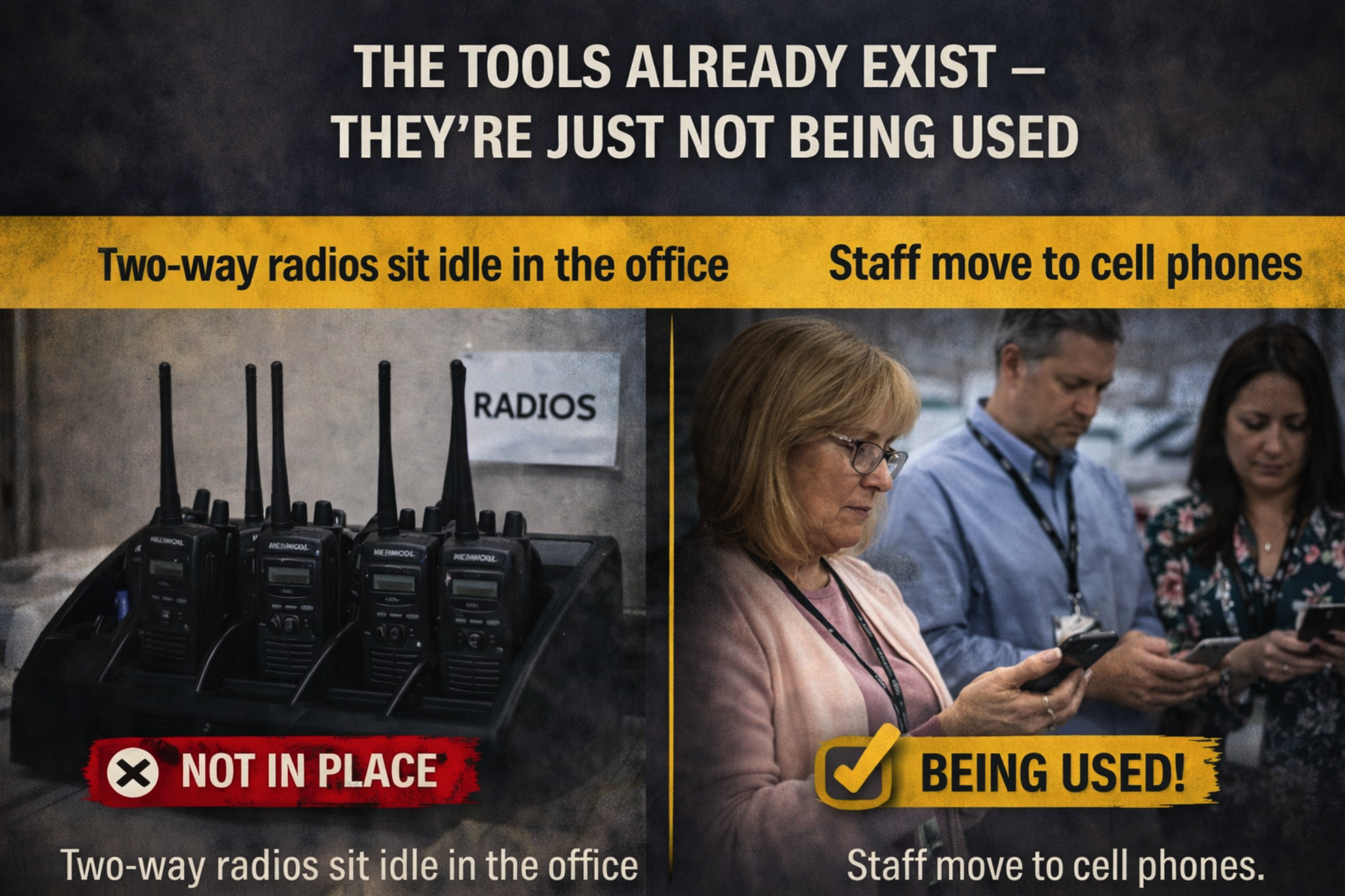
In most schools, two-way radios are already available.
But at times we find in a handful of schools:
- School leaders have – but don’t carry – the radios
- They’re not consistently carried
- They’re not embedded in daily practice
Before looking to purchase new systems, school leaders should ask:
👉 Are we fully using what we already have?
Often, the most immediate improvement in school safety doesn’t require new spending—
It requires better implementation of existing tools and practices.
School leaders don’t need to spend millions on software, apps or panic buttons. Start by using the basic tech you already have in the storage closet and your colleagues are using successfully at other schools in your own district!
Radios Aren’t “Old School” — They’re Purpose-Built
Two-way radios aren’t outdated.
They are:
- Purpose-built for real-time emergency communication
- Designed for immediate action under stress
- Proven across law enforcement, fire service, and emergency response
This isn’t about nostalgia.
It’s about functionality when seconds count.
If anything, choosing not to use them is ignoring decades of lessons learned in high-risk environments.
This Is a Classic Case of Overcomplicating School Safety
Schools sometimes fall into the trap of adopting tools because they are:
- Popular
- Familiar
- Already in use
But what works for convenience does not always work for crisis response.
This is a textbook example of:
Overcomplicating school safety with everyday technology that is not designed for emergency performance.
The Bottom Line
Cell phone calls, texting, and chat platforms can have a role in schools.
But they should not be relied upon as the primary tool for immediate, on-the-spot emergency communication.
When seconds matter:
- Simplicity beats complexity
- Reliability beats convenience
- Immediate voice beats delayed text
And sometimes, the most effective solution isn’t the newest technology —
…it’s the one that works when people are scared, stressed, and out of time.
Because that’s the moment your communication system will truly be tested and outcomes are often decided.
Note: We are independent and do not sell or promote security products or technology.
Please – no vendor pitches directly or indirectly advocating for products.
Dr. Kenneth S. Trump is President of National School Safety and Security Services
National School Safety and Security Services
Experts You Can Trust!
Connect with Dr. Ken on Linkedin: www.linkedin.com/in/kentrump/
Follow Dr. Ken on X(Twitter) @safeschools
Visit and “Like” Our Facebook School Safety News Channel at: www.facebook.com/schoolsafety
Well done, timely, and much needed advice. School safety in the REAL WORLD.