
As school districts consider weaponized drones equipped with pepper spray, strobe lights, and other tactical features for active shooter response, school leaders must carefully weigh the operational risks, unintended consequences, coordination with law enforcement, liability concerns, and the lack of independent evidence supporting their use.
I wasn’t even planning to write about this topic because it initially seemed too absurd to warrant serious discussion. But as another school year begins, national news stories are highlighting pilot programs that use remotely operated drones equipped with pepper spray, strobe lights, sirens, and other features to respond to active shooters. Some states are providing public funding, and some school leaders appear intrigued by the concept.
That’s why I am compelled to weigh in. It’s also exactly why it’s time to hit the pause button on this perhaps well intended, but definitely not well thought out, idea.
Too often in school safety, flashy new technology receives attention long before anyone seriously examines how it would function during a real crisis. The result can be unintended consequences that create new risks instead of reducing existing ones.
What Are Weaponized School Drones?
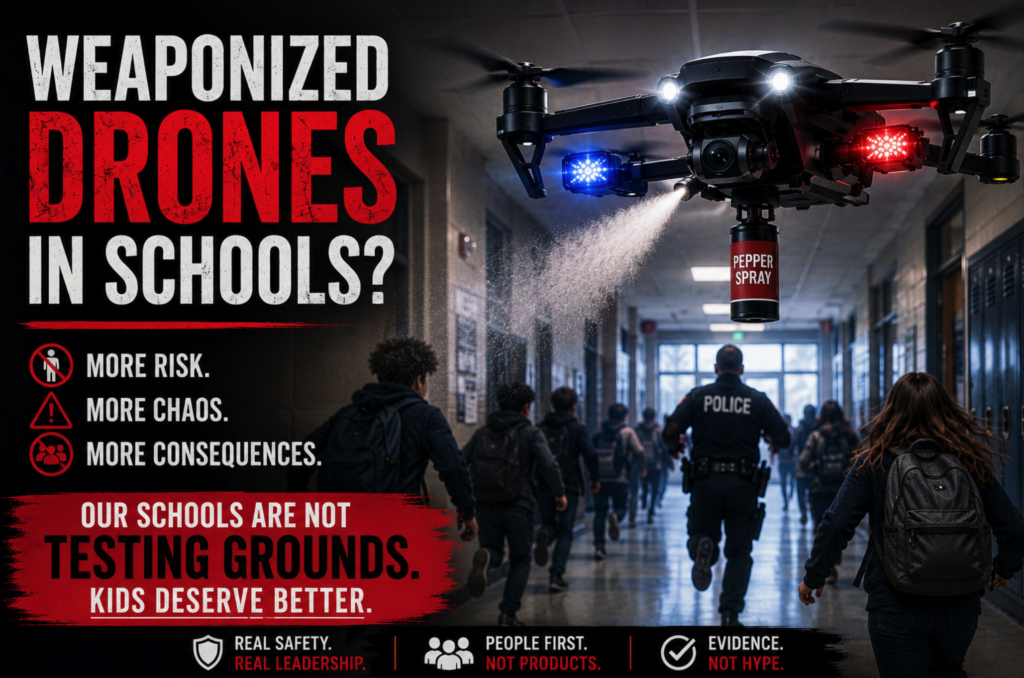
One company promoting this type of systems envisions drones that can be activated during an active shooter incident and remotely operated, in many cases from another state. Depending on the system, they may carry pepper spray, high-intensity strobe lights, sirens, cameras, two-way communications, and even the ability to physically strike or distract an attacker until law enforcement arrives.
The concept makes for exciting visual new stories. It also provides an impressive vendor-created demonstration.
But real schools with kids and teachers are not demonstrations.

The Difference Between a Weaponized Drone Demo and School Safety Reality
Promotional videos typically show a drone locating a clearly identifiable attacker moving through an otherwise empty hallway. Everything unfolds exactly as planned.
But actual school shootings don’t unfold perfectly as scripted:
They are chaotic, confusing, and constantly evolving. Students are running. Teachers are locking down or evacuating classrooms. Administrators are receiving incomplete information. School resource officers, police officers, firefighters, and EMS personnel may all be moving through the same areas at the same time.
This isn’t an online tactical game where a mistake means your character respawns and the mission starts over. There is no reset button. It’s not a battlefield war game.
If a remote operator misidentifies someone, deploys pepper spray in the wrong location, interferes with responding officers, or simply acts on incomplete information, innocent people can be seriously injured or killed. Decisions made in those moments have permanent consequences.

School Drone Operational Questions School Leaders Should Ask
Before embracing this technology, school leaders, policymakers, and taxpayers should demand answers to some very practical questions.
- How is the attacker positively identified? In a fast-moving incident, how does a remote operator distinguish the shooter from an armed school resource officer, responding police officer, staff member, or another person attempting to stop the attack?
- What happens when pepper spray affects innocent people? Chemical agents rarely stay confined to one individual. Students, teachers, first responders, and people with respiratory conditions could all be affected during an already chaotic emergency. What are the impacts on students with special needs?
- How will these drones integrate with law enforcement? Many police agencies already deploy drones during critical incidents. Who has operational control? How are flight paths coordinated? What happens if school-operated drones interfere with police tactics or intelligence gathering?
- Can remote operators really understand what’s happening? Cameras show only part of the picture. They cannot capture everything occurring throughout the building or replace the situational awareness of personnel actually on scene.
- What happens when technology fails? Batteries die, software malfunctions, and wireless connections are interrupted. Cameras have blind spots. Cybersecurity vulnerabilities exist. Every new technology introduces new opportunities for failure.
- Who assumes liability? If a drone injures an innocent person, interferes with police operations, or worsens an already dangerous situation, who bears responsibility?
These are not theoretical concerns. They are predictable operational issues that deserve careful evaluation before schools become testing grounds for another emerging technology.
Where Is the Independent Evidence that School Drones Would Work in a School Shooting?
Perhaps the most important question is also the simplest: Where is the independent evidence that weaponized drones improve outcomes during actual school shootings?
Not product demonstration, promotional videos, or vendor testimonials. It should be based upon actual independent research, objective testing, and peer-reviewed evaluation should be required.
School leaders should expect the same level of evidence for weaponized drones that they should demand for any academic, facility, or other school safety initiative.
Another Question Deserves Investigation: Why Are Politicians Funding School Drones?
The public also deserves to understand how this concept moved so quickly from demonstration videos to taxpayer-funded pilot programs.
Were legislators approached by lobbyists? Were vendor demonstrations conducted for elected officials? Were independent school safety practitioners consulted, or primarily those with a financial interest in selling the technology? Who advocated for state funding?
These are legitimate public policy questions, not accusations.
Unfortunately, school safety has seen this pattern before. A new product enters the market. Public funding is made available. A handful of schools participate in pilot programs. National media coverage follows, creating the impression that widespread adoption is already underway. That publicity then becomes one of the vendor’s most effective marketing tools.
Whether that pattern applies here deserves careful investigative reporting.

School Safety Is Still About People, Not Products
After more than four decades evaluating school safety programs across the country, I’ve learned that meaningful improvements rarely come from the newest gadget. They come from strong leadership, prevention, threat assessment, active supervision, secure facilities, effective emergency planning, well-trained staff, and close partnerships with local law enforcement and first responders.
Technology has an important place in school safety. But it should support sound practices, not distract from them or create new hazards that schools must then learn to manage.
School safety is not a technology race and and it certainly isn’t a video game. There are no extra lives and no reset buttons. Mistakes made during an active shooter incident cannot simply be undone.
Before educators and policymakers embrace weaponized drones equipped with pepper spray, they should demand independent research, rigorous operational analysis, and complete transparency about how these systems were developed, tested, funded, and promoted.
Children deserve evidence-based school safety, not to become part of the next high-tech gaming experiment.
Dr. Kenneth S. Trump is President of National School Safety and Security Services
National School Safety and Security Services
Experts You Can Trust!
Connect with Dr. Ken on Linkedin: www.linkedin.com/in/kentrump/
Follow Dr. Ken on X(Twitter) @safeschools
Visit and “Like” Our Facebook School Safety News Channel at: www.facebook.com/schoolsafety
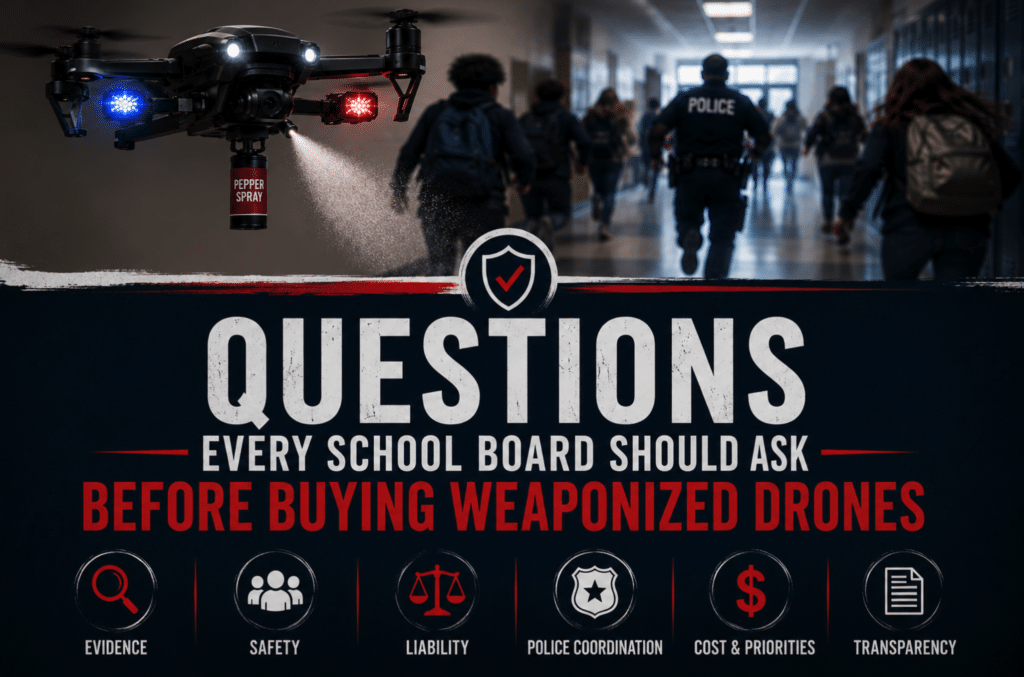
Questions Every School Board Should Ask Before Buying Weaponized Drones
Before investing taxpayer dollars in weaponized drones for active shooter response, school board members should insist on clear, evidence-based answers to questions including:
Evidence & Effectiveness
- Has this technology been independently tested, or only demonstrated by the vendor?
- Is there peer-reviewed research showing it improves outcomes during actual school shootings?
- What evidence supports this over investing in proven people-centered safety practices?
Operational Reality
- How will the drone positively identify the attacker without endangering innocent students, staff, or responding officers?
- How will remote operators obtain accurate, real-time situational awareness during a rapidly evolving incident?
- What happens if communications, GPS, batteries, or software fail?
Law Enforcement Coordination
- Has the local law enforcement agency formally approved the concept?
- How will school-operated drones integrate with police tactical operations and law enforcement drone programs?
- Who has operational command if the drone interferes with police response?
Student & Staff Safety
- What are the risks of pepper spray affecting students, educators, first responders, or people with respiratory conditions?
- Could deploying the drone create additional confusion, panic, or unintended injuries during an evacuation or lockdown?
- What potential adverse implications does this pose for students with special needs?
Liability & Risk
- Who is legally responsible if the drone injures an innocent person or interferes with emergency response?
- Has the district’s legal counsel and liability insurer reviewed and accepted the risks?
- How much additional insurance coverage may be required?
Financial Stewardship
- What is the total cost, including equipment, maintenance, monitoring, training, software, upgrades, and replacement?
- What proven school safety programs will receive less funding if this technology is purchased?
Transparency
- Who promoted this technology to state officials and lawmakers?
- Were independent school safety experts consulted, or primarily the companies selling the product?
- What financial interests or lobbying efforts helped secure public funding for pilot programs?
The Most Important Question
If this were your child in the hallway, would you want this technology making life-and-death decisions based on a remote camera feed?
School safety deserves evidence, operational realism, and sound leadership, not simply the next high-tech product demonstration.