
When SOS (Shiny Object Syndrome) overshadows impactful school safety strategies
When a school tragedy occurs, communities understandably demand action.
Parents want reassurance. Media attention intensifies. Political leaders call for solutions. School leaders feel enormous pressure to demonstrate that they are taking decisive steps to protect students and staff.
In that environment, the loudest and most visible solutions often dominate the conversation.

My friend and colleague Rick Kaufman recently wrote a thoughtful article on what we commonly call “security theater” in school safety — the tendency to implement highly visible security measures that create the appearance of protection but may do little to prevent targeted violence.
It’s an important reminder of a challenge that school leaders across the country face every day.
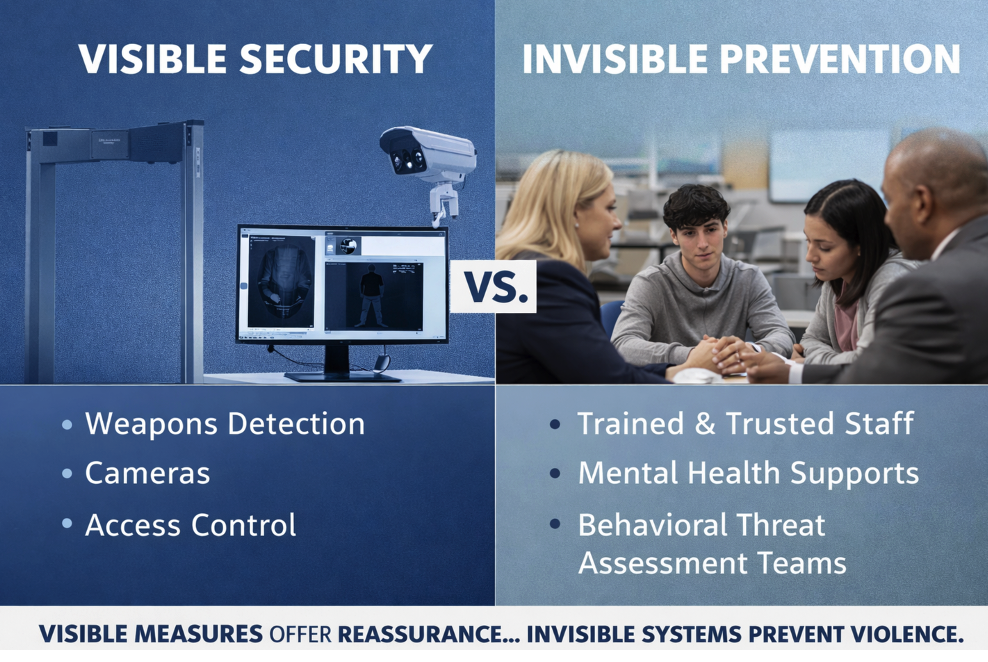
The most visible school security measures are not always the most effective.
And the most effective prevention strategies are often the least visible.
The Pressure to “Do Something” After a School Tragedy
After a high-profile incident, school administrators and school boards face enormous pressure from multiple directions:
- Parents demanding immediate action
- Media scrutiny
- Political leaders calling for new security measures
- Vendors promoting new technologies and solutions
In this environment, visible hardware and technology solutions can quickly become the focus of decision-making.
Weapons detection systems. Cameras. Door hardware. Security upgrades.
While some of these types of tools may have legitimate operational uses, they are sometimes promoted or perceived as stand-alone solutions to school violence.
That is rarely the case.
The Rise of “Shiny Object Syndrome” in School Security
One of the risks in modern school security planning is what I call the “Shiny Object Syndrome.”
Under intense pressure to act, decision-makers may gravitate toward highly visible technologies that appear decisive and reassuring to the public.
These solutions can be politically attractive because they are easy to explain and easy to see. But visibility should never be confused with effectiveness.
Schools can spend significant money on high-profile technologies while underinvesting in the prevention systems that research consistently shows are most effective.
Technology Has a Role — But It Cannot Replace the Human Side of School Safety
Technology absolutely has a place in school safety.
But school security is not a “plug and play” sport. Fidelity of implementation questions increasingly come into play.
Common school security often includes measures such as:
- Controlled access points
- Communication systems for staff and first responders
- Surveillance cameras placed strategically
- Door hardware and access control systems
These tools may support daily safety operations and emergency response.
However, hardware and technology alone cannot prevent targeted acts of violence.
Real prevention occurs through people, relationships, training, and early intervention.
Where School Violence Prevention Actually Happens
Decades of research into school violence consistently show that individuals who commit acts of targeted violence typically display warning signs beforehand.
They communicate grievances.
They exhibit escalating distress or isolation.
They may leak information to peers or online.
They show concerning behavioral changes.
Schools that successfully prevent violence typically have systems in place to identify and respond to those warning signs early.
Effective prevention often includes:
- Behavioral threat assessment and management teams
- Accessible mental health supports for students
- Staff trained to recognize concerning behavior
- Clear reporting systems so students and staff speak up
- Multidisciplinary collaboration to intervene early
These strategies disrupt pathways to violence long before a weapon ever appears on campus.
Why the Most Effective School Safety Work Is Often Less Visible
The strongest school safety cultures are not built on hardware alone.
- They are built on people and relationships.
- Students who trust adults are more likely to report concerning behavior.
- Staff who are trained in situational awareness, active supervision, and early intervention are more likely to recognize warning signs.
- Threat assessment teams can identify risk and intervene before problems escalate.
- Mental health support systems help address the underlying issues that often contribute to crisis situations.
None of these prevention strategies are highly visible to the public.
But they are often the most powerful tools schools have to stop violence.
Moving Beyond the Appearance of Safety
School leaders face a difficult balancing act.
Communities understandably want visible reassurance that schools are safe. But the goal should never be the appearance of safety.
The goal must be the reality of practical, supportive school security and evidence-based prevention measures.
That means grounding school safety decisions in research, operational experience, and evidence-informed practices rather than fear, marketing, or political pressure.
Properly selected and deployed security hardware and technology can support safety. But people prevent violence.
The most effective school security strategies are those that appropriately strengthen both.
Read Rick Kaufman’s Article
Rick Kaufman’s article offers a thoughtful perspective on the importance of balancing visible security measures with deeper prevention strategies.
👉 Read the article here: Security Theater – Rick Kaufman – 2026 March-April MSBA Journal_Security Theater Article
Dr. Kenneth S. Trump is President of National School Safety and Security Services
National School Safety and Security Services
Experts You Can Trust!
Connect with Dr. Ken on Linkedin: www.linkedin.com/in/kentrump/
Follow Dr. Ken on X(Twitter) @safeschools
Visit and “Like” Our Facebook School Safety News Channel at: www.facebook.com/schoolsafety