
How private-equity money, aggressive marketing, and vendor courting of education and school safety leaders are creating ethical and legal minefields
Marketing on Steroids in the School Security Industry
The school security product and technology industry is operating in hyper-drive, fueled by private-equity money, aggressive marketing, and increasingly sophisticated lobbying efforts aimed at legislators and funding streams.
Vendors selling school security products and technology are spending heavily to shape narratives and gain credibility. One common tactic is the recruitment of former school administrators and school safety officials to join vendor companies, trying to lend an air of authority and trust to the products being sold.
At the same time, current school administrators and school safety leaders are being courted in ways that blur ethical lines. Vendor-sponsored and moderated conference panels, sponsored travel, high-end dinners, and “relationship-building” events have become far too common. In some cases, vendors are effectively buying access to school decision-makers under the guise of professional development.
Decades ago, these types of relationships — particularly when vendors were actively seeking or holding contracts with school districts — could trigger ethics investigations. In some instances, they might lead to criminal charges.
That concern is no longer theoretical.
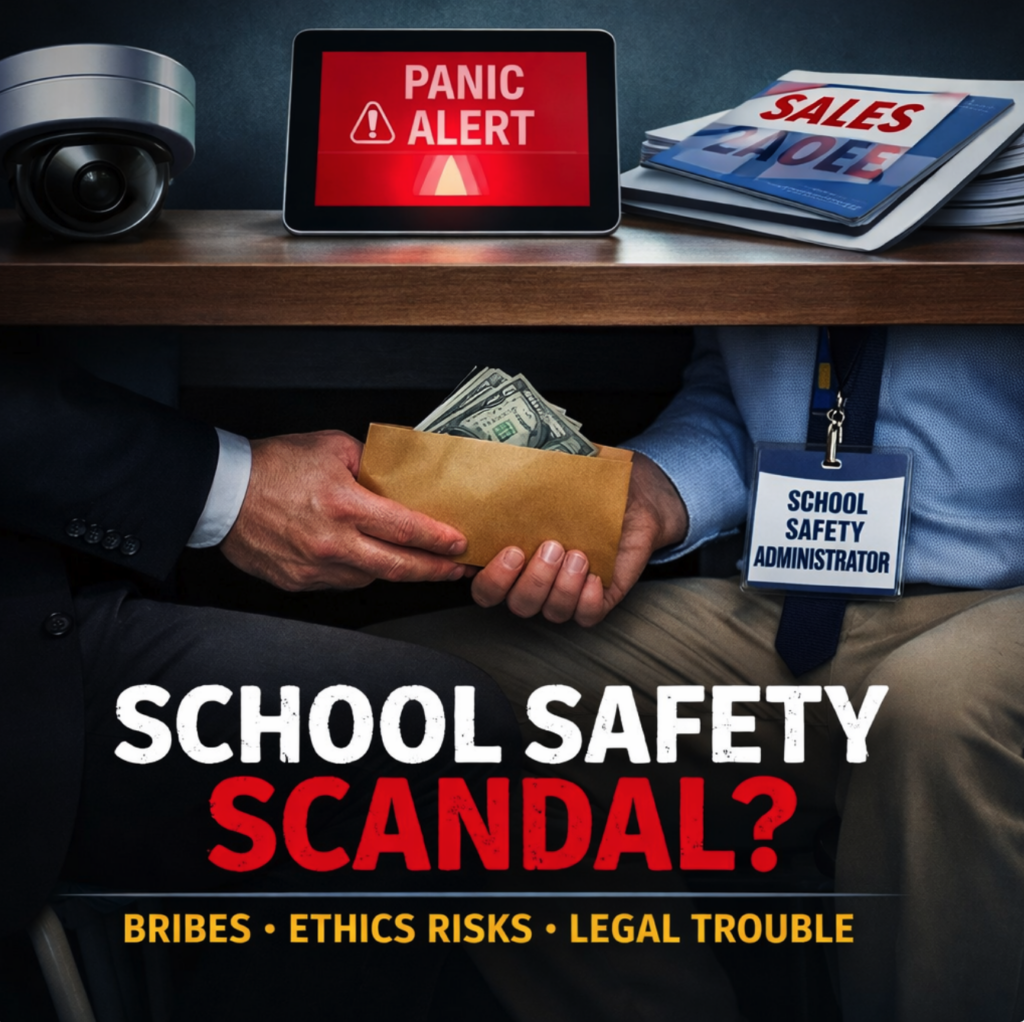
What Happened: Federal Bribery and Wire Fraud Charges in a School Safety Contract Scheme
Recent federal indictments involving a former school safety leader and a school security technology vendor underscore the risks of pay-to-play relationships.
Below is a summary of the allegations as reported by multiple news outlets and federal prosecutors.
Key Allegations and Charges
● Federal bribery and wire fraud charges
Former NYPD School Safety Division commander Kevin Taylor and Florida technology executive Geno Roefaro, CEO of SaferWatch, were indicted on federal charges including bribery conspiracy and honest-services wire fraud. Prosecutors allege Taylor accepted bribes in exchange for attempting to influence public officials to award an estimated $11 million school safety contract for a mobile panic alert system.
👉 https://www.justice.gov/usao-sdny/pr/former-nypd-official-and-florida-businessman-charged-bribery-offenses
● Cash payments and luxury perks
Court filings allege the vendor provided tens of thousands of dollars in cash, along with luxury travel and entertainment — including trips to Las Vegas and the Bahamas, high-end hotel stays, helicopter tours, Broadway shows, and upscale dining — while pressing for favorable contract outcomes.
👉 https://patch.com/new-york/new-york-city/ex-nypd-official-indicted-accepting-bribes-tech-exec-scheme-first-reported
● Pressure tactics tied to procurement
Text messages cited in the indictment allegedly show frustration from the vendor when contracts were not awarded quickly enough, reinforcing prosecutors’ claims of a quid-pro-quo arrangement tied to official influence.
👉 https://www.insurancejournal.com/news/east/2026/02/17/858228.htm
● Additional extortion allegations
Federal prosecutors also allege Taylor attempted to solicit payments related to other procurement matters, including threats of economic harm if payments were not made.
👉 https://www.justice.gov/usao-sdny/pr/former-nypd-official-and-florida-businessman-charged-bribery-offenses
● Ongoing legal proceedings
Both defendants have pleaded not guilty. The charges remain allegations, and all defendants are presumed innocent unless proven guilty in court.
Why This Matters to School Leaders: Ethical Lines and Legal Traps
The case above underscores critical risks for education and school safety professionals:
• Ethical Integrity is Not Optional
Accepting gifts, travel, or personal perks tied to vendor interests is not just a conflict of interest — in some cases, it can be illegal. Even when done under the guise of “relationships,” the appearance of impropriety can erode public trust and invite scrutiny.
• Procurement Must Be Transparent
School safety procurement decisions must be grounded in documented needs, fair competition, and clear separation from personal benefit. School districts typically have strict policies governing vendor interactions — a reason they exist. Falling short of those standards opens leaders to investigation and, in extreme cases, criminal exposure.
• Compliance With Ethics Rules Is Crucial
State and district ethics laws often prohibit the acceptance of gifts or travel tied to official duties. Leaders should routinely consult legal counsel or ethics officers before engaging in any vendor-sponsored event that could influence judgment.
• Reputation Is Everything
A momentary lapse in judgment or a well-intended but poorly documented interaction can destroy years of service. The fallout from disclosures, press coverage, and legal proceedings extends far beyond individual reputations — it affects community confidence and the credibility of school safety work overall.
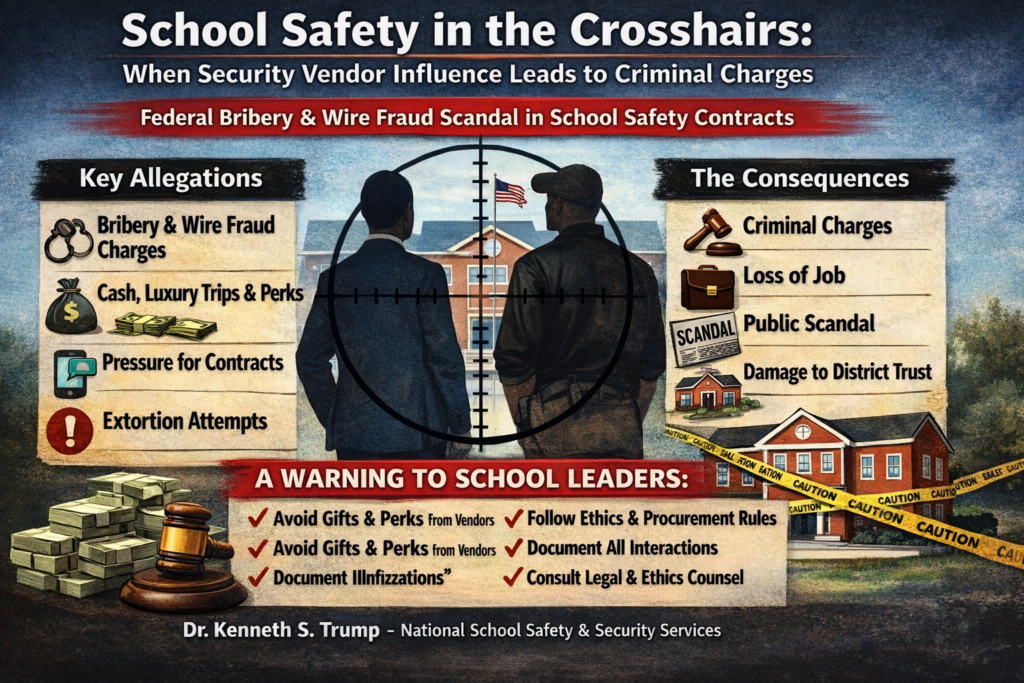
A Clear Warning to School Leaders
School safety is a public trust — not a marketplace for personal benefit.
Recent federal indictments show that pay-to-play sweetheart deals can catch up with administrators, with consequences that extend far beyond job loss:
● Criminal charges
● Loss of professional standing
● Public embarrassment and scrutiny
● Damage to district credibility
● Long-term harm to student and staff trust
School administrators and safety officials should:
● Maintain arms-length relationships with vendors
● Follow district procurement rules and state ethics laws without exception
● Decline gifts, travel, or perks that could influence — or appear to influence — decisions
● Document all vendor interactions carefully
● Seek guidance from legal counsel or ethics officers when in doubt
Vendors should compete on evidence, effectiveness, transparency, and value — not on access, favors, or influence.
Your mission is the safety and education of students and staff — not being entangled in marketing schemes that promise access, perks, or prestige. When in doubt, consult legal and ethics counsel. The risks of “pay-to-play” activities are real and the consequences severe.
The stakes are too high for anything less.
Dr. Kenneth S. Trump is President of National School Safety and Security Services
National School Safety and Security Services
Experts You Can Trust!
Connect with Dr. Ken on Linkedin: www.linkedin.com/in/kentrump/
Follow Dr. Ken on X(Twitter) @safeschools
Visit and “Like” Our Facebook School Safety News Channel at: www.facebook.com/schoolsafety