This page reflects updated analysis of both traditional school metal detectors along with AI-based and other newer school weapons detection systems. While technologies evolve, implementation challenges and limitations remain largely the same.
Day-to-day use of school metal detectors remains the exception—not the rule—in most U.S. schools. While some of the largest urban districts with chronic weapons issues have utilized them for some time now, more recently they tend to be proposed reactively after high-profile gun incidents.
Today, many discussions focus on school weapons detection systems, particularly AI-based technologies marketed as faster and less intrusive. However, the same core questions remain: Do they work in real-world conditions? Are they worth the investment? And what risks do they introduce?
Metal Detectors and School Safety
National School Safety and Security Services continues to receive frequent inquiries about school metal detectors and school weapons detection systems, especially following school shootings or high-profile incidents.
Common questions include:
- Are metal detectors necessary?
- Do weapons detection systems work?
- Should all schools have them?
These questions often reflect a desire for certainty—something no single strategy or technology can provide.
School Security and Metal Detectors: Seeking a “Guarantee” of School Safety
The majority of U.S. schools do NOT use daily weapons detection systems.
Following high-profile incidents, parents, media, and policymakers often call for visible security measures. These reactions are understandable—but they are frequently driven by a desire for a “guarantee” of safety.
There is no strategy—nor combination of strategies—that can guarantee the prevention of school violence.
Overreliance on visible security measures, including school metal detectors and weapons detection systems, can create a false sense of security, especially when implementation gaps exist.
School Metal Detectors and Weapons Detection: Philosophical Debates
Debates about school metal detectors and school weapons detection systems often stall between:
- “Do everything possible” advocates
- Concerns about cost, school climate, and “prison-like” environments
These debates miss the more important issue:
Effectiveness is not determined by the presence of technology—but by how it is implemented, managed, and sustained.
School Metal Detector and Weapons Detection Implementation Considerations
Discussions must move beyond philosophy and focus on real-world implementation:
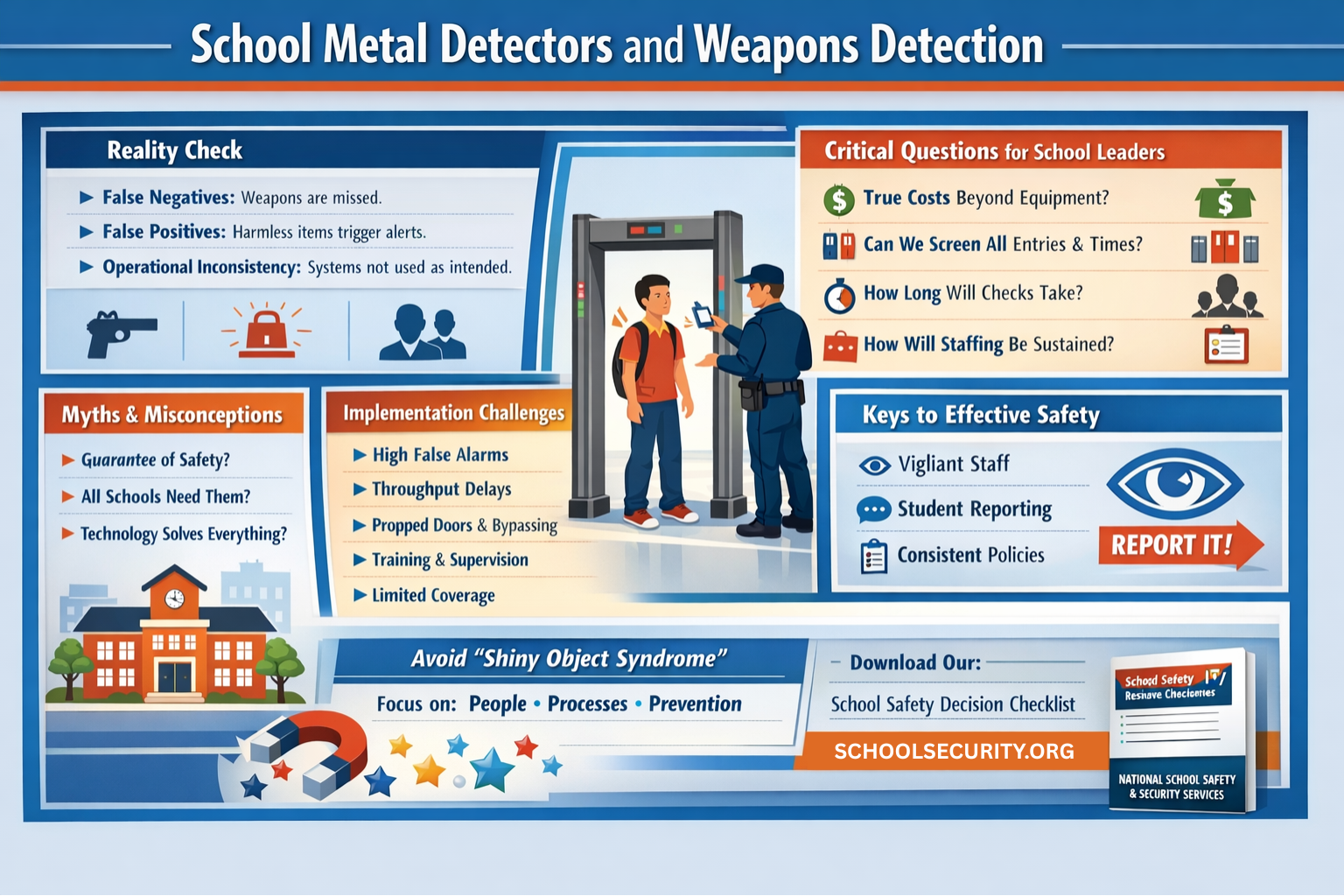
- True costs extend far beyond equipment (staffing, training, maintenance, replacement)
- Screening all entry points, buses, and after-hours events is operationally unrealistic
- Throughput challenges can significantly disrupt school operations
- Staffing must be continuous—not just at morning arrival
- Training must be ongoing, not one-time
- Systems require supervision, testing, and accountability
- Human behavior (propped doors, piggybacking, workarounds) creates vulnerabilities
- Limited hours of operation create predictable and exploitable gaps
With AI-based and other newer school weapons detection systems, additional concerns include:
- High false alarm rates from everyday items (e.g., laptops, binders, water bottles, eyeglass cases, musical instruments)
- Trade-offs between sensitivity levels to detect smaller guns, bladed weapons, etc. vs. faster throughput of students
- Operational “alarm fatigue” reducing vigilance
- Dependence on vendor claims vs. independent, real-world validation
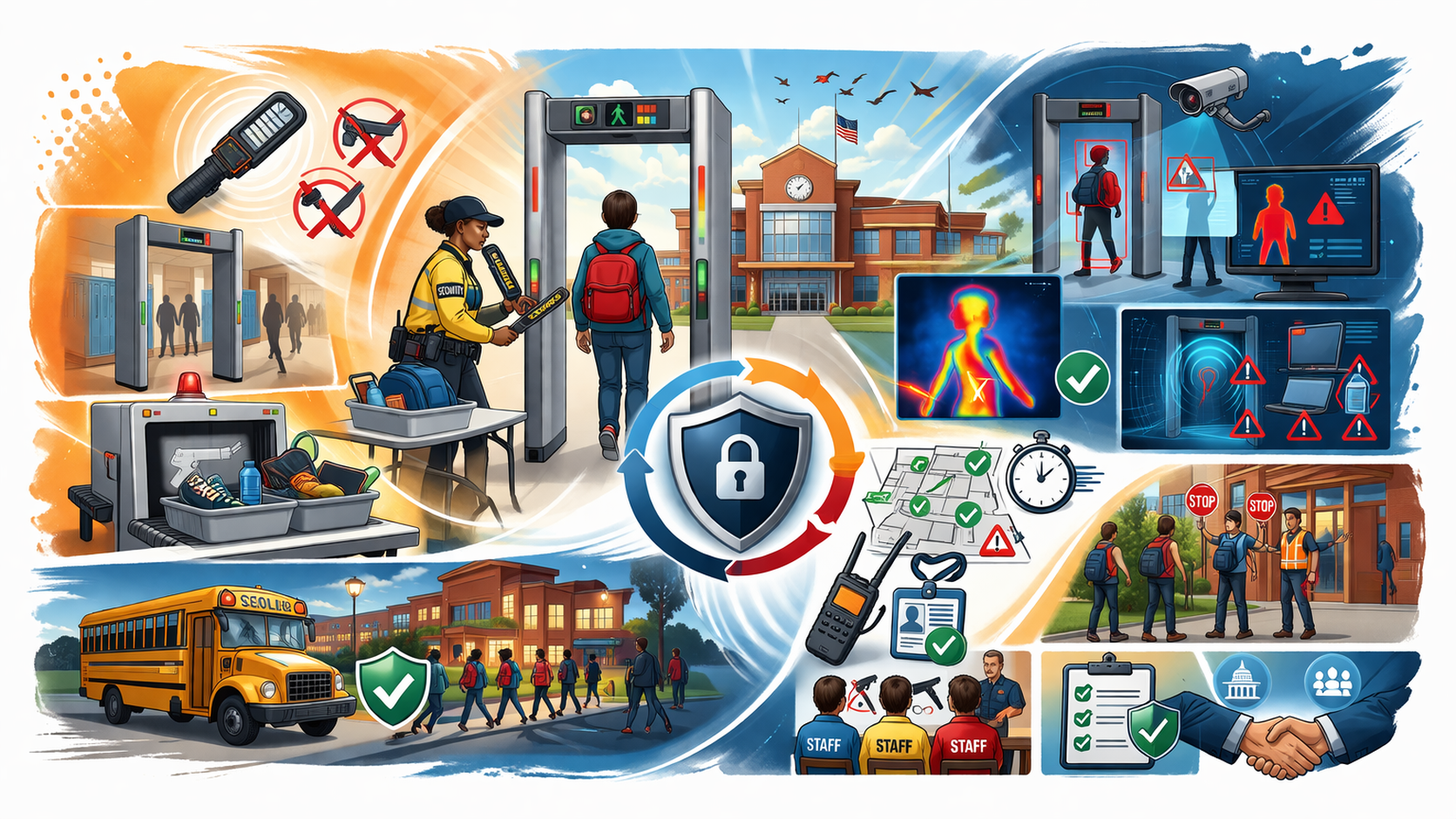
Examples of a Few Key Questions School Leaders Must Consider Before Implementing Metal Detectors or Weapons Detection Systems
If a school cannot confidently answer these questions, it should carefully reconsider implementation.
Costs and Sustainability
- What are the true long-term costs beyond equipment—staffing, training, maintenance, and replacement?
- How will ongoing funding be sustained—not just initial purchase dollars?
- What is the actual return on investment compared to other safety strategies?
Scope and Coverage
- If students ride buses, how will weapons be prevented from entering before arrival?
- How will incidents that occur outside the building (grounds, arrival/dismissal) be addressed?
- Will screening realistically cover all entry points and all times of day?
Throughput and Operations
- How long will it take to screen hundreds or thousands of students each morning?
- What is the impact on instructional time and school operations?
- How will late arrivals, early dismissals, and mid-day visitors be handled?
Staffing and Supervision
- How many trained personnel are required for:
- Morning arrival?
- The full school day?
- After-school activities and evening events?
- Who supervises and ensures consistency and accountability?
Training and Competency
- What initial and ongoing training will operators receive?
- How will staff be trained to:
- Recognize concealed weapons?
- Identify attempts to bypass detection?
- Is a one-time training sufficient—or defensible in court?
Testing and Accountability
- Will the district conduct:
- Regular integrity checks?
- Surprise testing?
- Covert assessments to evaluate effectiveness?
- How will failures be identified and corrected?
Access Control Gaps
- If detectors are at the main entrance:
- How are all other doors secured and staffed?
- How will schools prevent:
- Propped doors?
- Unauthorized entry?
- Weapons being passed through windows?
Hours of Operation Reality
- Will detection operate:
- All day?
- During after-school programs?
- During evening events and community use?
- Or only at morning arrival—leaving predictable gaps?
People and Practical Reality
- Will staff, students, visitors, and contractors all be screened consistently?
- What happens when systems are:
- Turned off for convenience?
- Bypassed due to staffing shortages?
- Ignored due to operational pressures?
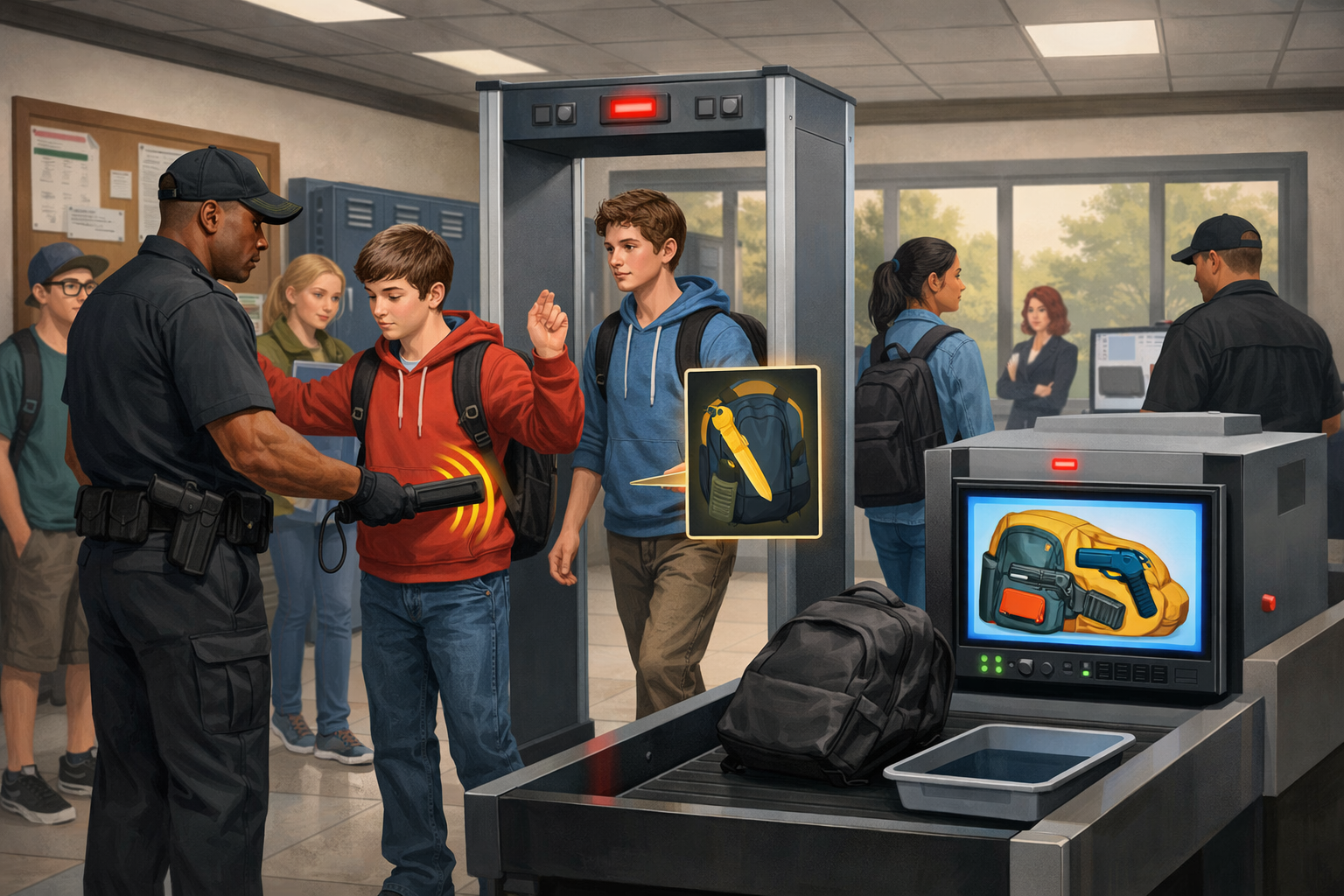
School Metal Detectors and Weapons Detection: Failures and Limitations
Both school metal detectors and school weapons detection systems continue to demonstrate significant real-world limitations—particularly in dynamic school environments.
Recent Real-World Examples
- Utica, NY – stabbing despite weapons detection system
A weapon passed through a weapons detection system and was later used in a stabbing incident, raising questions about detection reliability and real-world screening effectiveness. - Nashville, TN – fatal school shooting not detected
A school using AI-based weapons detection cameras experienced a fatal shooting where the firearm was not detected prior to the attack. The system reportedly only activated after responding officers arrived. - Baltimore County, MD – “bag of Doritos” false alarm
An AI camera weapons detection system misidentified a student holding a bag of chips as a firearm, triggering a police response with officers arriving with weapons drawn. No weapon was found.
Additional Documented Patterns
- Large school district deployments of weapons detection systems have reported high alert rates with no weapons recovered during pilot periods
- Systems routinely flag everyday items such as laptops, water bottles, musical instruments, eyeglass cases, and binders
- Detection capability varies based on sensitivity settings, potentially allowing smaller weapons to pass through undetected
- Camera systems can depend heavily on camera angles, lighting, positioning, and human monitoring
- Detection programs are often not operated consistently throughout the school day, evening, or during events
What These Cases Show
These are not isolated failures—they reflect broader systemic realities:
- False negatives: Weapons are missed
- False positives: Harmless items trigger alerts
- Operational inconsistency: Systems are not used as intended
- Human dependency: Outcomes rely heavily on people, not just technology
Technology does not eliminate risk — it can displace and redistribute it.
School Metal Detectors and Weapons Detection: Only as Strong as the Human Element
Even well-designed systems are not foolproof.
The most effective prevention strategies continue to be:
- Staff awareness and active supervision
- Student reporting and trusted relationships
- Strong leadership and accountability
- Clear procedures and consistent enforcement
When security fails, it is most often due to human and implementation factors—not simply the absence of technology.
Framing the Use of Metal Detectors and Weapons Detection
School metal detectors and school weapons detection systems, when considered, may be viewed as:
- One strategy to be reviewed for applicability in a more comprehensive assessment of risks, threats, and vulnerabilities
- A topic of analysis for your unique school/district, not as a tool to temporarily resolve public relations or political pressures
- Dependent on proper implementation, supervision, and accountability
Random screening approaches may address some limitations, but also introduce operational challenges.
Transparency with stakeholders is critical when school leaders choose to go down this road. Schools must clearly communicate:
- What these systems can and cannot do
- Operational limitations
- Realistic expectations
Bottom Line
School metal detectors and school weapons detection systems are not the answer for most schools that many parents and even students may believe them to be.
School leaders should:
- Avoid reactive, optics-driven decisions
- Focus on people, processes, and performance
- Invest in prevention, intervention, and preparedness strategies
- Ensure fidelity of implementation if technology is used
Effective school safety is not about the “Shiny Object Syndrome” of how much equipment you can purchase.
It is about how people lead, manage, and execute safety practices every day.
Download our guiding questions for school leaders considering school security products and technology: School Safety Product and Technology Decision Checklist – National School Safety and Security Services
Questions may be directed to Ken Trump.