
Federal emergency-management guidance has promoted plain-language emergency communications for roughly two decades. Yet color-coded alerts remain in use in some schools and are being incorporated into newer emergency notification technologies. School leaders should examine whether these systems simplify emergency response or require people to decode additional information under stress.
School emergency communications have one fundamental purpose: help people quickly understand what is happening and what they need to do. That sounds simple. But emergency terminology can become complicated.
Red. Blue. Yellow. Purple. Orange. Green. White.
Depending on the school or district, each color may represent a different emergency condition or protective action.
That raises an important school safety leadership question:
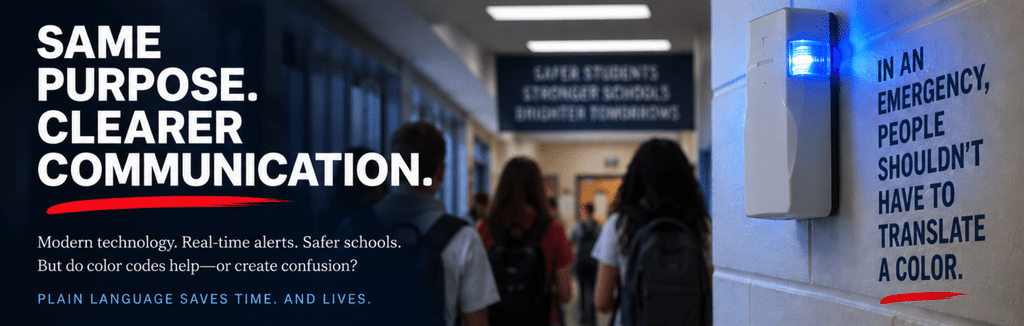
If modern emergency technology can instantly deliver audio, visual and written information throughout a school, why should students, teachers, substitutes or visitors have to translate a color before knowing what to do?
The issue is not simply technology. It is human performance under stress.
Why Emergency Management Moved Toward Plain Language
The movement away from emergency codes did not begin with today’s school safety technologies.
Following the September 11, 2001 terrorist attacks and other major incidents that exposed communication and interoperability problems, the federal government developed the National Incident Management System (NIMS) to establish common structures, terminology and practices across emergency-response disciplines.
By the mid-2000s, federal emergency-management doctrine was emphasizing plain language and common terminology rather than agency-specific codes during incidents involving multiple agencies and disciplines.
A December 19, 2006 FEMA NIMS Alert reinforced the use of plain language for multi-agency, multi-jurisdiction and multi-discipline incidents. Beginning in fiscal year 2006, federal preparedness grant funding was also contingent on the use of plain language during incidents requiring assistance from responders across agencies, jurisdictions and disciplines. FEMA later documented this history in its September 10, 2009 NIMS Alert on plain language.
In July 2008, the U.S. Department of Homeland Security issued a Plain Language Guide intended to help emergency responders transition from traditional 10-codes to plain-language radio communications. FEMA’s 2009 NIMS Alert specifically references that guide and describes plain-language emergency communications as “a matter of public safety.”
The 2008 National Incident Management System itself defines plain language as communication understandable by the intended audience and says that, for NIMS purposes, it is intended to eliminate or limit codes and acronyms during incident responses involving more than one agency.
The principle eventually became explicit in federal guidance directed at schools. In 2013, FEMA’s IS-360: Preparing for Mass Casualty Incidents: A Guide for Schools, Higher Education, and Houses of Worship told organizations developing emergency communication procedures: “Use simple, clear language. Plain language is preferred over codes.”
FEMA immediately explained why: “The use of codes often causes incorrect responses under stress.” See FEMA IS-360: Notification and Communication Tips.
Elsewhere in the same FEMA course, the guidance is equally direct: “The use of codes for initiating response actions is discouraged because of the confusion they can create.” See FEMA IS-360: Communications and Emergency Planning.
FEMA also advises that emergency procedures should use clear, common language usable by diverse audiences and provide only the amount of information that can be processed quickly during a crisis.
That direction did not disappear from later federal doctrine. The 2017 National Incident Management System, which remains FEMA’s current NIMS doctrine, addresses “Common Terminology, Plain Language, Compatibility” and states that using “plain language and clear text, not codes” in incident management is a matter of public safety. NIMS says personnel should use plain language in communications between organizational elements during an incident so information is communicated clearly and understood by its intended recipients. FEMA: 2017 National Incident Management System
The principle is straightforward: During an emergency, people should not have to translate terminology before understanding what they are expected to do.

Why Plain Language Matters in Schools
School emergency communications must work for a much broader audience than trained emergency responders.
That audience can include administrators, teachers, substitute teachers, support staff, School Resource Officers and school police, students of different ages, parents, volunteers, contractors, visitors and first responders from multiple agencies.
Training and experience across these groups can vary considerably. A veteran administrator may instantly understand a district’s emergency codes. A substitute teacher working in the building for the first time may not. A sixth grader may remember one color but confuse another. A visitor may have no idea what any of the colors mean.
Plain language reduces that dependency on prior knowledge.
Instead of: CODE RED we might see the communication say: LOCKDOWN. LOCKDOWN. LOCKDOWN.
Instead of: CODE PURPLE the communication might say: RESTRICT MOVEMENT. Remain where you are.
The objective should be the fewest, clearest cues necessary to trigger the correct protective action.
Emergency communications should therefore be evaluated as part of a comprehensive school safety and emergency preparedness strategy, not simply as a stand-alone technology purchase.

Color-Coded Alerts and New School Safety Technology
The plain-language issue becomes especially relevant as schools adopt technologies capable of rapidly distributing emergency notifications.
At the time of this writing, for example, CENTEGIX CrisisAlert, uses wearable alert badges and provides campus-wide emergency notification through multiple channels. On its CrisisAlert wearable panic button page, CENTEGIX says campus-wide notifications can include flashing strobes and describes those strobes as guiding action through “color-coded signals aligned with your safety protocols.”
The company’s CrisisAlert Quick-Start Guide provides a concrete example. For a campus-wide lockdown, the guide says red strobes will flash and chirp, an intercom message will play if applicable, and a desktop alert will appear on computers.
The important distinction is not simply whether visual notification exists. It is what people must understand from that notification.
When a Visual Alert Becomes Another Code to Decode
Consider a different model:
Red = Lockdown
Blue = No Entry
Purple = Restricted Movement
Orange = Severe Weather
Green = Fire
White = All Clear
Now color itself communicates information that people may need to learn, remember and interpret.
The question becomes: Does the visual alert reinforce the message, or has the visual alert become another code that must be decoded?
How Extensive Can School Emergency Color Codes Become?
Some school districts using modern emergency notification technology publicly document multiple color-coded emergency conditions.
For example, a Kansas City Public Schools CENTEGIX alert chart assigns six colors:
- Orange: Severe Weather
- Green: Fire
- Purple: Restricted Movement
- Blue: No Entry
- Red: Lockdown
- White: All Clear
Another example is Social Circle City Schools’ CENTEGIX CrisisAlert system in Georgia. The district publishes “CrisisAlert Color Codes” that include Red for Hard Lockdown, Yellow for Soft Lockdown, Blue for Shelter in Place, Green for Evacuate and White for All Clear. Parents, guardians and visitors are instructed to take note of the colored beacons during an alert.
These examples demonstrate an important point: Color can move beyond being a redundant visual notification and become part of the emergency terminology itself.
That deserves scrutiny.

Cognitive Load: Why “Less Is More” Matters
Emergencies do not occur under ideal cognitive conditions. Fear, uncertainty, noise, rapidly changing information and perceived threats compete for attention while people are simultaneously expected to understand instructions and act.
A meta-analysis of 51 studies involving 2,486 participants found that acute stress impaired working memory and cognitive flexibility, although its effects on inhibition were more nuanced.
That does not mean people cannot perform effectively under stress. Training, experience and well-learned responses matter greatly.
But emergency communication systems should avoid creating unnecessary cognitive work.
Consider the mental sequence: Purple → What does purple mean? → Restricted movement → What does restricted movement require? → Act.
Compare that with: RESTRICT MOVEMENT. Remain where you are.
The second communication eliminates steps. That is the essence of less is more in emergency communications.
The technology has changed. Human cognitive limitations under stress have not.

Accessibility and Special-Needs Considerations
Visual notification can serve an important accessibility function for people who are deaf or hard of hearing or who otherwise may not hear an intercom announcement.
But visual accessibility does not require color to function as a code that people must memorize.
Schools also serve students with autism, sensory-processing differences, intellectual and developmental disabilities, and other special needs.
An emergency environment may already include alarms, flashing lights, voices, movement, uncertainty and fear. For some students, multiple simultaneous stimuli may contribute to sensory overload, distress, dysregulation or difficulty processing instructions.
This makes simplicity even more important. The question should not only be: Can everyone see or hear the alert?
School leaders should also ask: Will everyone immediately understand what it means and what they are supposed to do?
Technology Should Reduce Cognitive Load, Not Add to It
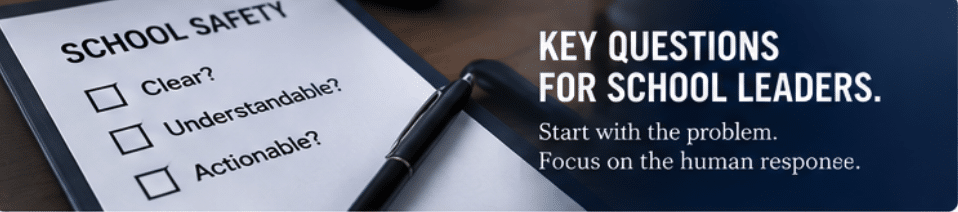
School leaders evaluating emergency notification systems should look beyond whether an alert activates successfully.
Start with the problem: What problem are we trying to solve?
Then ask:
- Is additional technology actually necessary to solve it?
- What happens after someone activates the system?
- What exactly will students and staff see and hear?
- Does the message immediately identify the protective action?
- Can substitute teachers, students and visitors understand it without memorizing codes?
- How will students with sensory, developmental or communication disabilities experience it?
- What information reaches first responders?
- What training and retraining will be required?
- What happens when personnel move between buildings or districts using different terminology?
- Does the technology reduce cognitive load or add another step?
- Does it reinforce plain language or require people to decode a color?
These are questions of school safety strategy, not simply technology capability.
For a broader due-diligence framework, see my School Safety Product and Technology Decision Checklist. It is designed to help boards, superintendents and district leaders identify the problem first and ask better questions before buying, piloting or renewing security technology.
The broader School Security Equipment & Technology resource examines these decisions from an independent, non-product-affiliated perspective and emphasizes that technology should support people, supervision, judgment and leadership rather than replace them.
This is also a question of implementation. As discussed in School Safety Is Not a “Plug and Play” Sport: It’s About Fidelity of Implementation, introducing new people, procedures or products alters the larger school safety system around them.
A product can operate exactly as designed and still raise legitimate questions about whether the procedures built around it make emergency response simpler or more complicated.
Plain Language Should Remain the Standard
New technology can distribute information faster, farther and through more channels than school emergency systems could decades ago.
That capability should make emergency communications simpler, not more complicated.
If a system can instantly communicate through computer screens, intercoms and visual notifications, school leaders should carefully consider why someone should have to translate purple into restricted movement, blue into no entry or red into lockdown before knowing what to do.
Innovation should not inadvertently reintroduce the communications problems emergency management spent years trying to eliminate.
FEMA’s guidance remains remarkably simple: “Use simple, clear language. Plain language is preferred over codes.” Read FEMA’s school emergency communication guidance.
Frequently Asked Questions About School Emergency Color Codes
What are school emergency color codes?
School emergency color codes assign colors such as red, yellow, blue or other colors to particular emergency conditions or protective actions. The meanings are not necessarily universal, which means users may need prior training to understand what a particular color means.
Does FEMA recommend plain language instead of emergency codes?
Yes. FEMA’s IS-360 school-related emergency guidance states that plain language is preferred over codes and warns that codes can produce incorrect responses under stress. Other material in the course discourages codes for initiating response actions because of the confusion they can create.
Are colored emergency lights inconsistent with plain language?
Not necessarily. A visual signal can reinforce an audible or written emergency instruction. The more significant concern arises when people must remember what a particular color means before they know which protective action to take.
Why can emergency color codes create problems in schools?
Schools include students, substitutes, visitors, volunteers, contractors and others who may have different levels of training. A code that is familiar to one employee may be unfamiliar to someone else. Plain-language protective-action instructions reduce dependence on memorized terminology.
What should school leaders ask before purchasing emergency notification technology?
Start with what problem the district is trying to solve. Then evaluate whether additional technology is necessary, what people will see and hear during an actual emergency, what training will be required, how the system integrates with existing procedures and first responders, and whether it makes the human response simpler or more complicated.