

The school security field is in the middle of one of the most turbulent shake-ups in its history.
Longstanding organizations are disappearing. Experienced professionals are losing jobs, crossing over to be the face for security vendors, or exiting the field. Private-equity and venture-capital money are reshaping organizations. Vendor lobbying influence is intensifying. And public-sector capacity is shrinking.
In just recent months, we’ve seen the decimation of the federal CISA school safety office, the elimination of the REMS Technical Assistance Center, and now the unexpected abrupt shutdown of the private sector Campus Safety Magazine and its annual conference after decades of existence.
Supporters of these organizations lament their loss and cite their value. Quieter critics may question cost, efficacy, or real-world impact on school leaders. But focusing only on whether these entities should have survived misses the much larger—and far more consequential—issue:
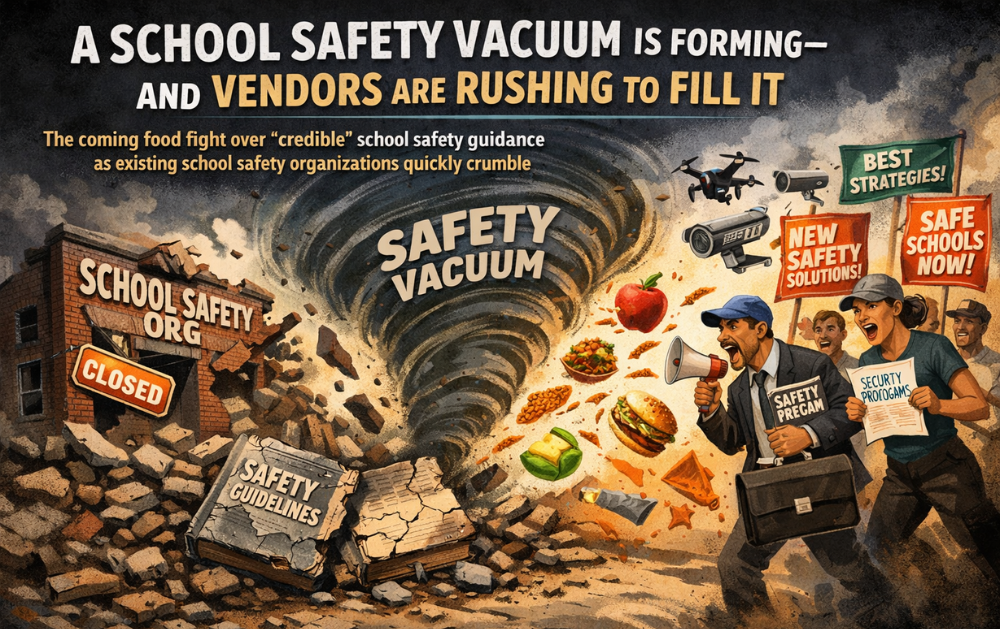
The vacuum their elimination creates and who is waiting in the wings to fill it.
Within hours of the Campus Safety Magazine and conference shutdown, comments began circulating—largely from vendors and associates of vendor-funded “non-profits”—asking the same question:
“Who will fill the void?”
That question reveals the real concern.
Because when neutral or semi-neutral institutions disappear, the vacuum rarely stays empty for long. It gets filled. And in today’s environment, it is most likely to be filled by:
-
- Security product and tech vendors
-
- Vendor-affiliated “non-profits”
-
- Industry groups financially dependent on security vendor dollars
The predictable result?
A new food fight over who gets to define “credible school safety guidance.”
Expect more glossy white papers. More self-manufactured “standards.” More webinars. More certification badges. More vendor funded and influenced “non-profits” combining efforts to bang their physical security drums. More claims that their framework is the responsible, defensible, must-follow approach for school leaders.
What school administrators may not hear as clearly is that many of these “standards” are not built from independent research, operational reality, well-established and long-standing best practices, or legal defensibility—but from marketing strategy and highly veiled sales agendas.
When security product and tech vendor-driven voices dominate the information ecosystem, the noise ratio increases. Complexity increases. Fear gets amplified. And school leaders are pushed toward compliance with product-centric narratives rather than thoughtful, evidence-based, and context-driven risk management and school safety decisions.
The coming challenge for districts isn’t just choosing security products or tech.
It’s discerning who is truly independent, which product or tech vendors benefit financially from the advice given, and who is quietly and covertly trying to redefine or create standards in their own image.
The danger isn’t the absence of voices.
It’s the absence of independent ones.
…But it’s also a great time for those truly independent consultants and organizations to stand tall above the growing crowds — and their noise.
Dr. Kenneth S. Trump is President of National School Safety and Security Services
National School Safety and Security Services
Experts You Can Trust!
Connect with Dr. Ken on Linkedin: www.linkedin.com/in/kentrump/
Follow Dr. Ken on X(Twitter) @safeschools
Visit and “Like” Our Facebook School Safety News Channel at: www.facebook.com/schoolsafety
Perhaps it is time to consider moving from the regional and national levels to the international level. The threat to the security of educational institutions has long gone beyond the borders of countries and continents; it is an international threat and must be addressed collectively.
I have been studying this problem for many years, collecting statistics and publishing an annual international handbook with information on crimes and terrorist acts in schools and other educational institutions. In the process of collecting and verifying information on each crime, I see that their scenarios are repeated. The methods of committing crimes are similar, regardless of location. Criminals and terrorists, regardless of where the crime is committed, in the US, China, Russia, Europe, Africa, South America, etc., exploit the same vulnerabilities in the security system, use similar tactical patterns, and imitate each other. They are connected, they unite in cults, movements, and other extremist communities; there are no borders for them.
Perhaps it is time for us to do the same. This is a common threat, and we need to work together to find a solution. There are not many specialists in this field of applied criminology in the world, and as long as we act separately, there will be no results. It is time to start consolidating our knowledge, experience, and skills and act together against this common threat.
Think about it.